


























Views
Downloads

Grade 5 Buoyancy and Forces Science Worksheet | Essential
Paste this activity's link or code into your existing LMS (Google Classroom, Canvas, Teams, Schoology, Moodle, etc.).
Students can open and work on the activity right away, with no student login required.
You'll still be able to track student progress and results from your teacher account.
Students investigate why objects float or sink by analyzing the relationship between weight, gravity, and upthrust. This activity combines theoretical background with data analysis and a hands-on engineering challenge to ensure a deep understanding of buoyant forces and displacement. It provides a structured path for learners to connect mathematical data to physical phenomena.
At a Glance
- Grade: 5 · Subject: Physical Science
- Standard:
5-PS1-3— Make observations and measurements to identify materials based on their properties- Skill Focus: Buoyancy, Gravity, and Upthrust
- Format: 1 page · 2 tasks · Answer key included · PDF
- Best For: Classroom science labs and independent practice
- Time: 30–45 minutes
Comprehensive Science Content
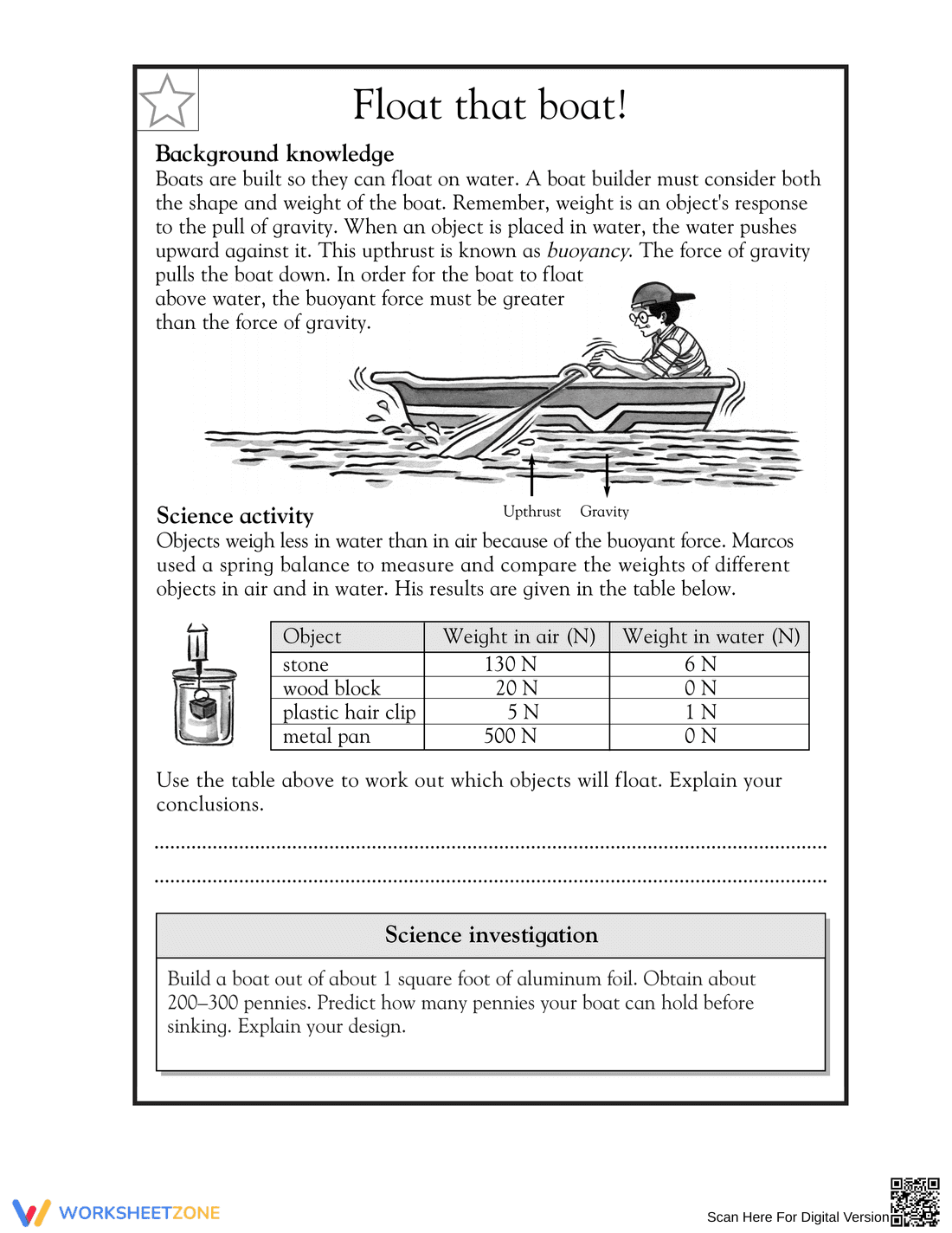
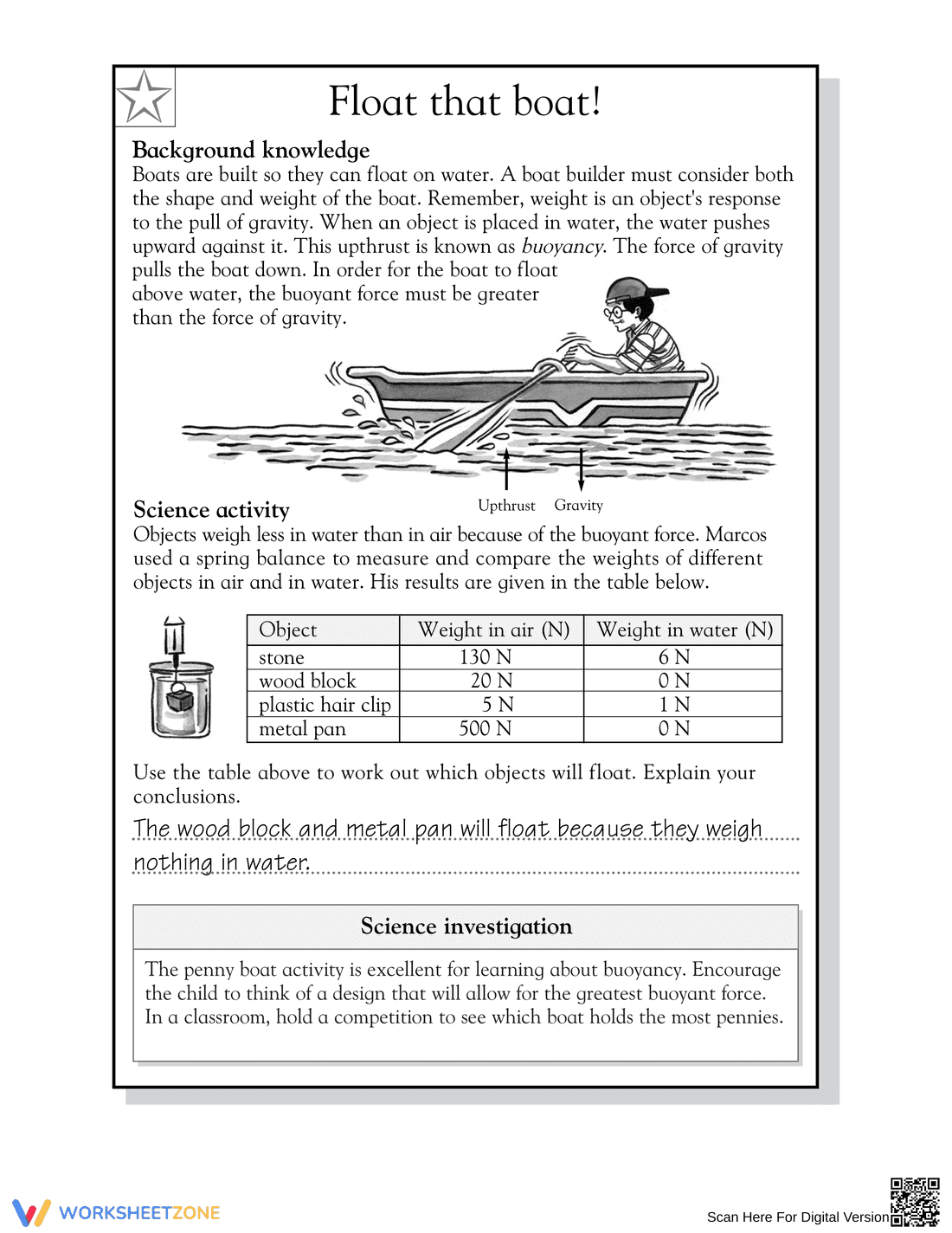
It begins with a background knowledge primer defining key terms like upthrust and buoyancy. The core activity presents a data table comparing the weight of four materials—stone, wood, plastic, and metal—in air versus water. It concludes with a hands-on science investigation where students design a foil boat to hold pennies, applying their understanding of displacement and buoyant force.
Zero-Prep Classroom Workflow
- Print: Generate the single-page PDF for your entire class in less than 1 minute.
- Distribute: Hand out the sheets for a 15-minute data analysis session where students interpret Marcos's spring balance results.
- Review: Use the included answer key to verify conclusions or transition into the 20-minute boat-building challenge.
Standards Alignment and Mastery
The core of this activity is aligned with 5-PS1-3, which requires students to make observations and measurements to identify materials based on their properties. By calculating the difference in weight between air and water, students gather empirical evidence of buoyant forces.
How to Use It
Use this worksheet as a mid-unit formative assessment to gauge student understanding of force interactions. During the boat-building phase, teachers should observe how students modify their designs to increase displacement and carry more weight. This provides a concrete instructional moment to discuss how shape affects an object's response to upthrust. The activity is expected to take between 30 and 45 minutes depending on the depth of the hands-on investigation.
Who It's For
This resource is optimized for 5th-grade students exploring physical science concepts. The inclusion of visual aids, such as the boat diagram and data table, provides essential scaffolds for English language learners and students with processing needs. It pairs naturally with anchor charts about Archimedes' principle or a hands-on demonstration using a water tank and spring scales to verify the data presented in the table.
Integrating data-driven science activities with hands-on engineering challenges improves student retention of physical science standards like 5-PS1-3. By bridging abstract concepts with tangible application, this worksheet helps students develop a functional understanding of buoyancy. The activity requires students to analyze weight differentials and engage in a boat-building design challenge, demonstrating mastery of material properties. This structured approach ensures that learners are not just memorizing definitions but are actively applying the scientific method. Educators can use the foil boat challenge to assess higher-order thinking skills and the ability to iterate on designs based on physical evidence. This resource provides a comprehensive tool for achieving mastery in elementary fluid mechanics and force interactions.


