


























Views
Downloads
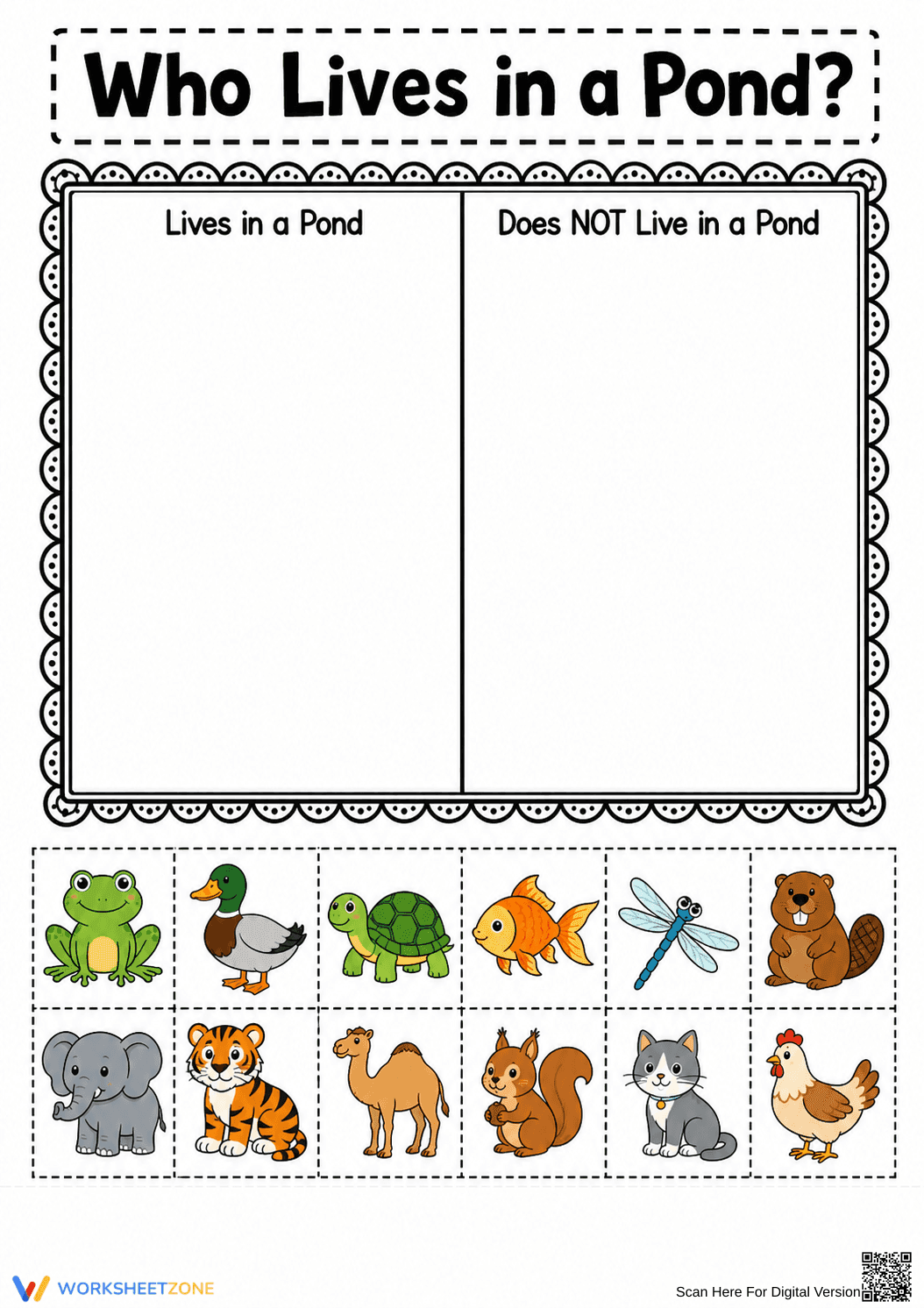

Pond Habitat Sorting Worksheet | Grade K-1 Printable
Paste this activity's link or code into your existing LMS (Google Classroom, Canvas, Teams, Schoology, Moodle, etc.).
Students can open and work on the activity right away, with no student login required.
You'll still be able to track student progress and results from your teacher account.
This Grade K-1 animal sorting worksheet helps young learners identify and classify creatures based on their natural habitats. Students answer the essential question of who lives in a pond by analyzing visual cues and categorizing 12 animals. This hands-on activity bridges foundational science concepts and reading comprehension skills through interactive learning.
At a Glance
- Grade: K-1 · Subject: Science
- Standard:
CCSS.ELA-LITERACY.L.K.5.A— Sort common objects into categories to understand concepts- Skill Focus: Habitat Classification
- Format: 1 page · 12 tasks · Answer key included · PDF
- Best For: Science centers and morning work
- Time: 15–20 minutes
What's Inside
This printable PDF contains a single-page sorting activity featuring two distinct columns for pond and non-pond dwellers. At the bottom of the page, students will find 12 colorful animal illustrations, including frogs, turtles, elephants, and tigers. The layout includes clear dotted lines for cutting, making it an excellent fine-motor exercise alongside the primary cognitive task. A full answer key is provided to ensure quick and accurate teacher review.
Zero-Prep Workflow
This zero-prep design allows educators to implement the lesson in under two minutes. First, print the single-sheet PDF (1 minute). Next, distribute it to students along with scissors and glue (1 minute). Finally, review the instructions briefly before students begin working independently. Because the visual cues are highly intuitive, students can start sorting immediately with minimal teacher intervention. This efficiency makes the worksheet a reliable choice for morning work, literacy centers, or emergency substitute folders.
Standards Alignment
The primary alignment is CCSS.ELA-LITERACY.L.K.5.A, which requires students to sort common objects into categories to deepen their conceptual understanding. Additionally, it supports foundational science standards by asking students to describe the connection between specific animals and their environments. Both standard codes can be copied directly into lesson plans, IEP goals, or district curriculum mapping tools.
How to Use It
Use this worksheet as a summative check after a read-aloud about pond ecosystems or during a broader life science unit on animal habitats. Teachers can observe students as they sort, noting if they can justify why an elephant belongs in the non-pond column based on size or geographic origin. The expected completion time is 15 to 20 minutes, allowing ample time for both the cognitive sorting decisions and the physical cut-and-paste assembly.
Who It's For
This resource is designed for Kindergarten and Grade 1 students who are actively developing foundational classification skills. It is particularly effective for English Language Learners who benefit from high-quality visual aids to understand new vocabulary. It pairs naturally with an anchor chart showing different habitats or a direct instruction lesson on basic animal survival needs.
Aligned to the CCSS.ELA-LITERACY.L.K.5.A standard, this classification worksheet leverages evidence-based principles regarding background knowledge and vocabulary acquisition. Students sort common objects into categories to understand concepts, building essential mental schemas. Research from Fisher & Frey (2014) emphasizes that categorical sorting tasks like this pond habitat activity provide the scaffolding necessary for young learners to organize new information effectively. By distinguishing between 12 distinct creatures and their appropriate habitats, students move from simple identification to logical grouping, a critical precursor to complex informational text analysis. This structured approach to habitat sorting ensures that students are actively engaged in the cognitive work of classification rather than merely completing a craft. The 12-item task count provides sufficient data points for formative assessment without overwhelming emerging learners, making it a highly effective tool for early childhood science and literacy integration.


