




























Views
Downloads

Essential Animal Habitats Matching | Preschool Science

Paste this activity's link or code into your existing LMS (Google Classroom, Canvas, Teams, Schoology, Moodle, etc.).
Students can open and work on the activity right away, with no student login required.
You'll still be able to track student progress and results from your teacher account.
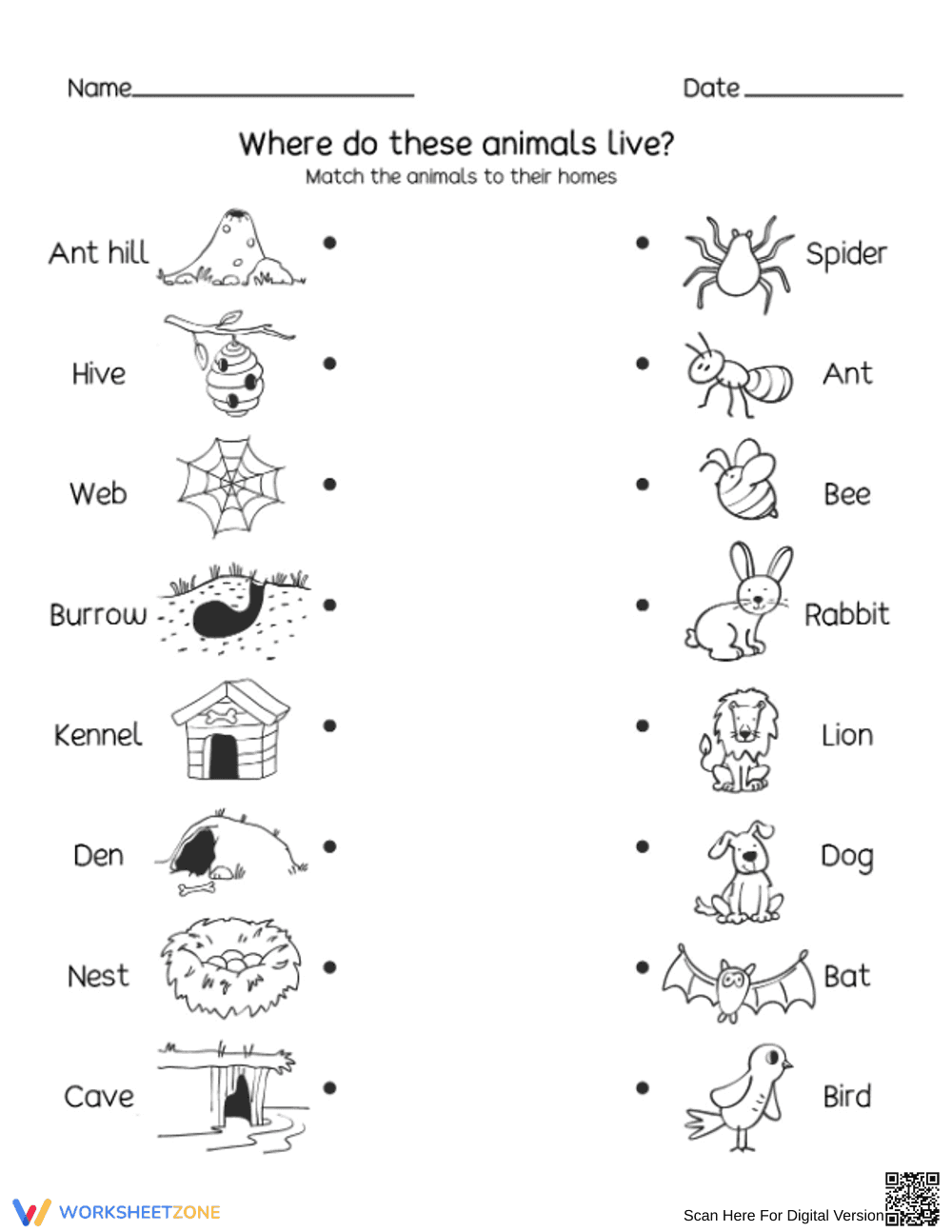
Help your youngest learners discover the natural world with this engaging animal habitats matching worksheet. By identifying where different creatures live, preschoolers develop critical observation and classification skills. This activity provides a structured way to explore the relationship between living things and their environments while practicing fine motor control through matching tasks.
At a Glance
- Grade: Preschool · Subject: Science
- Standard:
K-ESS3-1— Represent the relationship between animals and the places they live- Skill Focus: Animal habitat identification and matching
- Format: 1 page · 8 problems · Answer key included · PDF
- Best For: Early science centers or morning work
- Time: 10–15 minutes
This high-quality printable features eight distinct animals—including a spider, bee, rabbit, and dog—paired with their corresponding natural or domestic homes like a web, hive, burrow, and kennel. Each animal and habitat is represented by a clear, recognizable illustration, making it accessible for non-readers. The single-page layout includes a dedicated space for the student's name and the date.
Designed for immediate classroom implementation, this worksheet requires absolutely no teacher preparation. Simply print the PDF and distribute it to your students. The three-step workflow is efficient: first, print the document (30 seconds); second, distribute the sheets and explain the matching lines (1 minute); and third, review the completed homes together (2 minutes). It is an ideal resource for substitute folders.
This resource aligns with `K-ESS3-1`, which asks students to represent the relationship between the needs of animals and the places they live. By matching a bird to its nest or a bat to its cave, students demonstrate a foundational understanding of how specific environments meet survival needs. This standard code can be copied directly into lesson plans, IEP goals, or district curriculum mapping tools.
Use this worksheet during your "Living Things" unit after a group discussion about animal homes. It works well as a formative assessment to check if students can distinguish between domestic habitats and wild ones. Observe whether students can identify the animals based on the illustrations alone, which provides insight into their visual literacy and prior knowledge of the natural world.
This worksheet is tailor-made for preschoolers beginning their science journey. It is especially effective for visual learners who benefit from concrete pictorial representations. For students who need extra support, teachers can pair this with a physical animal habitat anchor chart or a read-aloud story about where animals sleep to provide additional context before the matching activity.
Early childhood science education emphasizes the development of inquiry-based skills through the observation of biological patterns and environmental relationships. According to Fisher & Frey (2014), providing structured practice with visual classification helps young learners transition from simple recognition to complex conceptual understanding of ecosystem dynamics. This worksheet focuses on the K-ESS3-1 standard, requiring students to match 8 specific animals to their habitats, thereby reinforcing the core scientific idea that living things have specific environmental requirements for survival. Research indicates that using recognizable illustrations in early science instruction significantly improves retention of vocabulary related to the natural world. By engaging in this matching task, preschoolers build the foundational cognitive frameworks necessary for later success in life science and ecology. This resource ensures that students meet benchmarks for environmental literacy while developing the hand-eye coordination essential for academic readiness.


