


























Views
Downloads

Essential Rainy Day Clothing Worksheet: Kindergarten Science
Paste this activity's link or code into your existing LMS (Google Classroom, Canvas, Teams, Schoology, Moodle, etc.).
Students can open and work on the activity right away, with no student login required.
You'll still be able to track student progress and results from your teacher account.
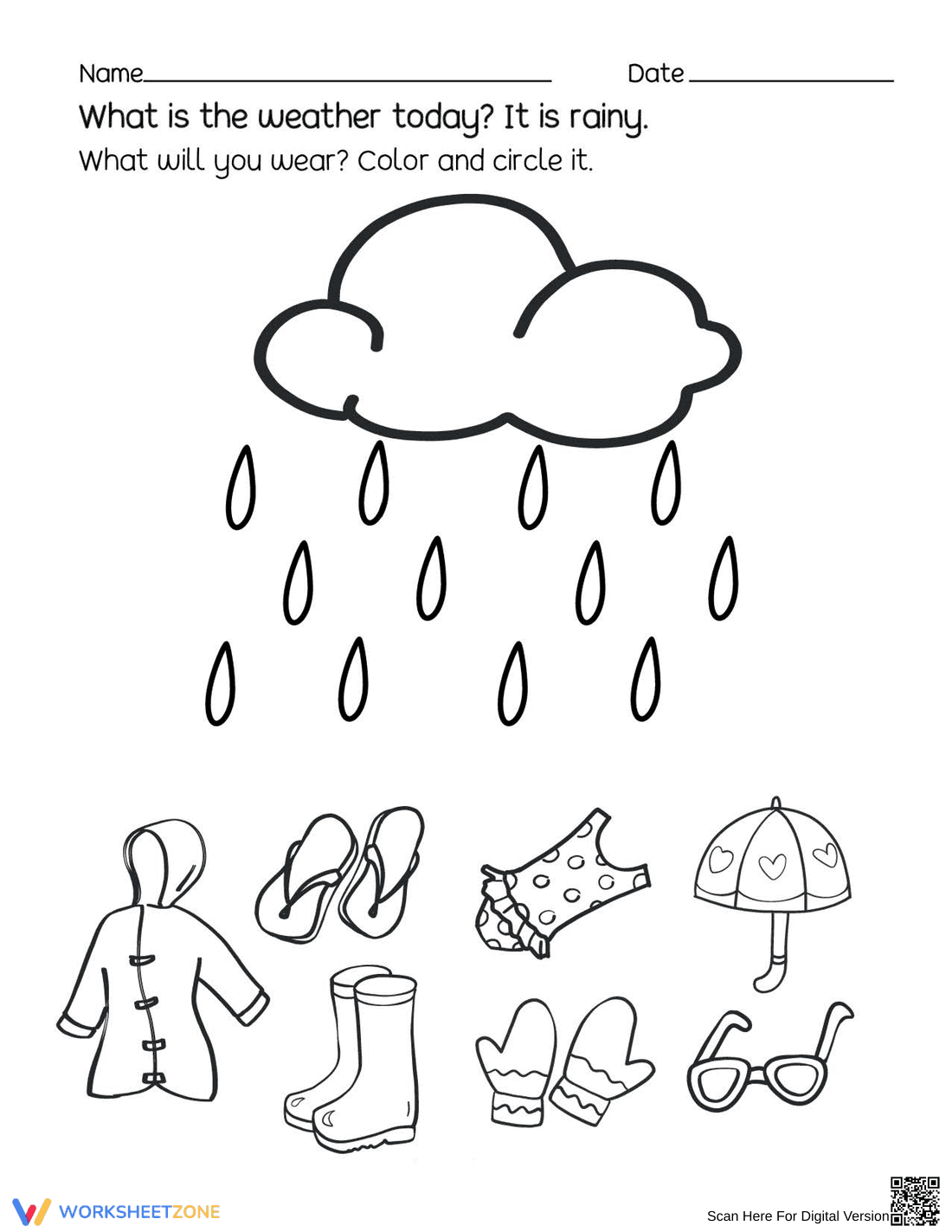
This Kindergarten science worksheet helps young learners identify the essential clothing needed for a rainy day. Students observe the weather prompt and evaluate various items to determine which ones provide protection from the rain. It is a fundamental activity that connects daily weather patterns with practical self-care skills and environmental awareness in early childhood education.
At a Glance
- Grade: Kindergarten · Subject: Science
- Standard:
K-ESS2-1— Use observations of weather conditions to describe patterns over time- Skill Focus: Weather-Appropriate Clothing
- Format: 1 page · 7 items · Zero-prep activity · PDF
- Best For: Morning meeting or science centers
- Time: 5–10 minutes
This single-page resource features a large, central weather illustration of a rain cloud to set the context. Below the prompt, students find seven distinct clothing and accessory illustrations, including a raincoat, rain boots, an umbrella, flip-flops, a swimsuit, mittens, and sunglasses. The clear, bold outlines are perfect for small hands to color and circle.
The zero-prep workflow is designed for maximum teacher efficiency. First, print a class set in seconds with no special settings. Second, distribute the sheets as part of your daily weather routine or morning work. Finally, conduct a quick 2-minute whole-class review where students explain their selections. This resource is an ideal sub-plan addition for early elementary classrooms.
Standards Alignment
This worksheet is aligned to K-ESS2-1, which focuses on using observations to describe patterns. By identifying that rain requires specific gear, students are demonstrating an understanding of a weather-related pattern. The standard code can be copied directly into lesson plans, IEP goals, or district curriculum mapping tools to track student progress in early science competencies.
How to Use It
Use this worksheet as a formative assessment after your daily weather calendar routine. As students work, observe if they can distinguish between "cold weather" gear (mittens) and "rainy weather" gear (raincoat). This provides a great opportunity to discuss why we might wear different things for different types of precipitation, taking only about 8 minutes of total instructional time.
Who It's For
Specifically designed for Kindergarten and Grade 1 students, this resource is perfect for English Language Learners (ELL) due to its high visual support. It pairs naturally with a weather-themed read-aloud or a "dress the bear" anchor chart. The simple instructions allow for independent practice even for students who are still developing their early reading skills.
The standard K-ESS2-1 requires students to connect weather observations with practical life patterns, a foundational skill for scientific inquiry. According to the RAND AIRS 2024 report, early childhood science instruction is most effective when it bridges abstract concepts with tangible, daily decisions such as selecting appropriate attire. This worksheet facilitates that bridge by asking students to evaluate seven distinct clothing items—including raincoats, boots, and umbrellas—against the specific stimulus of a rainy day. By engaging in the dual cognitive tasks of coloring and circling, learners reinforce their understanding of causal relationships between environmental conditions and human responses. This classroom-ready resource minimizes teacher overhead while maximizing student engagement through a structured, visual format. Utilizing such targeted practice ensures that students can accurately identify weather patterns and communicate their reasoning, aligning with the "Science and Engineering Practices" of the NGSS framework for early learners.


