


























Views
Downloads


Essential School Bag Vocabulary Worksheet | Grade 1
Paste this activity's link or code into your existing LMS (Google Classroom, Canvas, Teams, Schoology, Moodle, etc.).
Students can open and work on the activity right away, with no student login required.
You'll still be able to track student progress and results from your teacher account.
Identifying classroom objects and their corresponding actions is a foundational step in early childhood literacy. This "What is in My School Bag?" worksheet helps Kindergarten and Grade 1 students master essential school-themed vocabulary through visual identification and functional language application. By engaging with both nouns and verbs, students develop the lexical precision required for successful classroom communication.
At a Glance
- Grade: 1 · Subject: English Language Arts
- Standard:
CCSS.ELA-LITERACY.L.1.5— Demonstrate understanding of word relationships and nuances in word meanings- Skill Focus: School Objects and Action Verbs
- Format: 2 pages · 10 problems · Answer key included · PDF
- Best For: Vocabulary reinforcement and back-to-school lessons
- Time: 15–20 minutes
What's Inside
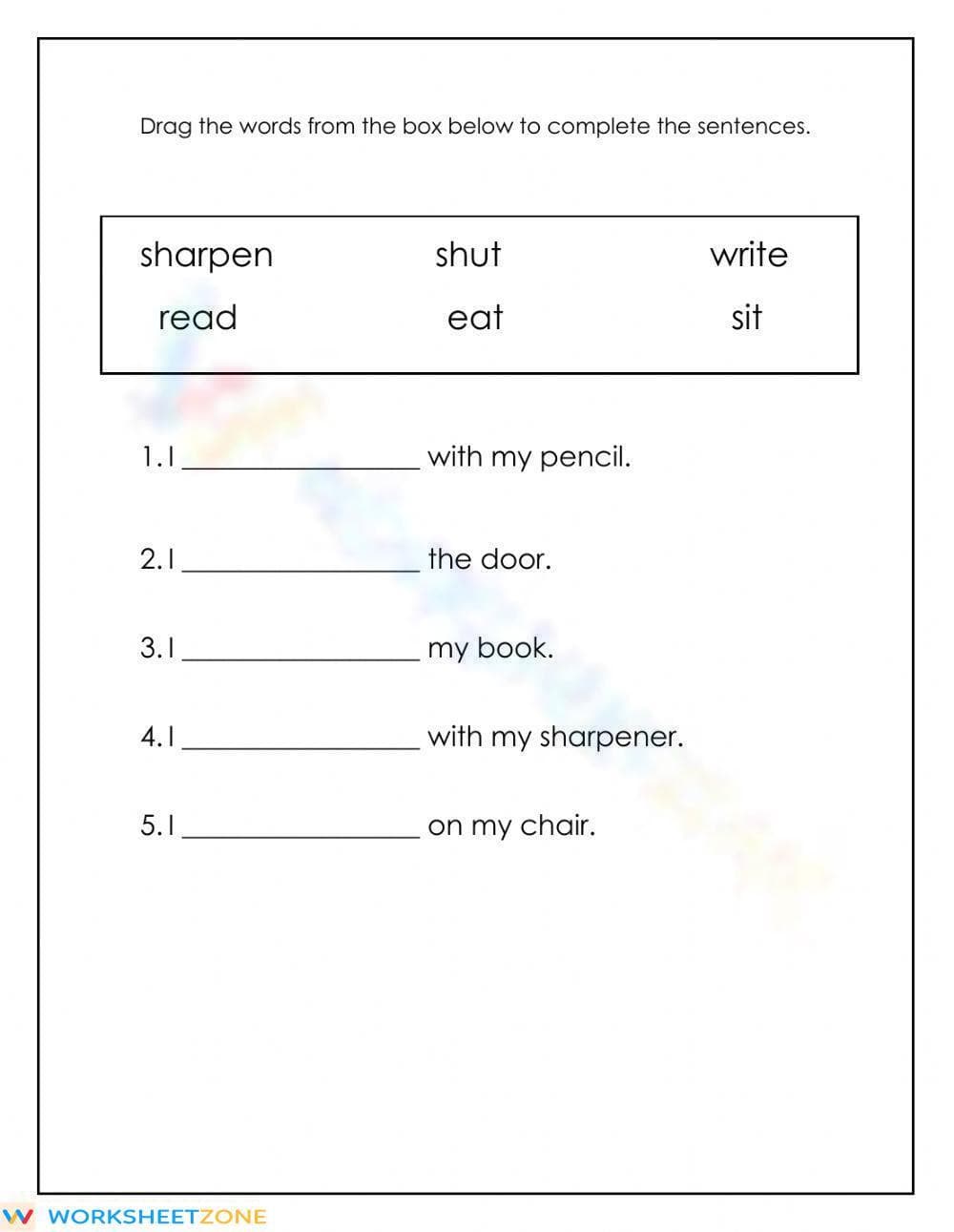
This two-page PDF resource features clear, child-friendly illustrations to support early readers. The first page presents a colorful backpack filled with supplies, followed by five True or False questions that test visual observation and noun recognition. The second page introduces a word bank of six common action verbs, challenging students to complete five sentences by matching the correct verb to its associated tool, such as writing with a pencil or sitting on a chair.
Zero-Prep Workflow
- Step 1: Print — Select the 2-page PDF and print enough copies for your group in under 30 seconds.
- Step 2: Distribute — Hand out the sheets during your morning meeting or as a quick transition activity.
- Step 3: Review — Use the included answer key to check for understanding as a whole class or individually.
Total teacher preparation time is less than two minutes, making this an ideal choice for emergency sub plans or supplemental seatwork.
Standards Alignment
This resource is specifically aligned to CCSS.ELA-LITERACY.L.1.5: "With guidance and support from adults, demonstrate understanding of word relationships and nuances in word meanings." It also supports CCSS.ELA-LITERACY.L.1.1 by providing structured practice in producing complete sentences with correct verb usage. Both standard codes can be copied directly into lesson plans, IEP goals, or district curriculum mapping tools.
How to Use It
Incorporate this worksheet during the first week of school to establish classroom vocabulary or use it as a formative assessment during a unit on community and school roles. For a quick observation tip, watch as students work through the verb matching section; difficulty associating "sharpen" with "sharpener" may indicate a need for more direct object-action instruction. Expected completion time ranges from 15 to 20 minutes depending on reading level.
Who It's For
This worksheet is designed for Kindergarten and Grade 1 learners, but it is also highly effective for ESL/ELL students who need to build basic functional vocabulary. The strong visual cues allow for independent practice even for emerging readers. It pairs naturally with a classroom "show and tell" or an anchor chart featuring school supply labels and their uses.
The "What is in My School Bag?" worksheet utilizes visual-linguistic mapping to reinforce noun-verb associations essential for early literacy development. According to Fisher & Frey (2014), the use of pictorial cues alongside structured linguistic tasks facilitates the gradual release of responsibility. By aligning with CCSS.ELA-LITERACY.L.1.5, this resource targets the foundational ability to understand word relationships and nuances, such as matching a pencil to writing or a book to reading. This scaffolded approach ensures that Grade 1 students build a robust mental lexicon of common classroom objects and their functional purposes. Research indicates that such integrated vocabulary practice is a significant predictor of later reading comprehension success. The inclusion of True/False logic and sentence completion offers multiple entry points for diverse learners, including those in ESL programs or requiring IEP accommodations for language processing and functional communication skills.


