


























Views
Downloads
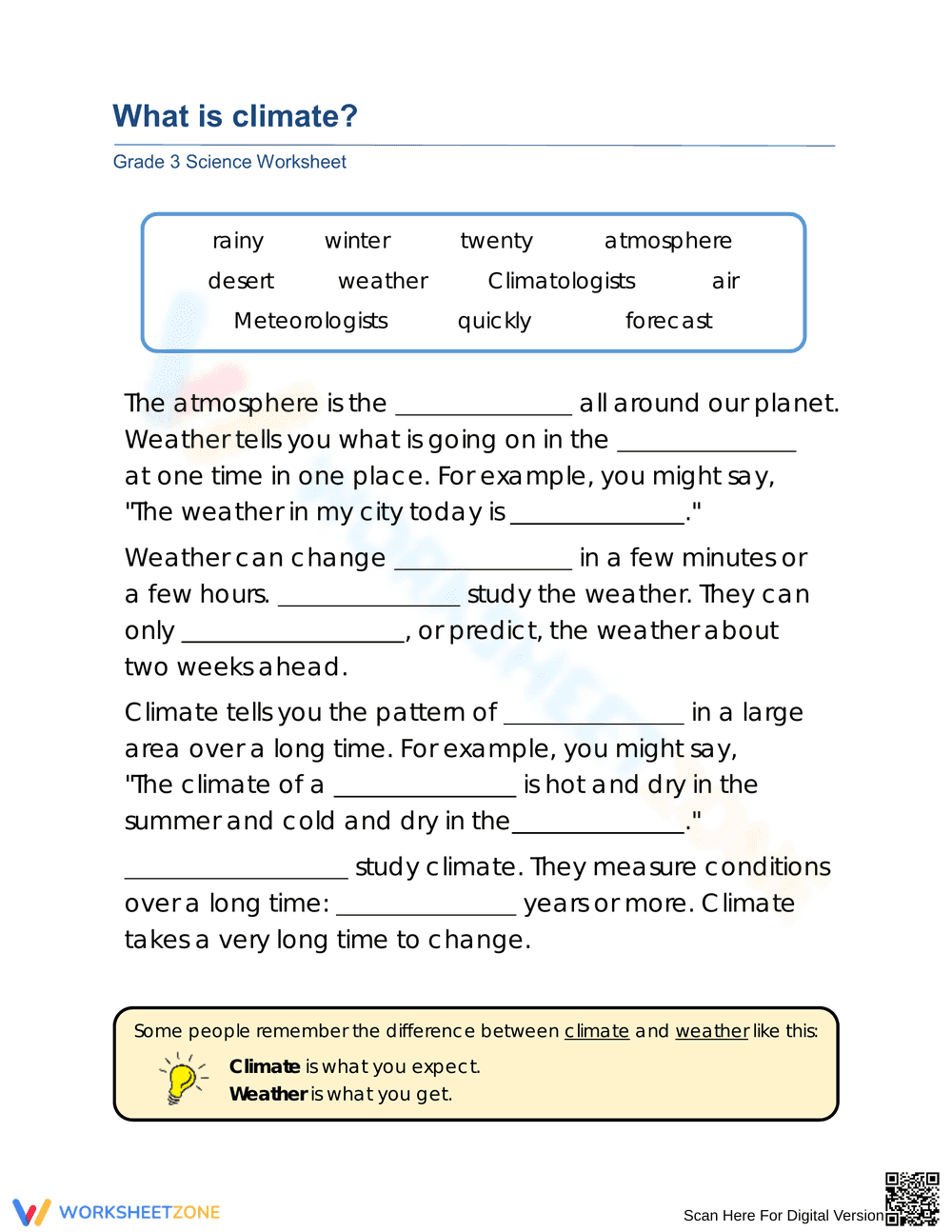

Grade 3 What is Climate? — Printable No-Prep Worksheet
Paste this activity's link or code into your existing LMS (Google Classroom, Canvas, Teams, Schoology, Moodle, etc.).
Students can open and work on the activity right away, with no student login required.
You'll still be able to track student progress and results from your teacher account.
This Grade 3 science worksheet helps students master the fundamental distinction between weather and climate through interactive fill-in-the-blank exercises. By identifying short-term atmospheric changes versus long-term patterns, learners develop a robust understanding of Earth's systems. This resource ensures students can accurately define the roles of meteorologists and climatologists while describing typical regional conditions.
At a Glance
- Grade: 3 · Subject: Science
- Standard:
3-ESS2-2— Contrast features of weather and climate to describe Earth's regional patterns- Skill Focus: Weather vs. Climate Distinction
- Format: 2 pages · 11 problems · Answer key included · PDF
- Best For: Science centers and independent practice
- Time: 15–20 minutes
What's Inside
This 2-page PDF includes a focused worksheet page and a comprehensive answer key for immediate feedback. The primary activity features a curated word bank containing eleven essential vocabulary terms such as atmosphere, meteorologist, and climatologist. Students use these terms to complete a narrative that explains the temporal differences between daily weather changes and the multi-decade averages that define a region's climate.
Zero-Prep Workflow
The zero-prep workflow for this resource is designed for maximum efficiency in busy classrooms. Printing the double-sided document takes less than 30 seconds, and distribution to a standard class of thirty students requires only 1 minute. Reviewing the answers using the included key can be completed as a whole-group activity in under 5 minutes, making this an ideal sub plan or sudden-notice science lesson.
Standards Alignment
This worksheet is primarily aligned with the Next Generation Science Standard 3-ESS2-2, which requires students to obtain and combine information to describe climates in different regions of the world. Additionally, it supports literacy in science by building domain-specific vocabulary. Both standard codes can be copied directly into lesson plans, IEP goals, or district curriculum mapping tools.
How to Use It
Use this worksheet as a formative assessment after an introductory lesson on Earth's atmosphere to gauge student comprehension of temporal scales. For a quick observational check, notice if students can distinguish between the "quickly" changing nature of weather and the "twenty" year minimum for climate data. It is most effective when assigned as independent practice during a science block, requiring approximately 20 minutes to complete.
Who It's For
This resource is designed for third-grade students beginning their exploration of Earth systems and climate science. It is particularly helpful for visual learners who benefit from word banks and structured sentence frames. It pairs naturally with a classroom anchor chart comparing local weather forecasts to global climate maps, providing a concrete bridge between daily experiences and scientific concepts.
The "What is climate?" worksheet addresses the critical pedagogical need for clear distinctions between atmospheric events and long-term trends, a core component of the 3-ESS2-2 science standard. Research from the NAEP highlights that students who master foundational Earth science vocabulary in early elementary grades show significantly higher proficiency in complex environmental modeling later in their academic careers. By focusing on the plain-English skill of contrasting weather and climate, this resource aligns with the ScienceDirect TpT Analysis recommendations for high-impact, low-barrier educational materials. These findings suggest that structured fill-in-the-blank activities with word banks provide the necessary scaffolding for third graders to internalize technical definitions without cognitive overload. This worksheet serves as a reliable instrument for evidence-based instruction, ensuring that every student can access and articulate the differences between a two-week forecast and a thirty-year climate average.


