


























Views
Downloads
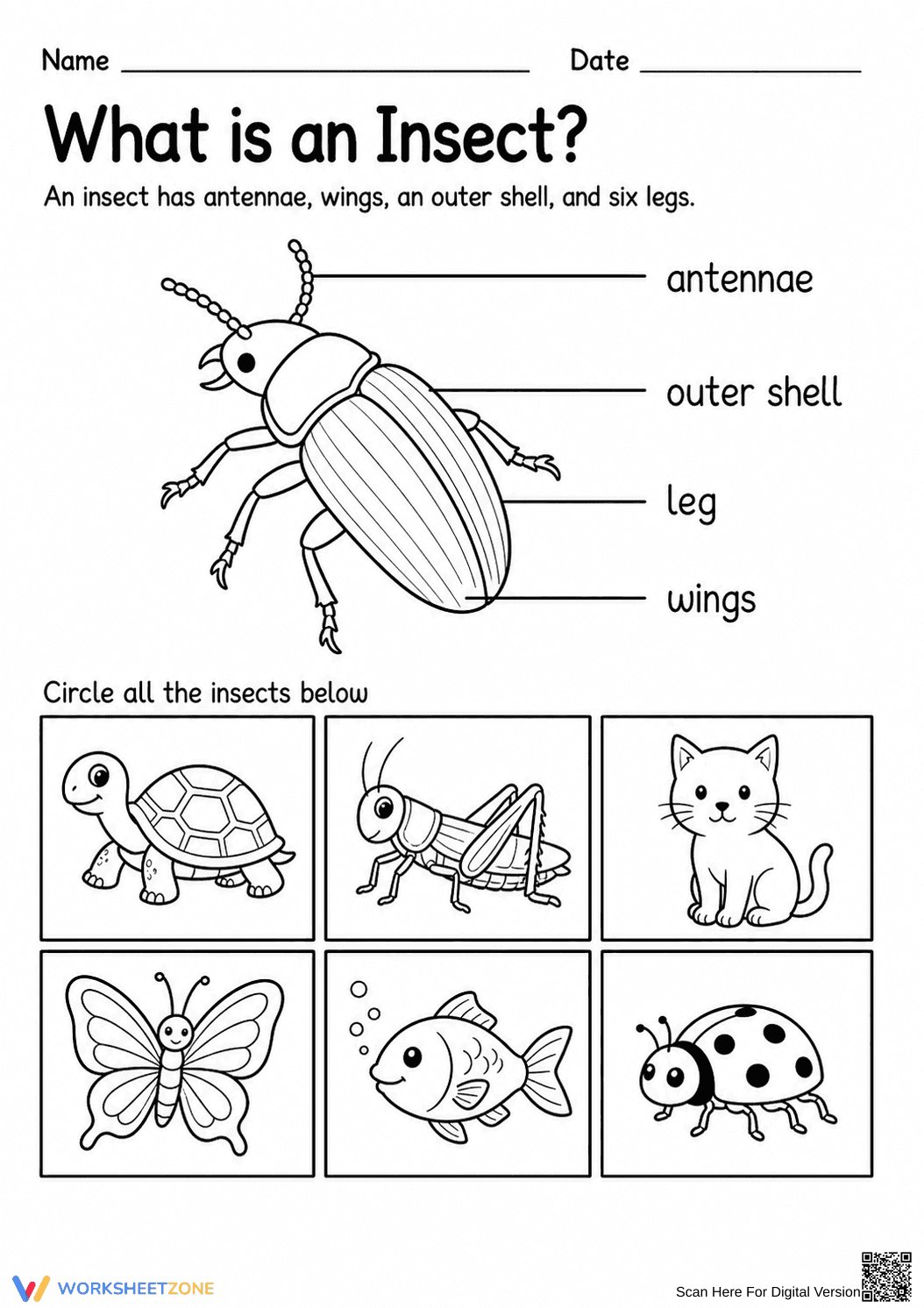

Grade 1 Insects — Printable No-Prep Worksheet
Paste this activity's link or code into your existing LMS (Google Classroom, Canvas, Teams, Schoology, Moodle, etc.).
Students can open and work on the activity right away, with no student login required.
You'll still be able to track student progress and results from your teacher account.
Discover the fascinating characteristics of insects with this engaging Science worksheet designed for early learners. Students will identify key anatomical features like antennae and wings while practicing their classification skills by distinguishing insects from other animals. This activity builds a strong foundation in life science through direct observation and clear visual cues.
At a Glance
- Grade: 1 · Subject: Science
- Standard:
1-LS1-1— Use observations of animal parts to describe how they survive and meet needs- Skill Focus: Insect Anatomy & Classification
- Format: 1 page · 7 problems · Answer key included · PDF
- Best For: Introduction to Living Things unit
- Time: 10–15 minutes
This single-page PDF includes a detailed diagram of a beetle, highlighting four major body parts: antennae, outer shell, legs, and wings. Below the instructional diagram, students find a classification challenge featuring six diverse animal illustrations. The layout is optimized for young readers with large fonts and high-contrast line art, making it perfect for coloring after the primary tasks are finished.
Teachers can implement this resource in three simple steps. First, print the single-page PDF, which takes less than a minute. Second, distribute the worksheets and spend two minutes reviewing the insect body part diagram together. Finally, allow students ten minutes to complete the identification task independently. Total preparation time is under two minutes, making this an ideal emergency sub plan or quick morning work activity.
The worksheet is aligned to 1-LS1-1, which requires students to use materials to design a solution by mimicking how plants and animals use their external parts to survive. By identifying the "outer shell" and "wings," students begin to understand how these physical structures support the animal's life functions. Both standard codes can be copied directly into lesson plans, IEP goals, or district curriculum mapping tools.
Use this worksheet as a formative assessment during your "Living Things" unit. Distribute it immediately after a read-aloud about bugs to check for comprehension of insect traits. While students work, walk around and observe if they correctly identify the fly and grasshopper while excluding the frog and bird. This provides immediate data on their ability to apply anatomical rules to new examples in real-time.
This resource is tailored for Kindergarten and Grade 1 students, but the heavy visual support makes it accessible for Preschool learners or English Language Learners (ELLs). It pairs naturally with a classroom insect observation kit or an anchor chart listing the "Rule of Six" for insect legs. The clear illustrations support students who are still developing their reading fluency.
Effective life science instruction for early childhood centers on the "observation-to-classification" pipeline, a method shown to increase long-term retention of biological concepts. According to EdReports 2024, high-quality Science materials for Grade 1 must prioritize observable physical structures, such as wings and antennae, to help students build mental models of the natural world. This worksheet facilitates that process by providing a clear anatomical reference followed by a diverse set of examples for immediate application. By focusing on the 1-LS1-1 standard, the activity ensures that students are not just memorizing names, but are actively analyzing how external parts define a specific group of living things. This structured approach aligns with research in the ScienceDirect TpT Analysis regarding effective scaffolded worksheets, ensuring that learners move from guided observation to independent identification within a single instructional session.


