


























Views
Downloads

Grade 1 Animal Diet Worksheet — Printable Science
Paste this activity's link or code into your existing LMS (Google Classroom, Canvas, Teams, Schoology, Moodle, etc.).
Students can open and work on the activity right away, with no student login required.
You'll still be able to track student progress and results from your teacher account.
This Grade 1 science worksheet simplifies the concept of animal diets by inviting students to match common animals with their primary food sources. Students develop foundational biological knowledge by observing the relationship between a creature's physical traits and its nutritional needs, ensuring they understand how living things survive in their natural habitats.
At a Glance
- Grade: 1 · Subject: Science
- Standard:
1-LS1-1— Use observations to identify how the parts of animals help them survive- Skill Focus: Animal Diet Identification
- Format: 2 pages · 4 problems · Answer key included · PDF
- Best For: Quick formative assessment or science centers
- Time: 5–10 minutes
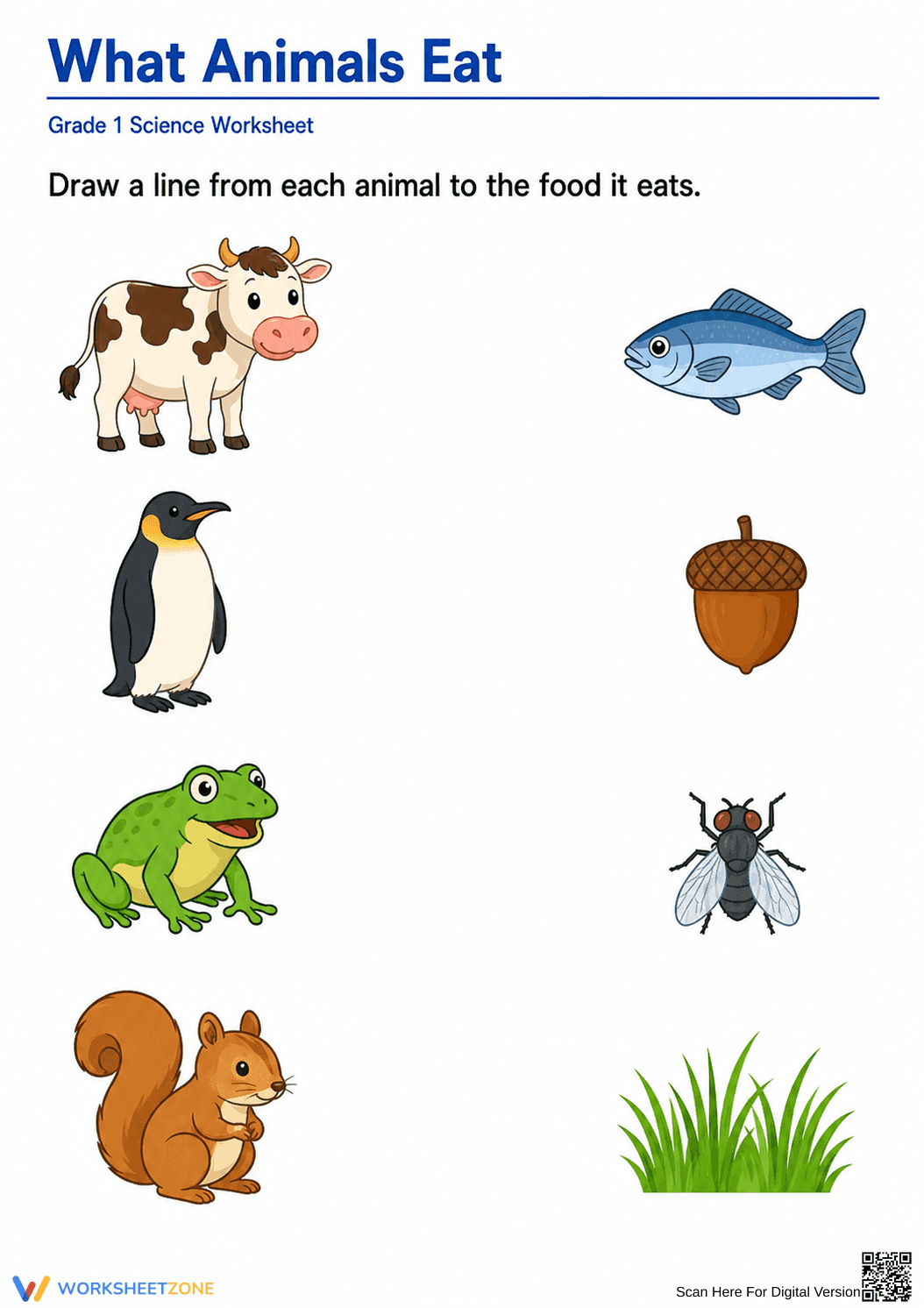
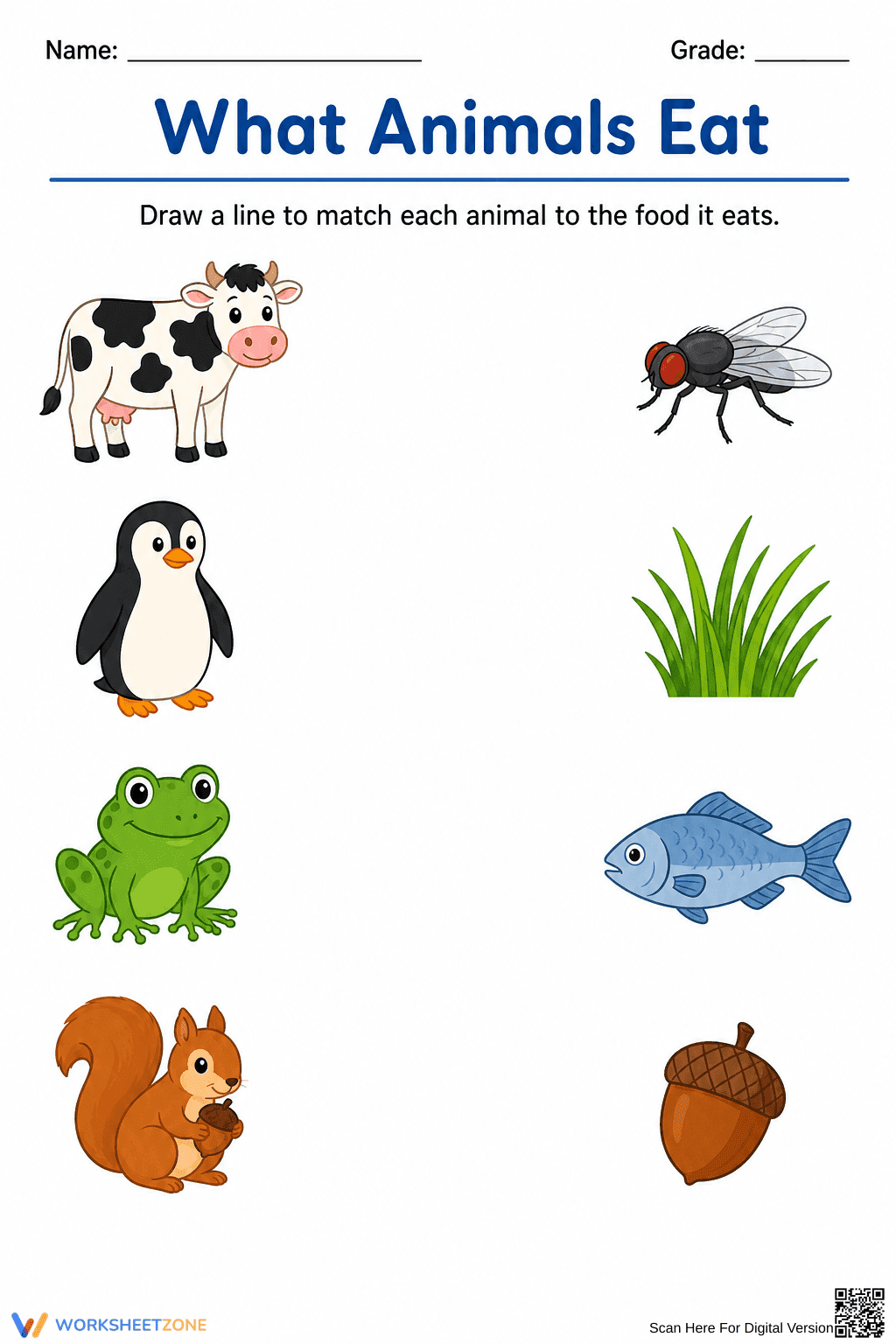
This two-page PDF resource includes a cleanly designed matching activity and a corresponding answer key. The first page features four vibrant illustrations of animals—a cow, penguin, frog, and squirrel—positioned opposite four food sources: fish, an acorn, a fly, and grass. The large, clear visuals are specifically selected for early learners to ensure recognition without heavy reading demands.
Implementing this resource is designed for maximum efficiency in a busy classroom. Step 1: Print the single-sided worksheet for your class (30 seconds). Step 2: Distribute the pages during your living things unit or as a morning warm-up (1 minute). Step 3: Review the answers together using the included key or have students self-check their work (2 minutes). Total teacher preparation time is under 2 minutes, making it an ideal choice for substitute lesson plans or unexpected schedule gaps.
Aligned to 1-LS1-1, this activity focuses on how animals use their structures to obtain food. By identifying what each animal eats, students begin to see the connection between specialized body parts (like a squirrel's paws or a frog's tongue) and survival strategies. Both standard codes can be copied directly into lesson plans, IEP goals, or district curriculum mapping tools.
Use this worksheet as an exit ticket following a lesson on carnivores and herbivores to gauge student understanding of specific dietary needs. Alternatively, place it in a science center along with animal figurines to create a tactile learning experience where students match the toy to the correct food card. Observe students as they draw lines to identify if they can explain why an animal chooses a specific food source.
This resource is tailored for first-grade students and ESL learners who benefit from high-contrast visual supports. It provides an entry point for discussing broader ecosystem concepts. This worksheet pairs naturally with a read-aloud about animal habitats or a classroom anchor chart detailing the differences between plant-eaters and meat-eaters.
Effective science instruction in the primary grades relies on visual categorization to build conceptual frameworks. Research from Fisher & Frey (2014) emphasizes the importance of visual aids as essential scaffolds before moving toward abstract textual information. This worksheet leverages the 1-LS1-1 standard to help students recognize biological patterns through observation. By matching four distinct animals to their specific nutritional requirements, students engage in evidence-based reasoning at a developmentally appropriate level. The use of high-interest graphics reduces cognitive load, allowing first-grade learners to focus on the scientific relationship between organism and environment rather than decoding complex text. This approach is consistent with NAEP recommendations for improving scientific literacy through the early introduction of systems-thinking and habitat-dependency models, providing a robust foundation for more complex life science units in later elementary grades.


