


























Views
Downloads

Printable Picture Comprehension Worksheet | Grade K ELA
Paste this activity's link or code into your existing LMS (Google Classroom, Canvas, Teams, Schoology, Moodle, etc.).
Students can open and work on the activity right away, with no student login required.
You'll still be able to track student progress and results from your teacher account.
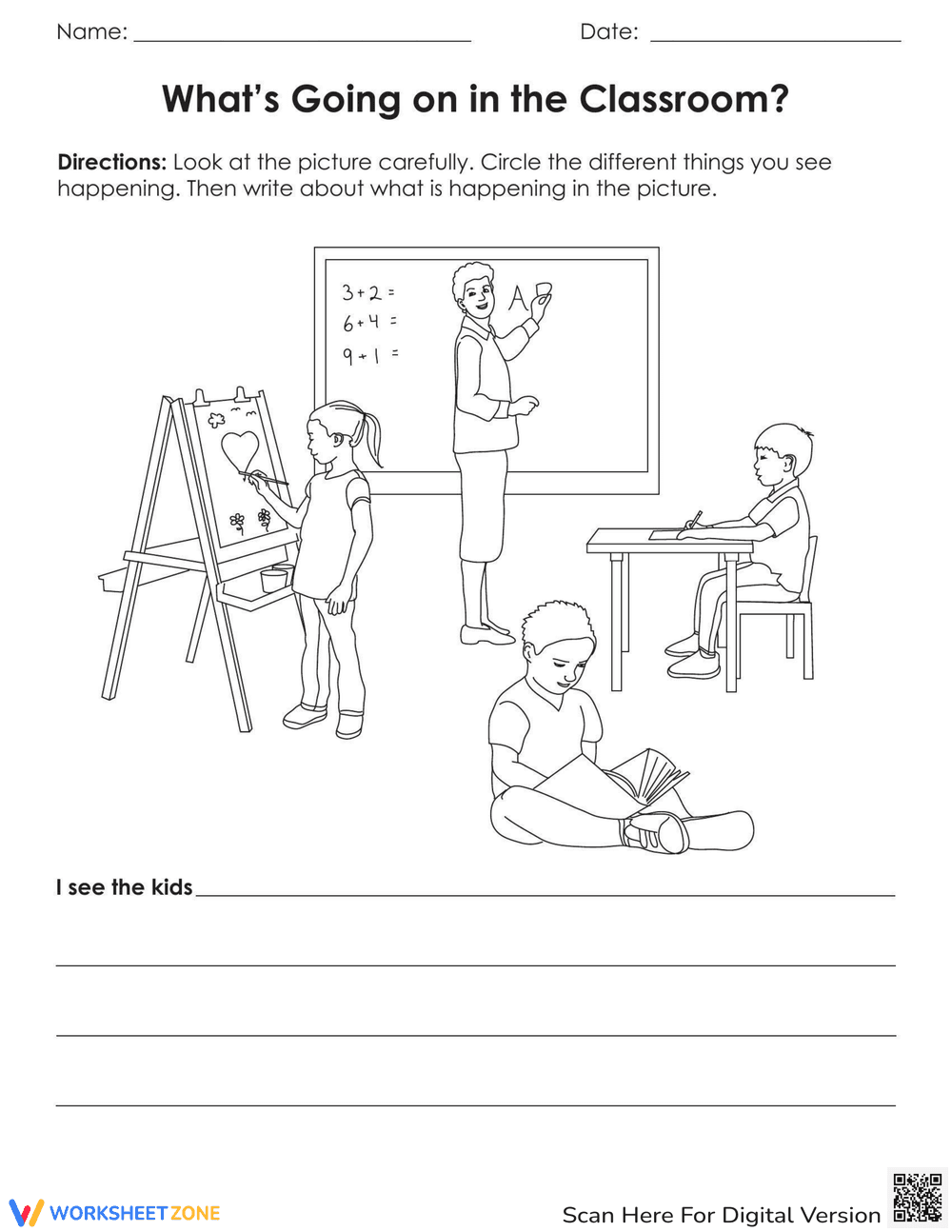
This printable Kindergarten ELA worksheet builds early reading comprehension by having students analyze a detailed classroom illustration. Young learners observe the scene, identify key actions, and write descriptive sentences about what they see. This visual literacy practice strengthens foundational skills for connecting images to text meaning.
At a Glance
- Grade: K · Subject: ELA
- Standard:
CCSS.ELA-LITERACY.RL.K.7— Describe relationship between illustrations and text- Skill Focus: Picture Comprehension
- Format: 1 page · 2 problems · Open-ended · PDF
- Best For: Independent practice
- Time: 10–15 minutes
This single-page resource features an engaging illustration of a classroom environment with multiple activities. It includes two primary tasks: a visual identification activity where students circle actions, followed by a guided writing section with a sentence starter. The open-ended format allows for varied responses based on student observation, making it an excellent tool for assessing early writing and descriptive skills without requiring a rigid answer key.
Zero-Prep Workflow
- Print (1 minute): Simply download the PDF and print a class set. No special materials or color ink required.
- Distribute (1 minute): Hand out the worksheet along with pencils. Instructions are self-explanatory.
- Review (3 minutes): Briefly read the directions aloud and model how to circle an action in the picture.
Total teacher prep time is under 2 minutes. This straightforward format makes it an ideal, stress-free addition to any emergency sub plan or morning work routine.
Aligned to primary standard CCSS.ELA-LITERACY.RL.K.7: With prompting and support, describe the relationship between illustrations and the story in which they appear. By analyzing the classroom scene and writing about it, students practice extracting meaning from visual cues, a crucial step toward understanding illustrated texts. The standard code can be copied directly into lesson plans, IEP goals, or district curriculum mapping tools.
Use this worksheet as an independent morning work activity to settle students into the day, or as a quiet center rotation during literacy blocks. As a formative assessment observation tip, watch how students select which action to write about; this reveals their ability to focus on specific details versus the overall scene. Expected completion time is 10 to 15 minutes.
This resource is designed for Kindergarten students developing early literacy and writing skills. It naturally differentiates itself, as emerging writers can complete a single simple sentence, while advanced students can write multiple descriptive sentences using the provided lines. Pair this worksheet with a whole-group read-aloud lesson focusing on how pictures tell a story to reinforce the concept.
Developing visual literacy through picture comprehension is a critical foundational skill for early readers. Aligned with CCSS.ELA-LITERACY.RL.K.7, this activity requires students to describe relationship between illustrations and text. According to Fisher & Frey (2014), integrating visual analysis with writing tasks significantly enhances students' ability to infer meaning and construct narrative understanding. When young learners actively engage with an image by circling specific details and translating those observations into written words, they effectively bridge the gap between visual processing and linguistic expression. This targeted instructional approach not only supports reading comprehension but also builds essential expressive writing capabilities in early childhood education. By providing structured opportunities to decode complex illustrations, educators lay the necessary groundwork for more advanced textual analysis in later grades, ensuring students develop robust, multifaceted literacy skills.


