


























Views
Downloads

Printable Area Estimation & Word Problems Worksheet | Gr 4-6
Paste this activity's link or code into your existing LMS (Google Classroom, Canvas, Teams, Schoology, Moodle, etc.).
Students can open and work on the activity right away, with no student login required.
You'll still be able to track student progress and results from your teacher account.
This comprehensive Grade 4-6 math worksheet helps students master the dual concepts of area estimation and calculation through a structured, four-task progression. By moving from counting unit squares to solving complex word problems, learners develop a deep conceptual understanding of spatial measurement. Students will demonstrate mastery by estimating irregular shapes and applying formulas to real-world scenarios.
At a Glance
- Grade: 4–6 · Subject: Math
- Standard:
4.MD.A.3— Apply area and perimeter formulas for rectangles in real world and mathematical problems- Skill Focus: Area estimation and composite shape calculation
- Format: 4 pages · 4 tasks · Answer key included · PDF
- Best For: End-of-week review or substitute lesson plans
- Time: 40–50 minutes
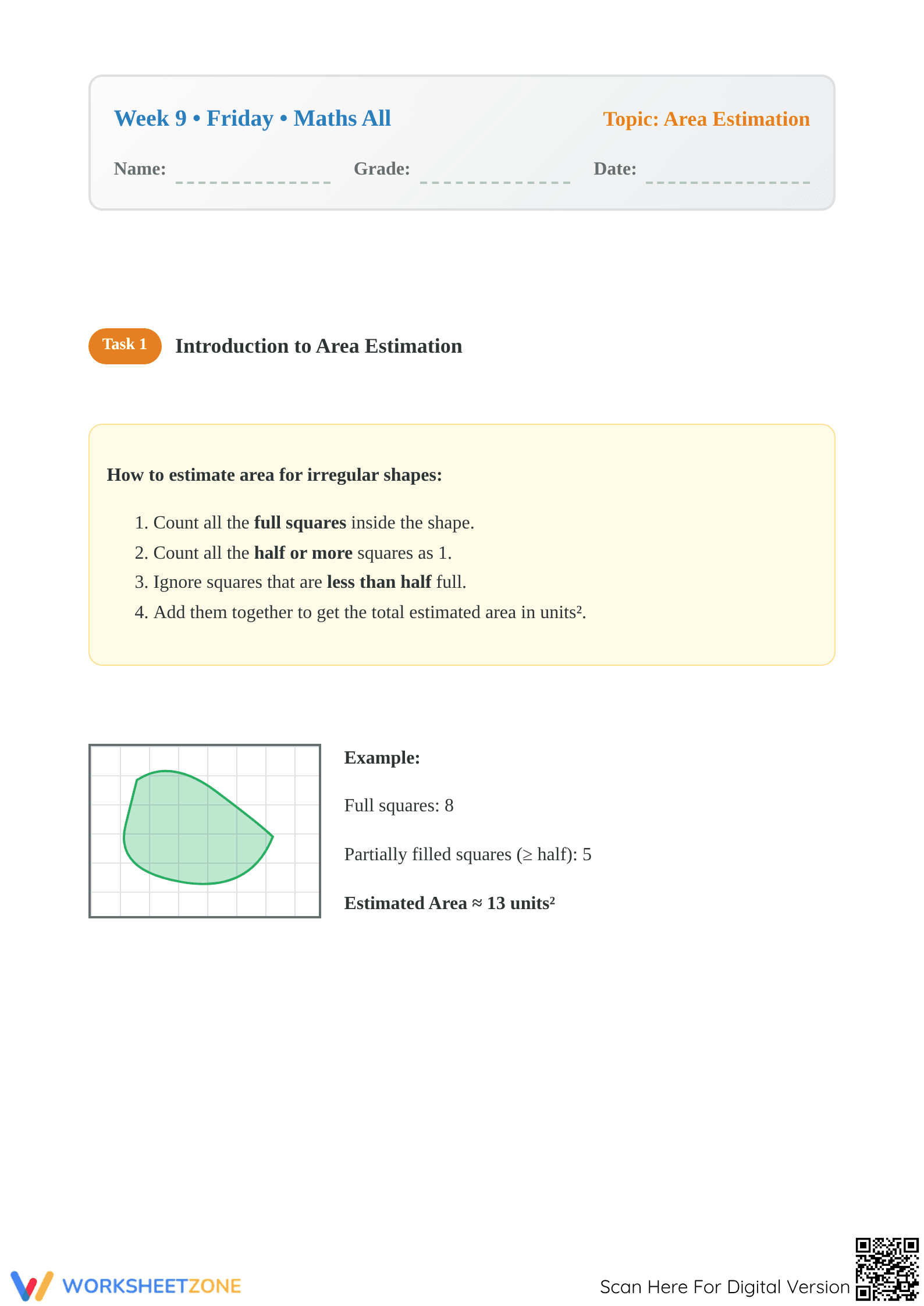
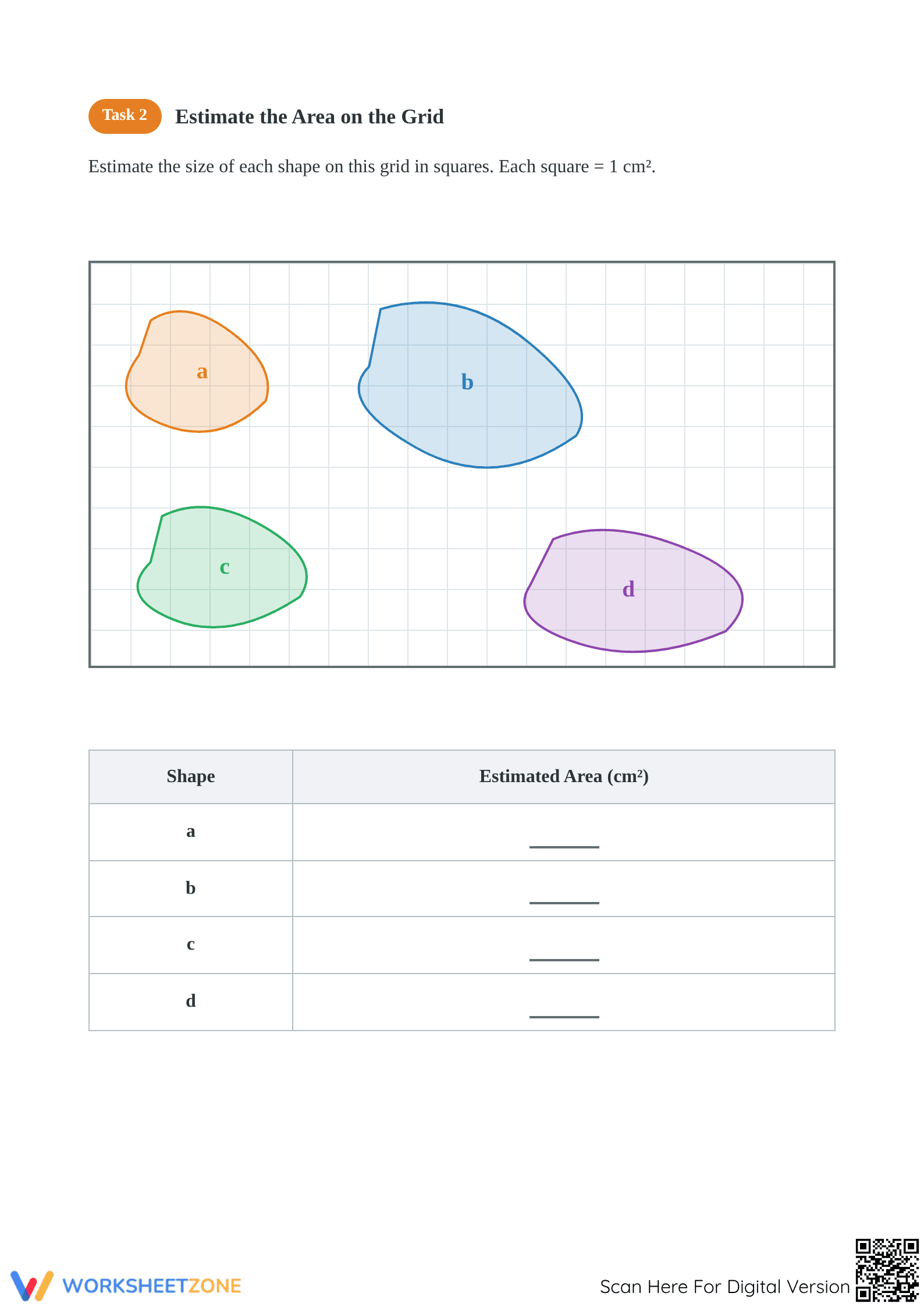
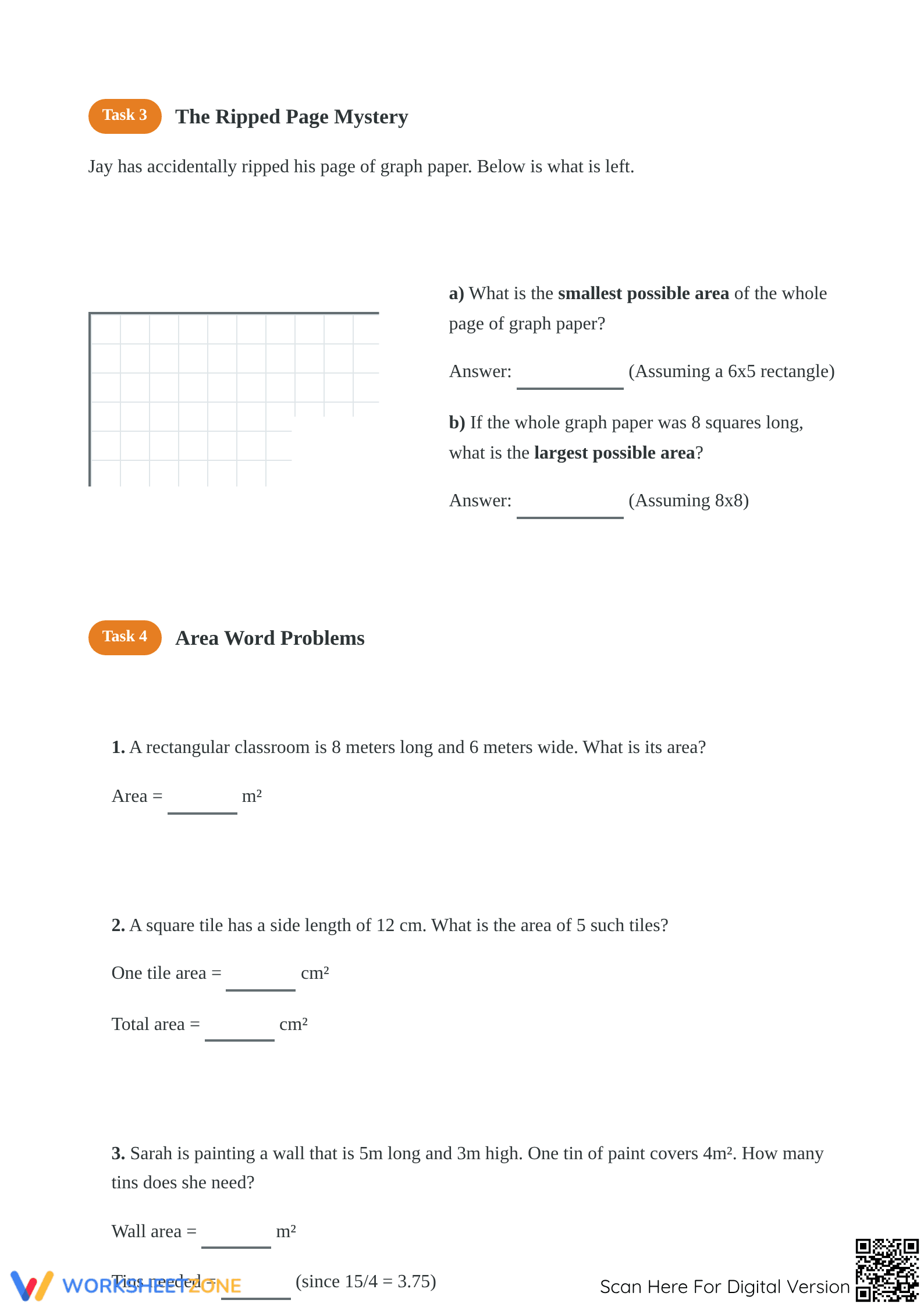
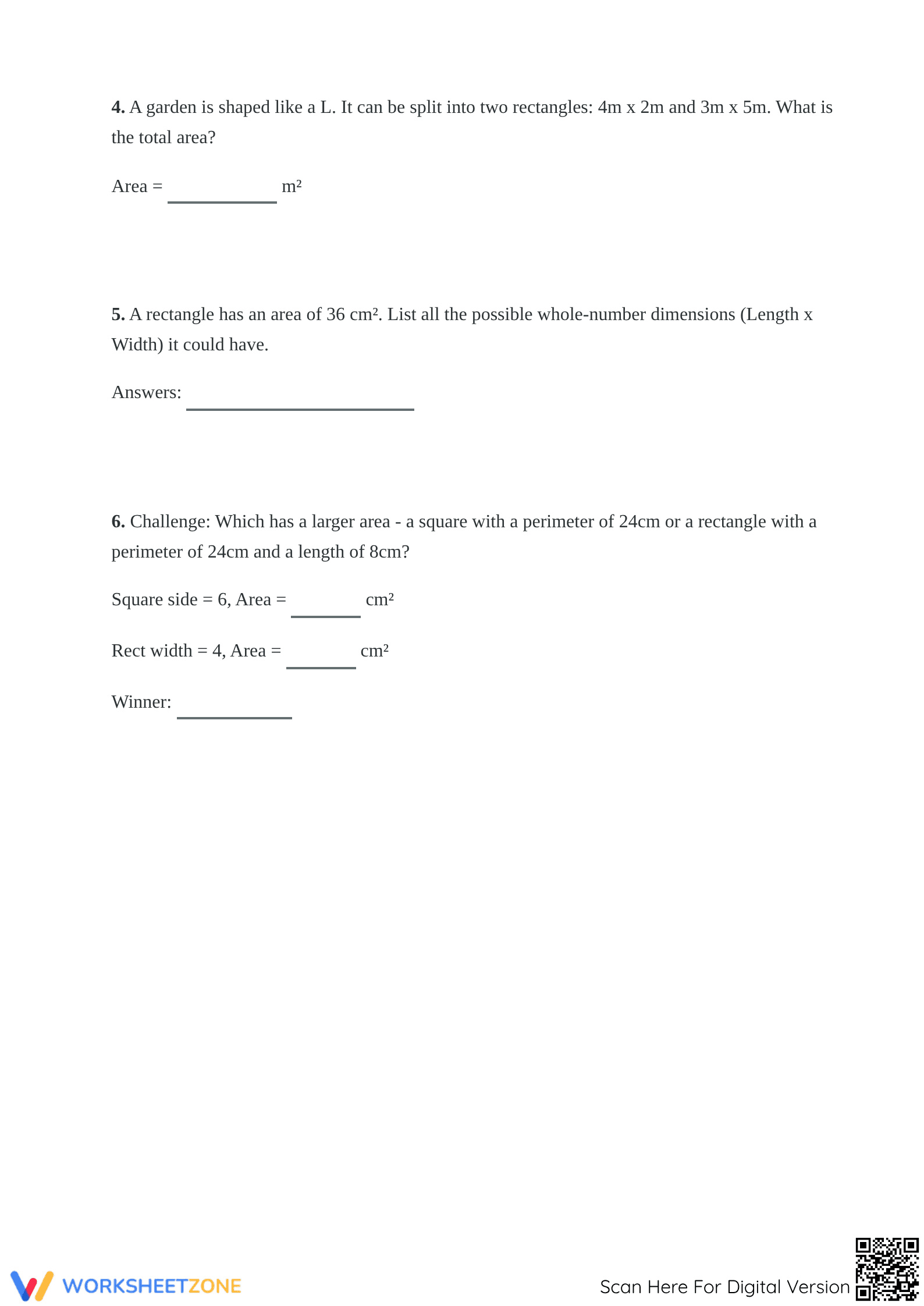
What's Inside: The resource consists of a 4-page PDF featuring four distinct tasks. Task 1 introduces the methodology for estimating area on a grid with clear, bolded rules. Task 2 provides hands-on practice with irregular shapes. Task 3 presents a "Ripped Page Mystery" to challenge deductive reasoning, while Task 4 offers six rigorous word problems, including composite L-shapes and area-perimeter comparisons. A full answer key is provided for rapid grading.
Zero-Prep Workflow: This resource is designed for immediate classroom use. First, print the four-page packet (30 seconds). Second, distribute the sheets and review the estimation rules on page one (2 minutes). Finally, use the answer key to review results or as a self-check station (5 minutes). Total teacher preparation time is under two minutes, making it an ideal choice for busy educators who need a high-quality, complete lesson ready in moments.
Standards Alignment: Primary standard 4.MD.A.3 — Apply area and perimeter formulas for rectangles in real world and mathematical problems. This worksheet also supports CCSS.MATH.CONTENT.3.MD.C.6 through its focus on measuring area by counting unit squares. Both standard codes can be copied directly into lesson plans, IEP goals, or district curriculum mapping tools to ensure instructional accountability across Grade 4, 5, and 6 levels.
How to Use It: Assign during the independent practice phase of your geometry unit to solidify estimation skills. Effective as a formative assessment, observing students on the "Ripped Page" challenge identifies gaps in grid-logic understanding. With an expected completion time of 45 minutes, it serves as a complete standalone lesson, engaging homework, or a robust assessment for end-of-unit measurement reviews.
Who It's For: Tailored for upper elementary students (Grades 4-6), this resource includes scaffolds like visual grids and worked examples, making it accessible for diverse learners. It pairs well with hands-on activities like geoboards or digital interactives to reinforce the transition from concrete grid-counting to abstract formulaic measurement in complex geometric scenarios.
The NAEP framework identifies the transition from counting unit squares to applying algebraic area formulas as a critical milestone in upper elementary math. This Grade 4-6 worksheet supports this by first grounding students in conceptual area through irregular shape estimation on a grid (CCSS.MATH.CONTENT.3.MD.C.6). It then scaffolds to abstract application of area formulas in multi-step word problems involving rectangles, composite L-shapes, and comparative perimeter challenges (aligned with 4.MD.A.3). Research (Fisher & Frey, 2014) highlights that guided practice, moving from concrete visuals to independent problem-solving, significantly improves spatial reasoning skill retention. By integrating task-based mysteries with real-world scenarios, this resource ensures students perceive area as a functional measurement tool. This comprehensive practice set provides the necessary rigor for middle school geometry, including surface area and volume.


