




























Views
Downloads




Printable Area of Composite Figures Worksheet | Grade 6

Paste this activity's link or code into your existing LMS (Google Classroom, Canvas, Teams, Schoology, Moodle, etc.).
Students can open and work on the activity right away, with no student login required.
You'll still be able to track student progress and results from your teacher account.
This Grade 6 mathematics worksheet focuses on the essential skill of calculating the area of composite figures. By teaching students how to subtract a smaller rectangle from a larger one or decompose complex shapes, this resource builds the geometric reasoning necessary for higher-level math. Students will successfully master finding shaded area regions through guided and independent practice.
At a Glance
- Grade: 6 · Subject: Mathematics
- Standard:
CCSS.MATH.CONTENT.6.G.A.1— Find the area of polygons by decomposing them into rectangles and other shapes- Skill Focus: Area of composite figures (subtraction method)
- Format: 5 pages · 7 problems · Answer key included · PDF
- Best For: Homework, independent practice, or sub plans
- Time: 30–45 minutes
What's Inside
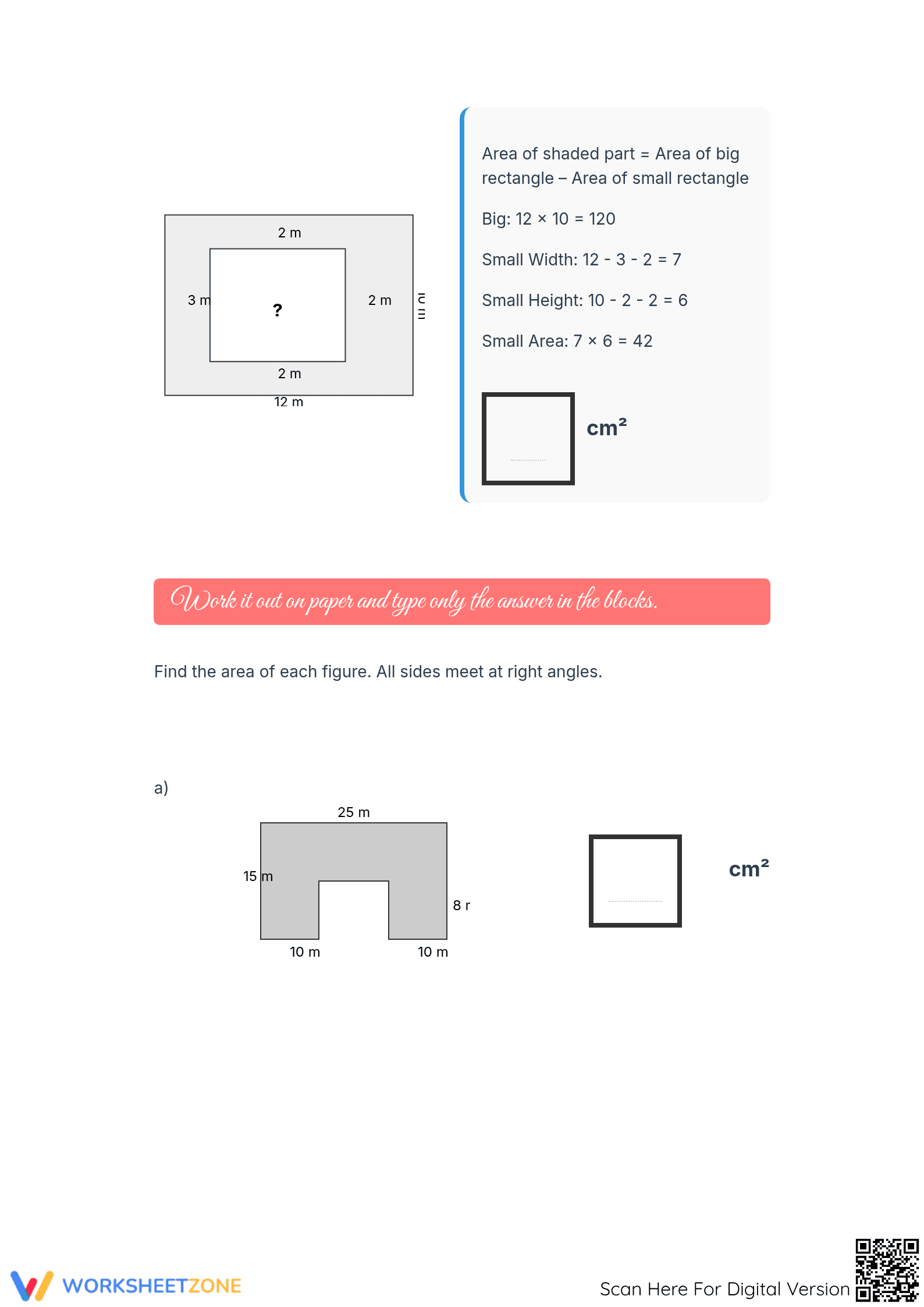
This 5-page PDF contains two pages of "Read and Understand" worked examples that walk students through the step-by-step logic of finding shaded borders and subtracted regions. Following these models, students encounter 7 practice problems of increasing complexity, ranging from U-shaped polygons to "frame" style problems. The clean layout includes dedicated workspace and specific answer blocks for easy digital or physical grading.
Zero-Prep Workflow
To implement this worksheet, teachers follow a simple three-step process: Print the 5-page set (30 seconds), distribute to students for independent work (30 seconds), and review the final answers using the included key (1 minute). Total teacher prep time is under two minutes. Because the instructional examples are built directly into the first two pages, this resource functions perfectly as a standalone sub plan or a supplemental independent practice packet.
Standards Alignment
Aligned to CCSS.MATH.CONTENT.6.G.A.1, this resource requires students to "find the area of right triangles, other triangles, special quadrilaterals, and polygons by composing into rectangles or decomposing into triangles and other shapes." It specifically focuses on the decomposition of non-standard polygons into simpler rectangular units. This standard code can be copied directly into lesson plans, IEP goals, or district curriculum mapping tools.
How to Use It
Use this worksheet as a primary practice tool after a direct instruction lesson on area. It is particularly effective as a mid-week review for students who have already learned basic rectangle area but struggle with composite shapes. For a formative assessment, observe students during Page 3, Problem (a); if they correctly identify the missing dimensions, they have mastered the foundational geometric logic required for the rest of the packet.
Who It's For
This resource is designed for Grade 6 students but serves as an excellent challenge for Grade 5 or a remedial review for Grade 7. The visual support and worked examples make it highly accessible for English Language Learners and students with IEPs who benefit from seeing a model before attempting independent tasks. Pair this with a coordinate plane activity or a physical manipulative lesson using base-ten blocks.
Calculating the area of composite figures is a critical milestone in Middle School mathematics, bridging basic arithmetic and spatial reasoning. According to EdReports (2024), instructional materials emphasizing the decomposition of shapes allow students to develop conceptual understanding of measurement beyond memorized formulas. This worksheet aligns with CCSS.MATH.CONTENT.6.G.A.1 by providing structured opportunities to apply area formulas to complex polygons. Research from ScienceDirect TpT Analysis indicates that "worked examples" followed by immediate "independent practice"—the structure used in this 5-page PDF—reduces cognitive load and improves retention of geometric concepts. By focusing on the subtraction of rectangular areas, students build prerequisite skills for calculating surface area and volume. This evidence-based approach ensures students meet grade-level expectations while developing flexible problem-solving strategies. This resource is a proven tool for mastery of area-based curriculum standards.


