




























Views
Downloads
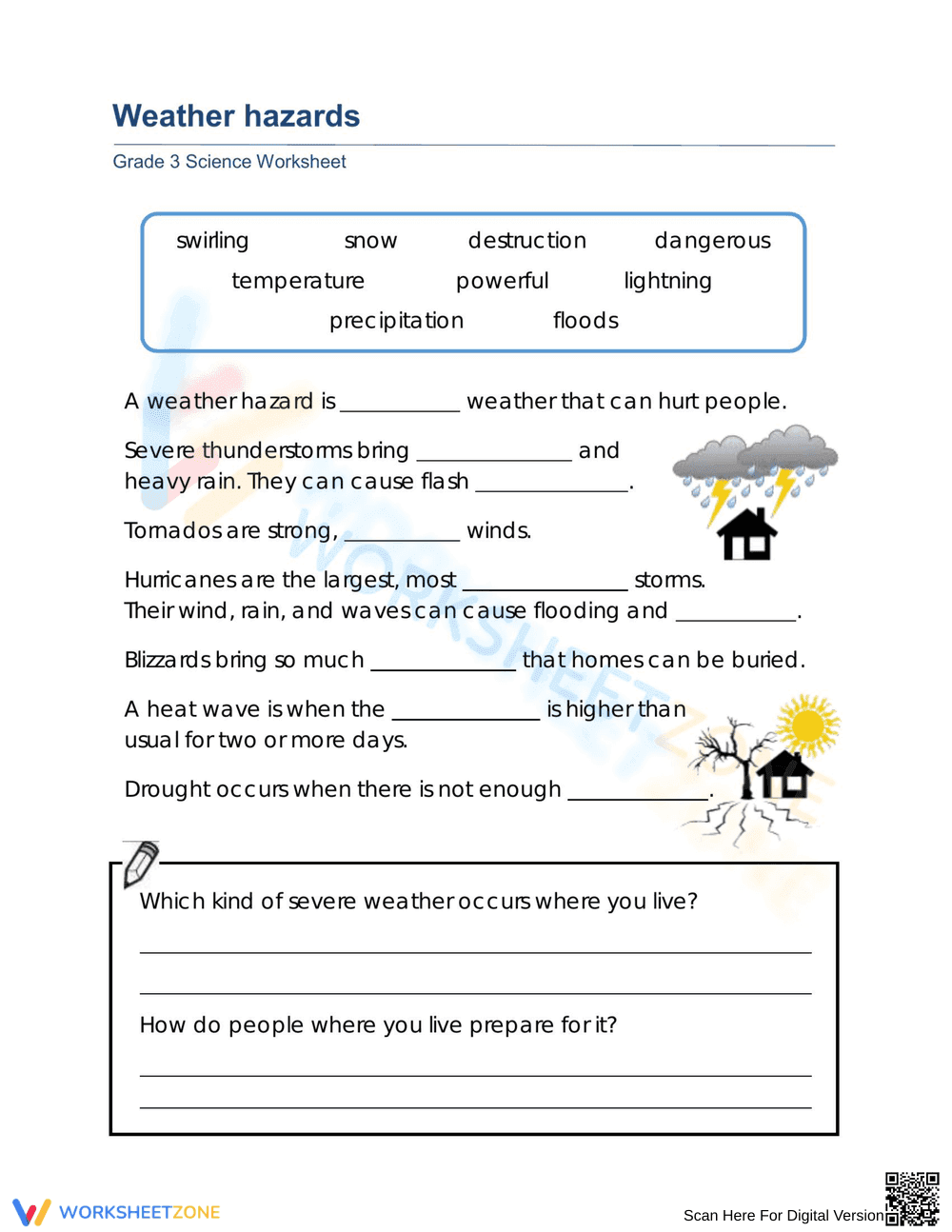

Weather Hazards Worksheet | Grade 3 Essential Science

Paste this activity's link or code into your existing LMS (Google Classroom, Canvas, Teams, Schoology, Moodle, etc.).
Students can open and work on the activity right away, with no student login required.
You'll still be able to track student progress and results from your teacher account.
Students identify the defining characteristics and impacts of severe weather events with this focused science worksheet. By connecting specific terminology to real-world hazards like blizzards and droughts, learners develop a foundational understanding of Earth's atmospheric systems and safety. This resource transitions from vocabulary reinforcement to critical thinking about local environmental contexts.
At a Glance
- Grade: 3 · Subject: Science
- Standard:
3-ESS3-1— Evaluate how weather-related hazards affect people and their surroundings- Skill Focus: Weather Hazard Identification
- Format: 2 pages · 11 problems · Answer key included · PDF
- Best For: Independent practice or quick sub plans
- Time: 15–20 minutes
This two-page PDF includes a comprehensive worksheet and a full-color answer key. The first page features nine fill-in-the-blank sentences supported by a curated word bank, covering tornadoes, blizzards, and heat waves. Below the vocabulary section, students engage with two open-ended reflection questions that prompt them to describe local weather hazards and personal preparation strategies, bridging the gap between theory and life experience.
The zero-prep workflow for this resource is designed for maximum efficiency. Print the single-sided worksheet in seconds. Distribute to students for independent work during a science block or as a morning warm-up. Finally, use the included answer key for rapid grading or whole-class review. Total teacher preparation time is less than two minutes, making it an ideal emergency sub plan or transition activity.
This resource is aligned to the Next Generation Science Standard 3-ESS3-1, which requires students to understand the impacts of weather-related hazards. By examining the causes and effects of various storms, students build the prerequisite knowledge needed to evaluate design solutions for hazard reduction. This standard code can be copied directly into lesson plans, IEP goals, or district curriculum mapping tools.
Use this worksheet as a formative assessment following a unit on Earth's systems or as a scaffolded review before a test. During instruction, observe how students map "swirling" to "tornadoes" or "precipitation" to "droughts" to gauge their grasp of meteorological terminology. The expected completion time is 20 minutes, allowing it to fit neatly into a 30-minute science rotation or as a homework assignment.
This worksheet is designed for third-grade students but serves as an excellent review for fourth graders or as an extension for advanced second graders. It naturally pairs with a weather-tracking project or an anchor chart detailing severe storm safety. The inclusion of a word bank provides essential support for English Language Learners and students with IEP accommodations while maintaining high academic standards.
The Grade 3 Weather Hazards worksheet targets cognitive domains in the NAEP Science Framework, focusing on Earth systems and human activity. Research by Fisher & Frey (2014) shows that structured vocabulary supports like word banks accelerate content acquisition. This worksheet moves from cloze sentences to reflective responses about local hazard preparation. By emphasizing the 3-ESS3-1 standard, it ensures students synthesize how environmental forces impact human infrastructure and safety. This design provides a rigorous entry point into the study of natural disasters, making it a valuable asset for elementary science curricula focused on atmospheric hazards and community resilience.


