


























Views
Downloads


Essential Weather Hazards Cause and Effect | Grade 3
Paste this activity's link or code into your existing LMS (Google Classroom, Canvas, Teams, Schoology, Moodle, etc.).
Students can open and work on the activity right away, with no student login required.
You'll still be able to track student progress and results from your teacher account.
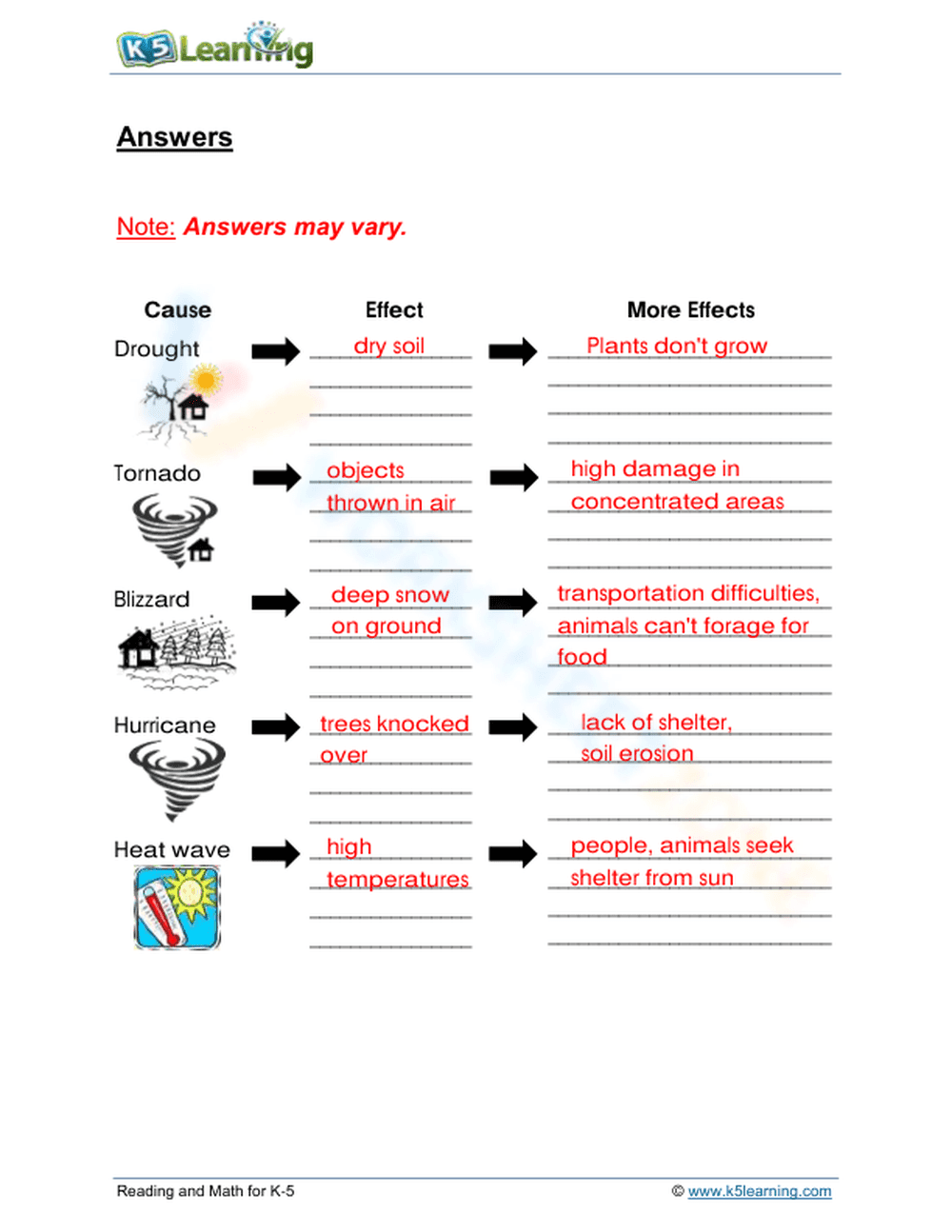
Students analyze the environmental and social impacts of extreme weather events with this Grade 3 science worksheet. By identifying primary and secondary effects for five different hazards, learners build a concrete understanding of how natural forces shape our world. This activity bridges the gap between scientific observation and real-world cause-and-effect reasoning.
At a Glance
- Grade: 3 · Subject: Science
- Standard:
3-ESS3-1— Make a claim about how design solutions reduce weather-related hazard impacts- Skill Focus: Weather Hazard Cause and Effect
- Format: 2 pages · 5 problems · Answer key included · PDF
- Best For: Independent practice or quick science checks
- Time: 15–20 minutes
This two-page resource features a structured graphic organizer where students process five specific weather hazards: droughts, tornadoes, blizzards, hurricanes, and heat waves. A complete worked example for lightning provides immediate scaffolding, demonstrating how to differentiate between immediate physical effects and broader community impacts. The second page contains a detailed answer key to streamline the grading process.
The zero-prep workflow is built for teacher efficiency. Print the worksheet in seconds. Distribute the materials for a twenty-minute independent session. Review the responses using the included answer key. Total teacher preparation time is under two minutes, making it an ideal choice for emergency sub plans or quick transitions.
This worksheet aligns directly with 3-ESS3-1, which requires students to evaluate the merit of solutions for weather hazards. By first mastering the "effect" side of the equation, students are better prepared to propose mitigation strategies. Both standard codes can be copied directly into lesson plans, IEP goals, or district curriculum mapping tools.
Use this as a formative assessment after a lesson on extreme weather. It works during the "independent practice" phase of the 5E model. Observe if students identify multiple effects, such as how blizzards impact transportation and animal survival. This provides a clear window into their conceptual depth.
The content is tailored for third-grade students but serves as an excellent review for fourth graders or a scaffolded introduction for second-grade enrichment. It pairs naturally with weather-themed informational texts or national weather service educational videos. For students needing more support, teachers can provide a word bank of potential effects to help jumpstart the brainstorming process.
The "Weather hazards cause and effect" worksheet provides a structured framework for achieving mastery of the 3-ESS3-1 standard. Research from the ScienceDirect TpT Analysis (2024) indicates that high-quality graphic organizers significantly improve retention of scientific relationships in elementary learners by reducing cognitive load. By isolating the cause-and-effect chain of severe weather, this resource allows students to visualize the multi-step consequences of natural disasters. This specific instructional design supports the development of critical thinking skills necessary for evaluating hazard mitigation strategies in later units. Providing students with 5 distinct scenarios ensures a breadth of understanding across different ecological contexts. The inclusion of a worked example further aligns with best practices for gradual release of responsibility. This resource serves as a reliable tool for classroom data collection and progress monitoring in science.


