


























Views
Downloads

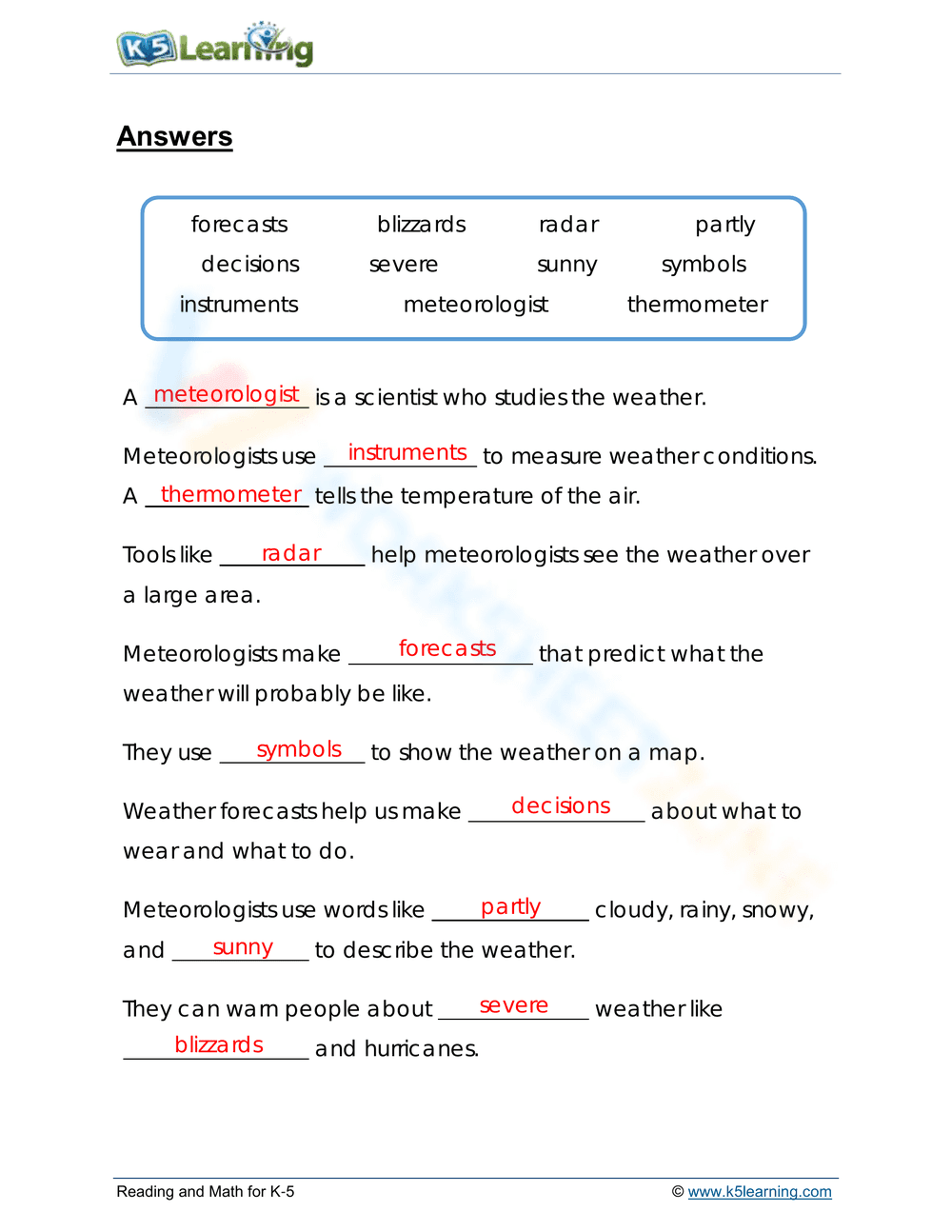

Grade 3 Weather Forecasting — Printable No-Prep Worksheet
Paste this activity's link or code into your existing LMS (Google Classroom, Canvas, Teams, Schoology, Moodle, etc.).
Students can open and work on the activity right away, with no student login required.
You'll still be able to track student progress and results from your teacher account.
Understanding how meteorologists predict the weather is an essential component of elementary earth science instruction. This Grade 3 weather forecasting worksheet helps students identify fundamental meteorological tools and terminology through a structured fill-in-the-blank format. Learners will explain how forecasts are created and how they influence daily human decisions.
At a Glance
- Grade: Grade 3 · Subject: Science
- Standard:
3-ESS2-1— Represent weather data to describe typical conditions expected during a season- Skill Focus: Meteorological tools and terminology
- Format: 2 pages · 10 problems · Answer key included · PDF
- Best For: Independent practice or quick formative assessment
- Time: 15–20 minutes
This resource features a clear activity page containing 10 targeted fill-in-the-blank questions. Students utilize a provided word bank featuring essential terms like meteorologist, instruments, thermometer, radar, and forecasts. The focused layout ensures that student attention remains on scientific concepts. A complete, color-coded answer key is provided for rapid grading or student self-correction.
Zero-Prep Workflow
This worksheet is designed for maximum efficiency in a busy classroom. You can print the student page in seconds, distribute it during a transition between subjects, and review the answers using the included key for immediate feedback. The total teacher prep time is under two minutes, making it an ideal choice for emergency sub plans or last-minute reinforcement of weather concepts.
Standards Alignment
The worksheet is aligned to `3-ESS2-1`, which requires students to represent data to describe typical weather conditions. By identifying tools like the thermometer and radar, students build the foundational knowledge necessary to interpret the data these instruments provide. This standard code can be copied directly into lesson plans, IEP goals, or district curriculum mapping tools.
How to Use It
Assign this worksheet after introducing weather patterns as a check for understanding. It helps learners distinguish between the tool (thermometer) and the professional (meteorologist). For a formative assessment observation, watch to see if students correctly pair the tool radar with the outcome of seeing weather over a large area. Completion typically takes 15 to 20 minutes.
Who It's For
This resource is tailored for third-grade students but also works for second-grade enrichment or fourth-grade review. The clear word bank and predictable sentence structures support English Language Learners in the science classroom. Pair this worksheet with a short video clip of a local weather forecast or a weather instrument anchor chart for a more comprehensive learning experience.
Effective earth science instruction at the elementary level relies on building a robust academic vocabulary and understanding the functional application of scientific tools. Research from EdReports 2024 emphasizes that high-quality science materials must explicitly connect specialized terminology to observable phenomena to ensure long-term retention. This Grade 3 worksheet aligns with these findings by requiring students to apply terms like thermometer, radar, and forecasts within the context of real-world meteorology. By bridging the gap between abstract terms and their practical use in predicting severe weather like blizzards and hurricanes, students develop a more sophisticated mental model of the atmosphere. Standard 3-ESS2-1 focuses on the representation of weather conditions, and this resource provides the prerequisite conceptual scaffolding for such analysis. Utilizing structured practice allows for the gradual release of responsibility, ensuring that students can eventually interpret complex weather maps and symbols independently in higher grade levels.


