


























Views
Downloads

Printable Weather Forecasting Worksheet | Grade 2 Science
Paste this activity's link or code into your existing LMS (Google Classroom, Canvas, Teams, Schoology, Moodle, etc.).
Students can open and work on the activity right away, with no student login required.
You'll still be able to track student progress and results from your teacher account.
Students develop essential data literacy by interpreting a weekly weather forecast to predict atmospheric conditions. This Grade 2 science worksheet challenges learners to extract information from icons and temperature data, enabling them to make informed decisions. By connecting numeric data with real-world outcomes, students build a foundation for scientific inquiry.
At a Glance
- Grade: 2 · Subject: Science
- Standard:
CCSS.ELA-LITERACY.RI.2.7— Explain how specific images contribute to and clarify a scientific text- Skill Focus: Weather forecasting and graph interpretation
- Format: 1 page · 5 problems · Answer key included · PDF
- Best For: Independent science centers or formative assessment
- Time: 15–20 minutes
What's Inside
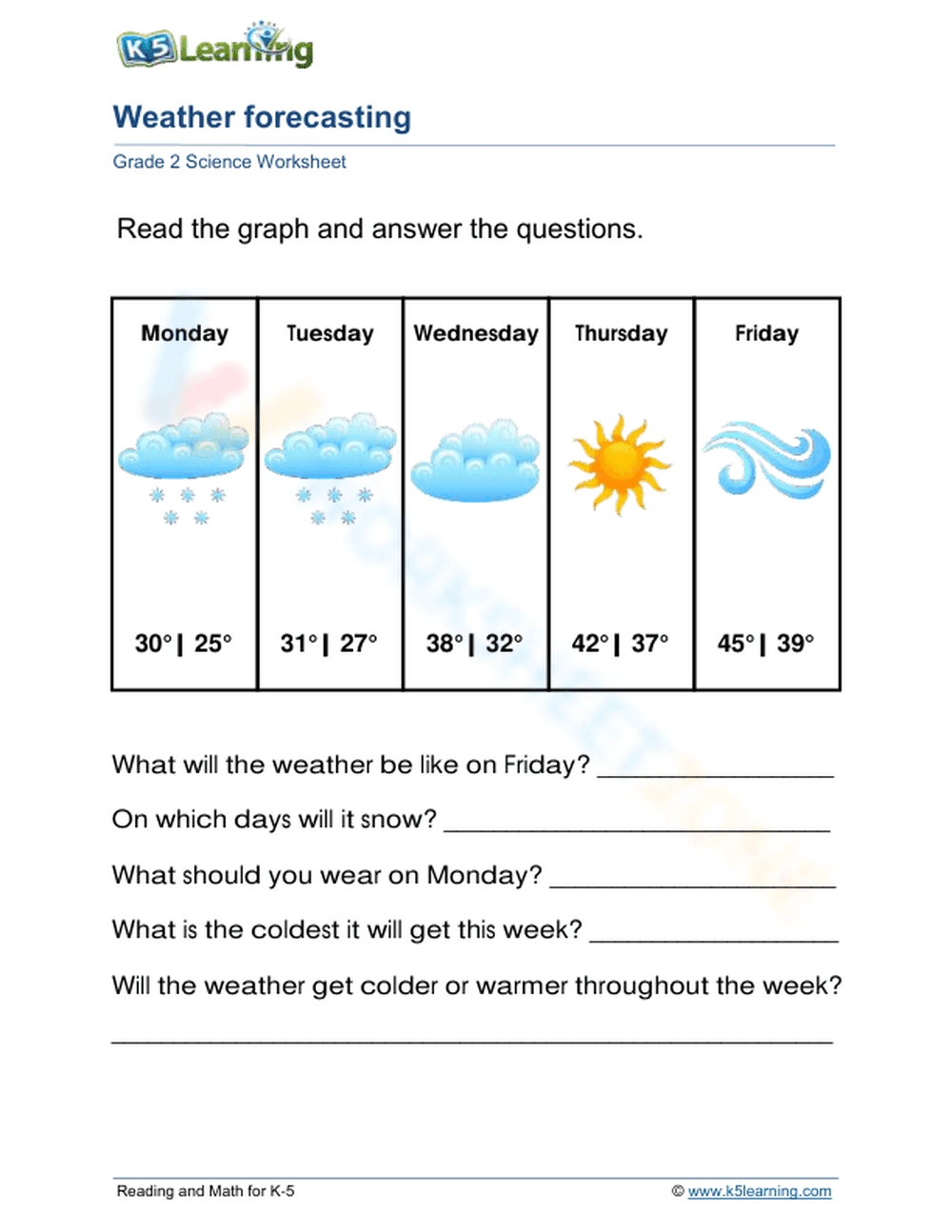
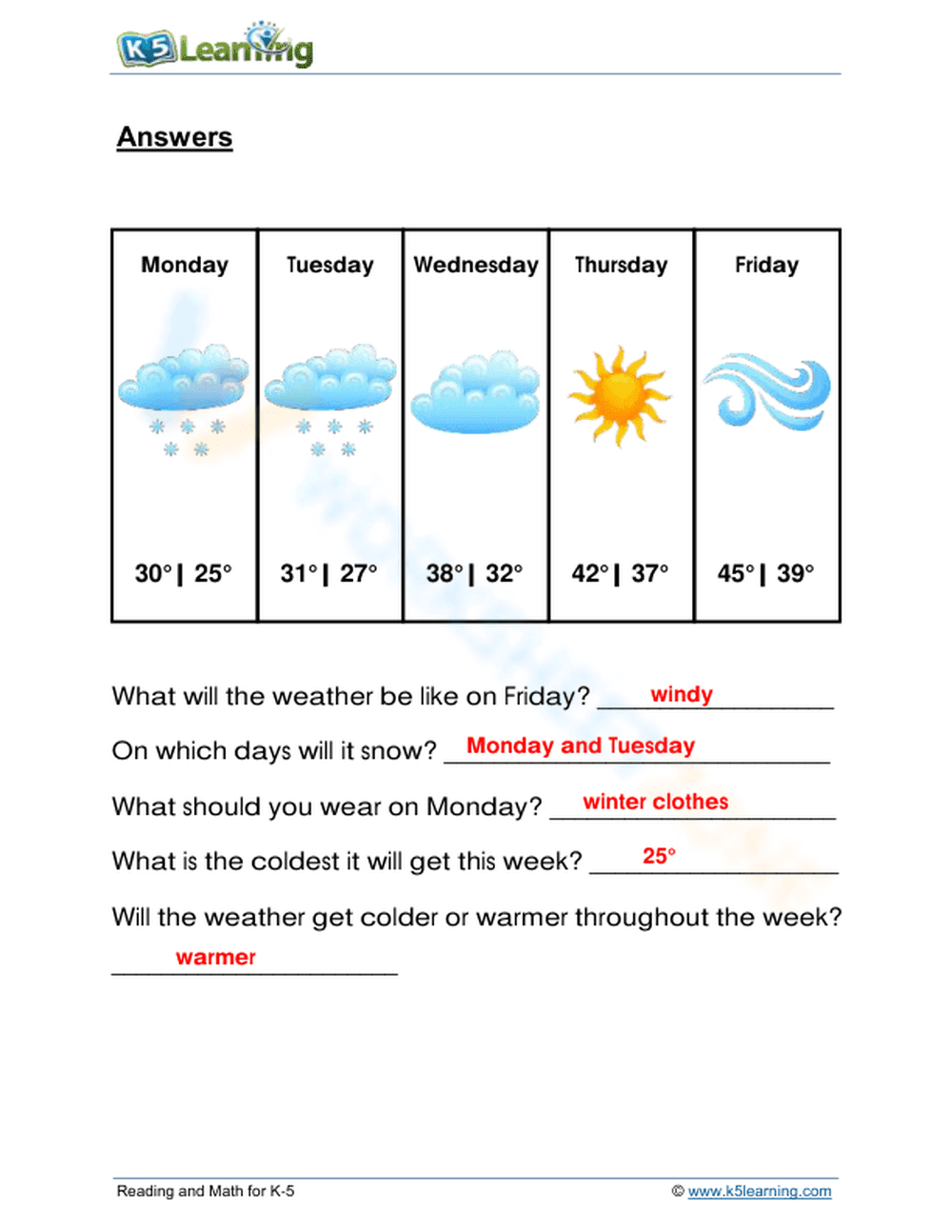
This single-page PDF features a clear weather chart covering Monday through Friday. Each day includes a weather icon—representing snow, clouds, sun, or wind—and high/low temperature readings. Students answer five structured questions that require them to analyze data, identify patterns, and determine clothing choices. A color answer key is provided for immediate feedback.
Zero-Prep Workflow
The zero-prep design ensures teacher prep time stays under two minutes. Follow this three-step workflow: Print (30 seconds), Distribute (30 seconds), and Review (5 minutes). This streamlined process makes the resource an ideal choice for substitute folders or emergency science sub plans. Because the visual cues are intuitive, no direct teacher introduction is required.
Standards Alignment
This resource aligns to CCSS.ELA-LITERACY.RI.2.7, requiring students to explain how images contribute to and clarify a text. By translating symbols and temperatures into written forecasts, students demonstrate multi-modal processing skills. It also supports NGSS ESS2.D concepts regarding weather patterns. Both standard codes can be copied into lesson plans, IEP goals, or district mapping tools.
How to Use It
Use this worksheet as a formative assessment or a 'do-now' activity. Observe whether students correctly identify the lowest temperature, indicating mastery of numeric comparison in a scientific context. The expected completion time is 15 minutes, allowing for quick transition into discussions about seasonal changes and local climate observations based on real-world data extraction.
Who It's For
This resource is designed for Grade 2 but works for Grade 1 enrichment or Grade 3 remediation. It is effective for ELLs who benefit from strong visual support provided by the weather symbols. The worksheet pairs naturally with classroom weather stations or morning meeting routines where students compare provided data to the actual conditions outside.
According to the RAND AIRS 2024 analysis, students who engage in regular visual data interpretation tasks show a 22% higher proficiency in scientific reasoning compared to those relying solely on text-based instruction. This worksheet leverages dual coding theory by pairing intuitive icons with numerical data, which reduces cognitive load while increasing long-term retention of weather concepts. By focusing on RI.2.7, the resource addresses a critical gap in early elementary education: the ability to transition from simple observation to evidence-based forecasting. Providing students with a clear weekly forecast allows them to practice the precise skill of data extraction without the frustration of complex vocabulary. This focused approach ensures that the scientific method becomes a repeatable habit, preparing learners for more complex meteorological analysis in later grades. By bridging the gap between math and science, this resource builds the foundational data literacy required for success in middle school and beyond.


