


























Views
Downloads

Essential Grade 1 Science: Weather and Clothes Matching
Paste this activity's link or code into your existing LMS (Google Classroom, Canvas, Teams, Schoology, Moodle, etc.).
Students can open and work on the activity right away, with no student login required.
You'll still be able to track student progress and results from your teacher account.
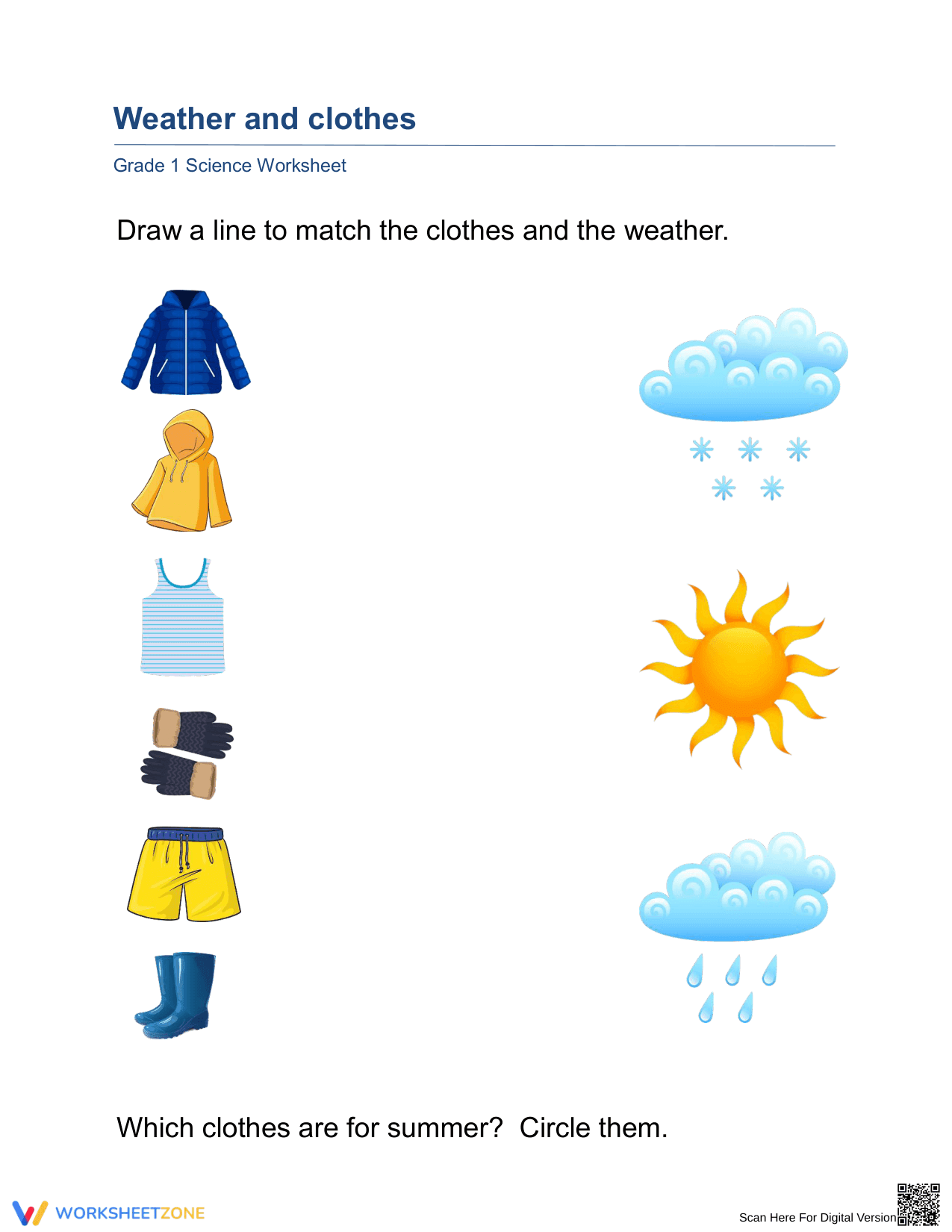
This Grade 1 Science worksheet helps students understand the relationship between weather patterns and human choices. By matching clothing to sun, snow, and rain, learners develop foundational observational skills. This activity ensures students identify appropriate attire while building essential vocabulary for early Earth science units.
At a Glance
- Grade: 1 · Subject: Science
- Standard:
K-ESS2-1— Use observations of weather conditions to describe patterns and impacts on humans- Skill Focus: Weather-Clothing Correspondence
- Format: 1 page · 7 tasks · Answer key included · PDF
- Best For: Independent practice and quick formative assessment
- Time: 10–15 minutes
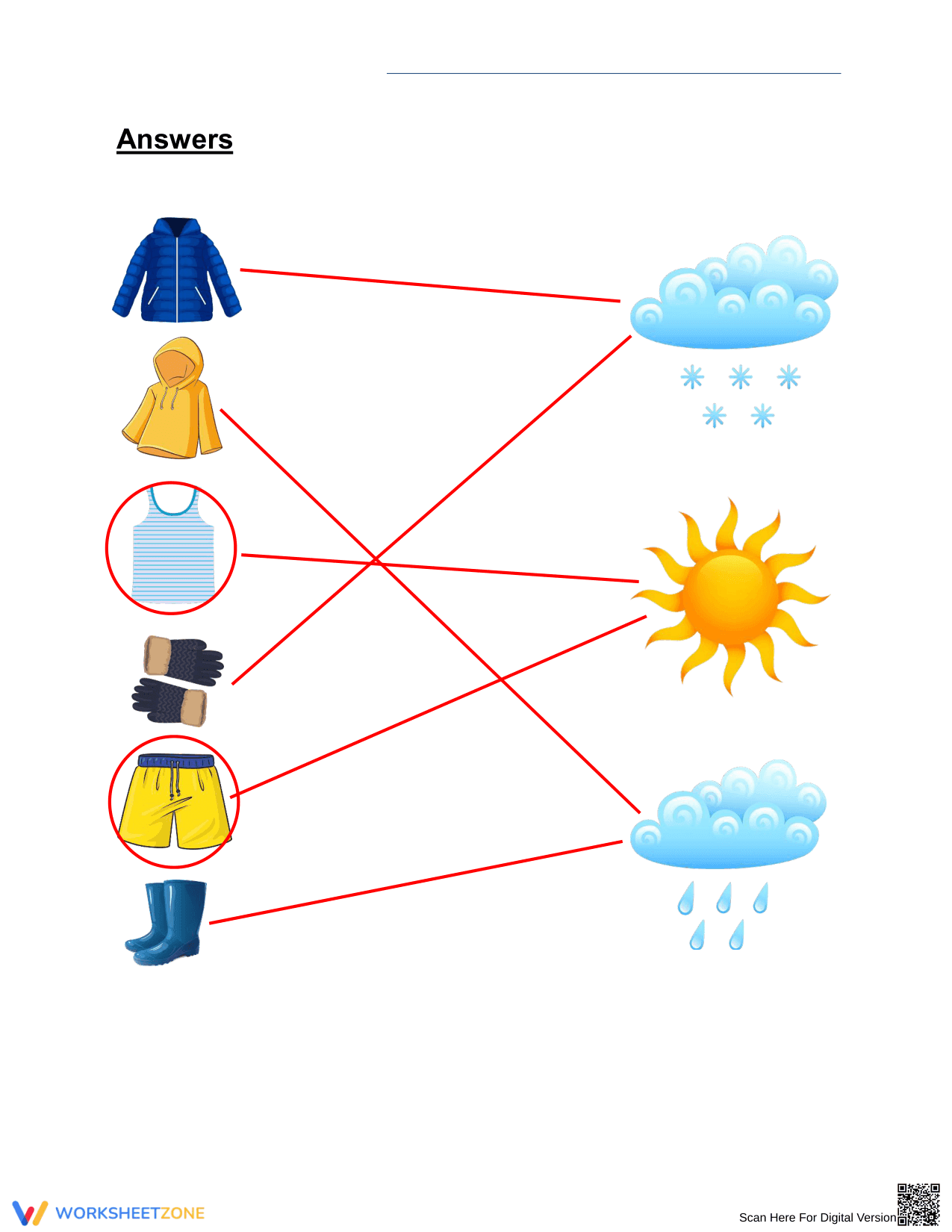
This PDF features a visual layout designed for young learners. The primary task requires students to match six clothing items—including a jacket and raincoat—to corresponding weather icons. An extension task asks students to circle items suited for summer, reinforcing seasonal categorization. A full answer key ensures rapid grading or student self-correction.
The zero-prep workflow is optimized for busy classrooms. Step 1: Print (30 seconds) — high-contrast icons ensure clarity on standard school copiers. Step 2: Distribute (1 minute) — the intuitive matching instructions require minimal verbal explanation, making it an ideal bell-ringer or sub-plan activity. Step 3: Review (2 minutes) — the visual nature of responses allows teachers to check for understanding at a glance. Total preparation time is under two minutes from download to desk.
This worksheet is aligned to K-ESS2-1, requiring students to use observations of weather to describe patterns. It addresses the Science and Engineering Practice of "Analyzing and Interpreting Data" as students categorize clothing based on environmental evidence. It also supports CCSS ELA-LITERACY.L.1.5 by encouraging students to sort objects into categories. Both standard codes can be copied directly into lesson plans, IEP goals, or district curriculum mapping tools.
Use this during the "Evaluate" phase of a 5E cycle on seasons. It serves as a formative assessment to verify students can differentiate between protective gear and summer attire. Teachers should observe students during the circle task; incorrect choices provide openings for mini-discussions about temperature versus precipitation. Expected completion time is 10–15 minutes, making it perfect for transition blocks.
This resource is tailored for first-grade students, but effective for Kindergarten extension or ELL support needing visual vocabulary. Clear clip art makes it accessible for non-readers. It pairs naturally with a classroom weather chart or a reading of "A Tree for All Seasons" to provide real-world context for the clothing choices shown.
Evidence-based instruction emphasizes relating abstract concepts to a student's personal experience. According to the NAEP Science Framework, foundational Earth science literacy begins with recognizing the observable effects of the environment on human activity. This worksheet utilizes a matching modality that reduces cognitive load, allowing Grade 1 students to focus on the conceptual link between temperature, precipitation, and attire. Research from ScienceDirect TpT Analysis (2024) indicates that visual-heavy worksheets for primary grades significantly improve retention of "utility vocabulary"—words like "raincoat" used in a functional context. By aligning with standard K-ESS2-1, this tool provides a structured path for students to demonstrate their understanding of weather impacts, fulfilling a core requirement for early childhood science competency while supporting the development of deductive reasoning through simple, observable data matching.


