


























Views
Downloads

Wario and Waluigi Word Search | Printable Grade 3
Paste this activity's link or code into your existing LMS (Google Classroom, Canvas, Teams, Schoology, Moodle, etc.).
Students can open and work on the activity right away, with no student login required.
You'll still be able to track student progress and results from your teacher account.
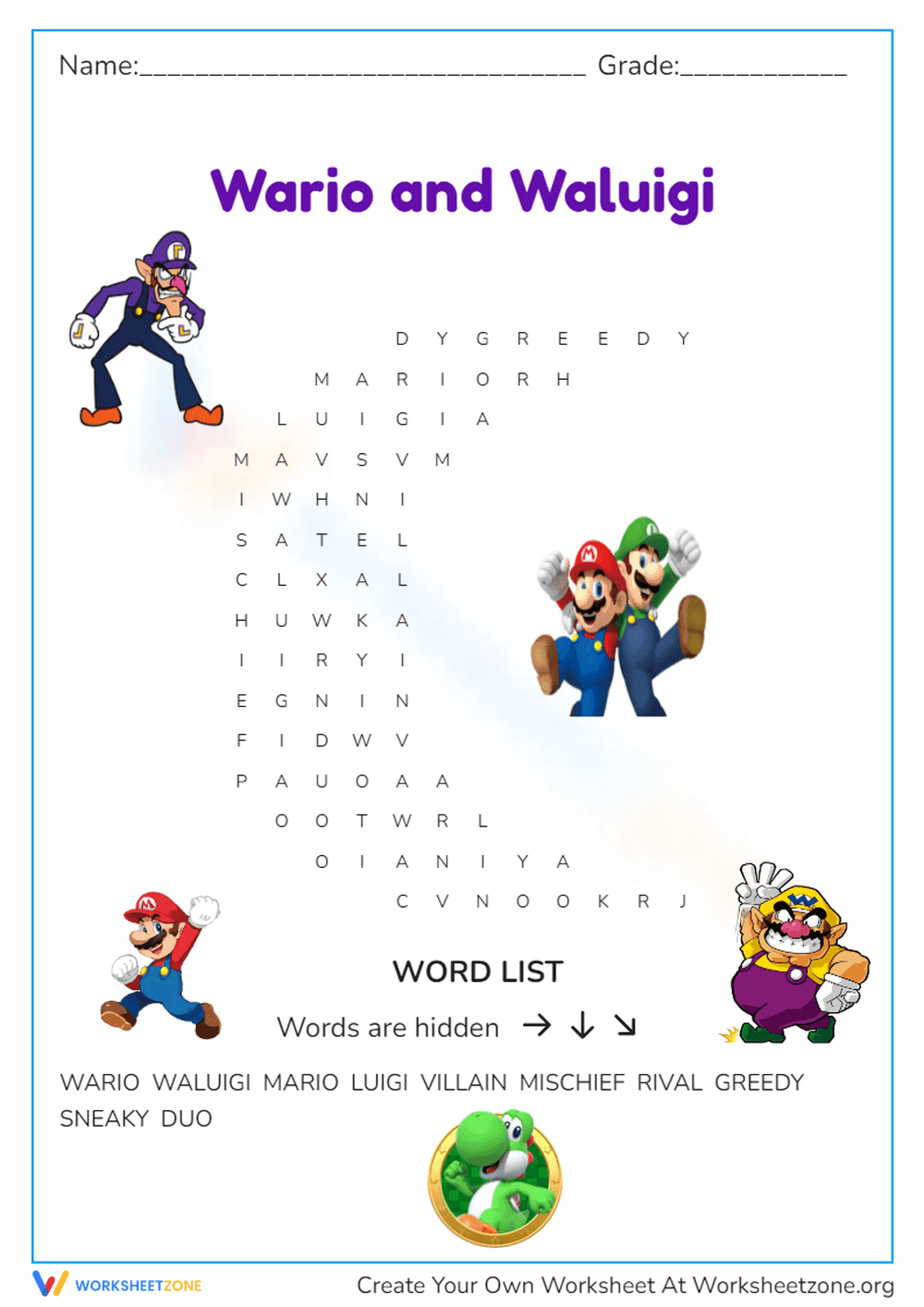
This engaging word search worksheet helps students practice spelling and visual scanning by finding vocabulary related to popular video game characters. By searching for ten specific terms, learners reinforce letter recognition and word formation in a fun, familiar context.
At a Glance
- Grade: 3 · Subject: ELA
- Standard:
CCSS.ELA-LITERACY.L.3.2.E— Use conventional spelling for studied words- Skill Focus: Vocabulary and Spelling
- Format: 1 page · 10 problems · PDF
- Best For: Independent practice or early finishers
- Time: 10–15 minutes
Inside this single-page resource, educators will find a themed word search puzzle featuring beloved characters like Wario, Waluigi, Mario, and Luigi. The worksheet includes a clear word bank with ten target vocabulary words, such as "mischief," "villain," and "greedy." Students must locate the words hidden horizontally, vertically, and diagonally, providing a straightforward and entertaining spelling challenge.
Zero-Prep Workflow
- Print (1 minute): Simply download the PDF and print the required number of copies. No special materials or color ink are strictly necessary, though the character graphics are vibrant.
- Distribute (1 minute): Hand out the worksheets to students during transition times, morning work, or as a reward activity.
- Review (3 minutes): Quickly check completed puzzles using the word bank as a reference. Total teacher prep time is under two minutes, making this an excellent addition to any emergency sub plan.
This activity aligns with CCSS.ELA-LITERACY.L.3.2.E, requiring students to use conventional spelling for high-frequency and other studied words. By repeatedly scanning for correct letter sequences, learners reinforce their internal spelling models. Both standard codes can be copied directly into lesson plans, IEP goals, or district curriculum mapping tools.
This worksheet serves as an excellent morning work assignment to settle students before direct instruction begins. Alternatively, it functions perfectly as an early finisher activity during longer ELA blocks. While students work, teachers can observe their visual tracking skills and ability to identify correct letter patterns. Expect most third graders to complete the puzzle within a 10 to 15-minute time range.
This resource is ideal for primary grade students who benefit from high-interest, gamified learning materials. It naturally supports learners who need extra practice with focus and visual discrimination. Pair this word search with a creative writing prompt where students write a short story using at least five words from the provided word bank.
Integrating high-interest themes into foundational literacy tasks significantly boosts student engagement and time-on-task across elementary grades. This worksheet targets CCSS.ELA-LITERACY.L.3.2.E, helping students use conventional spelling for studied words through active visual scanning and letter recognition. According to Fisher & Frey (2014), providing students with familiar, culturally relevant contexts—such as popular video game characters like Mario and Luigi—lowers the affective filter and encourages persistence in repetitive tasks like spelling practice. When learners search for challenging words like "mischief" and "villain," they are not merely playing a game; they are repeatedly exposing themselves to correct orthographic patterns, which solidifies their spelling accuracy and vocabulary retention over time. This targeted repetition within a low-stakes, enjoyable format ensures that foundational literacy skills are reinforced without causing cognitive fatigue, making it a highly effective instructional tool for diverse classrooms and varying ability levels.


