


























Views
Downloads
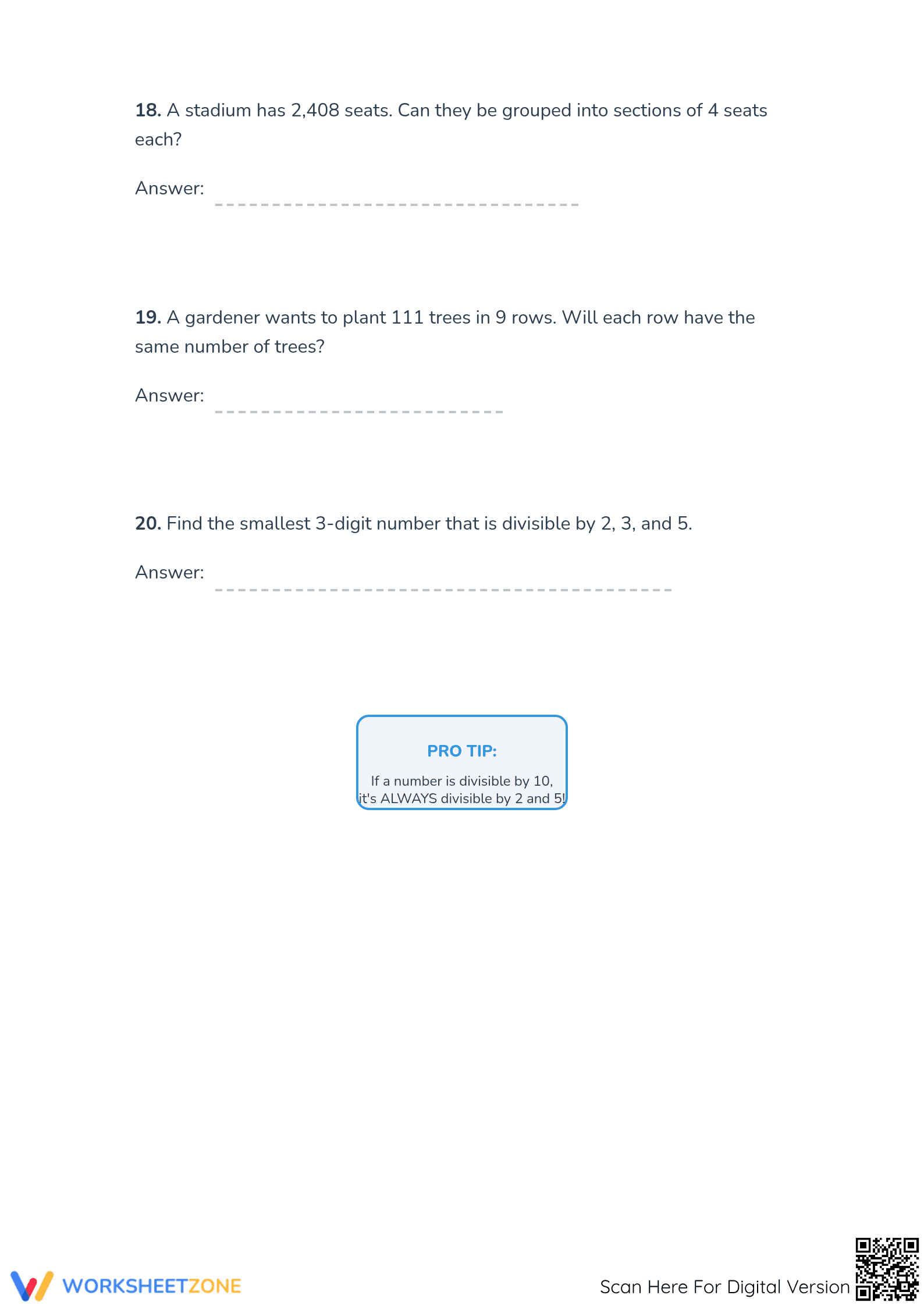

Printable Divisibility Rules Worksheet | Grade 5 Math
Paste this activity's link or code into your existing LMS (Google Classroom, Canvas, Teams, Schoology, Moodle, etc.).
Students can open and work on the activity right away, with no student login required.
You'll still be able to track student progress and results from your teacher account.
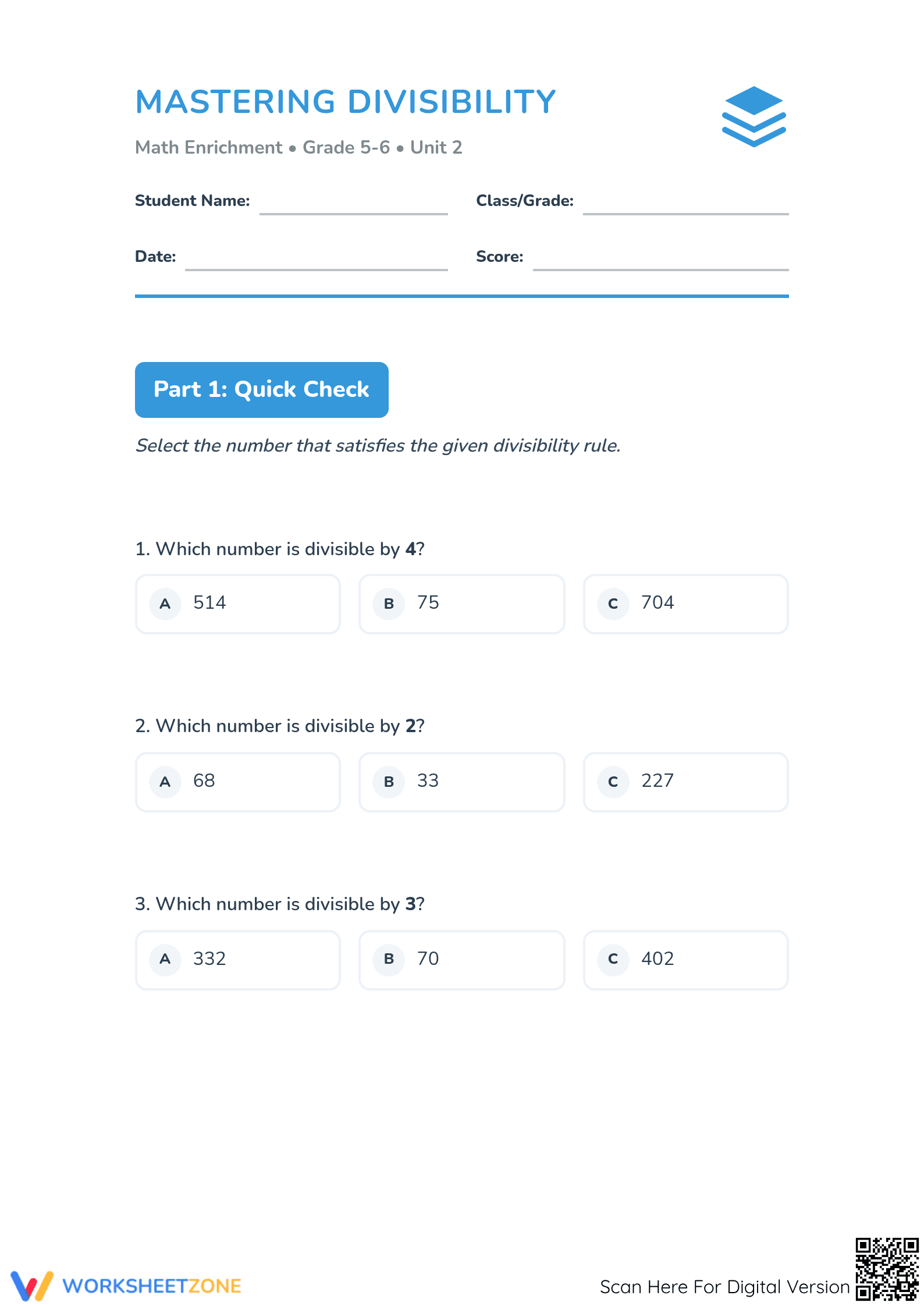
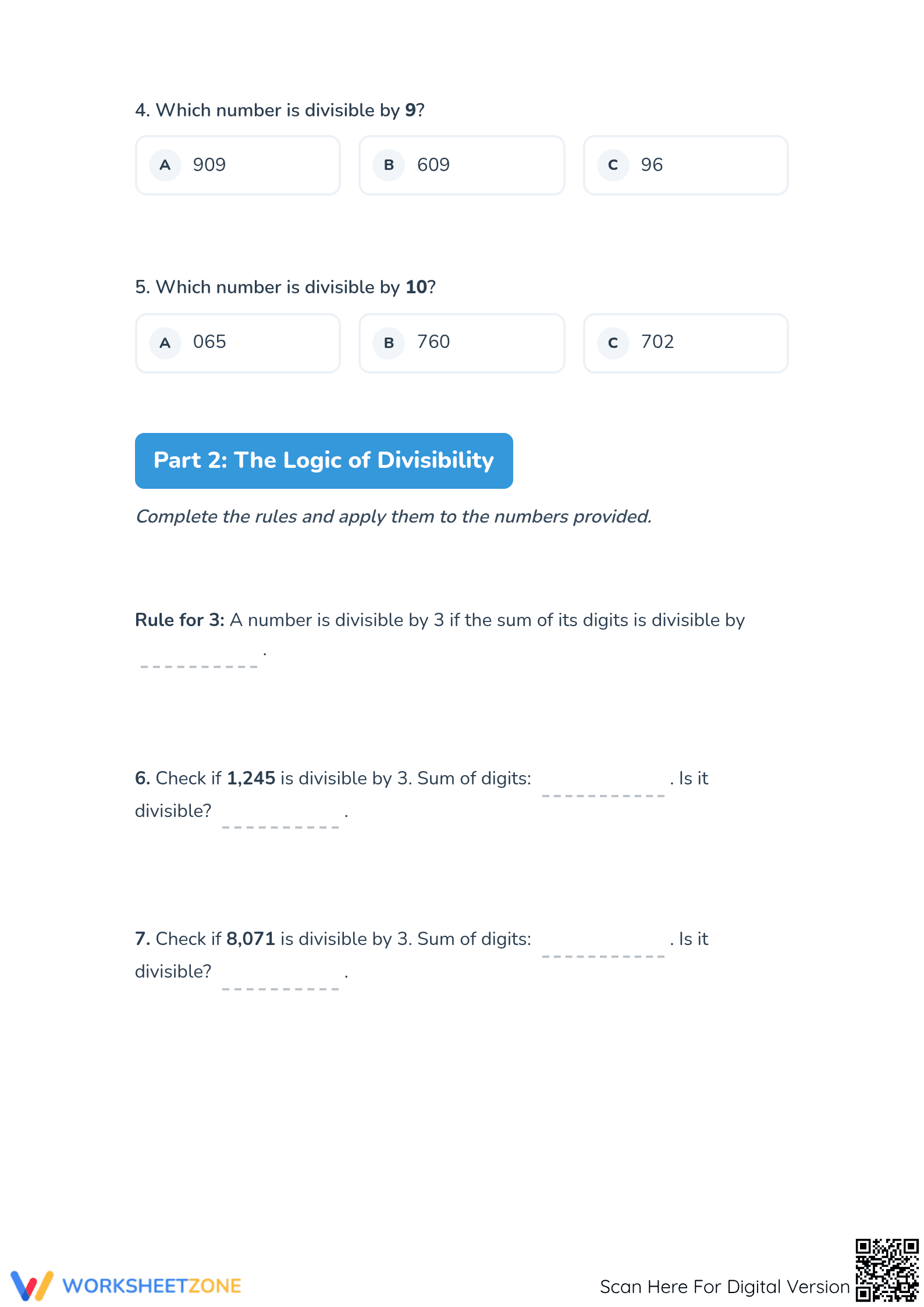
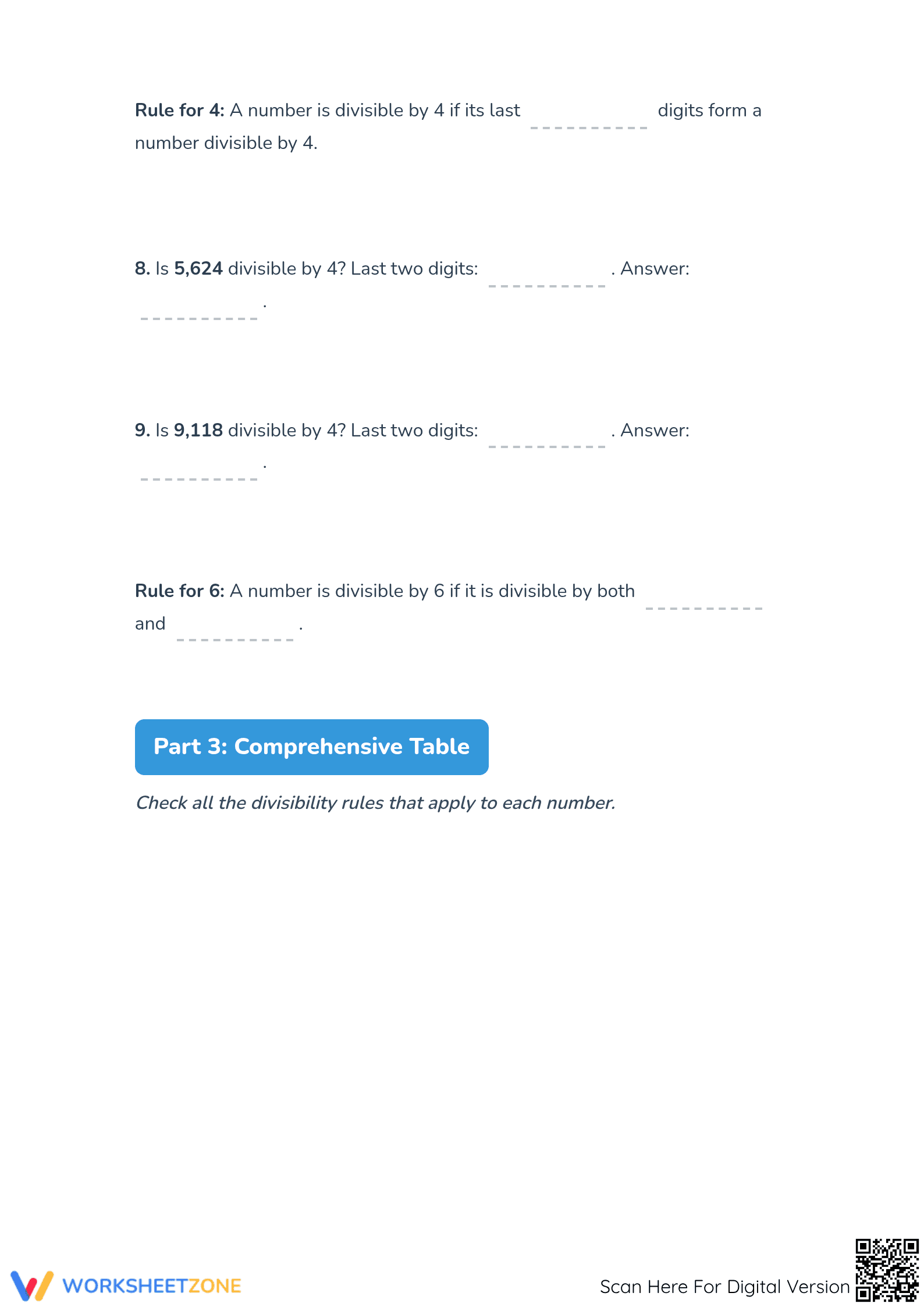
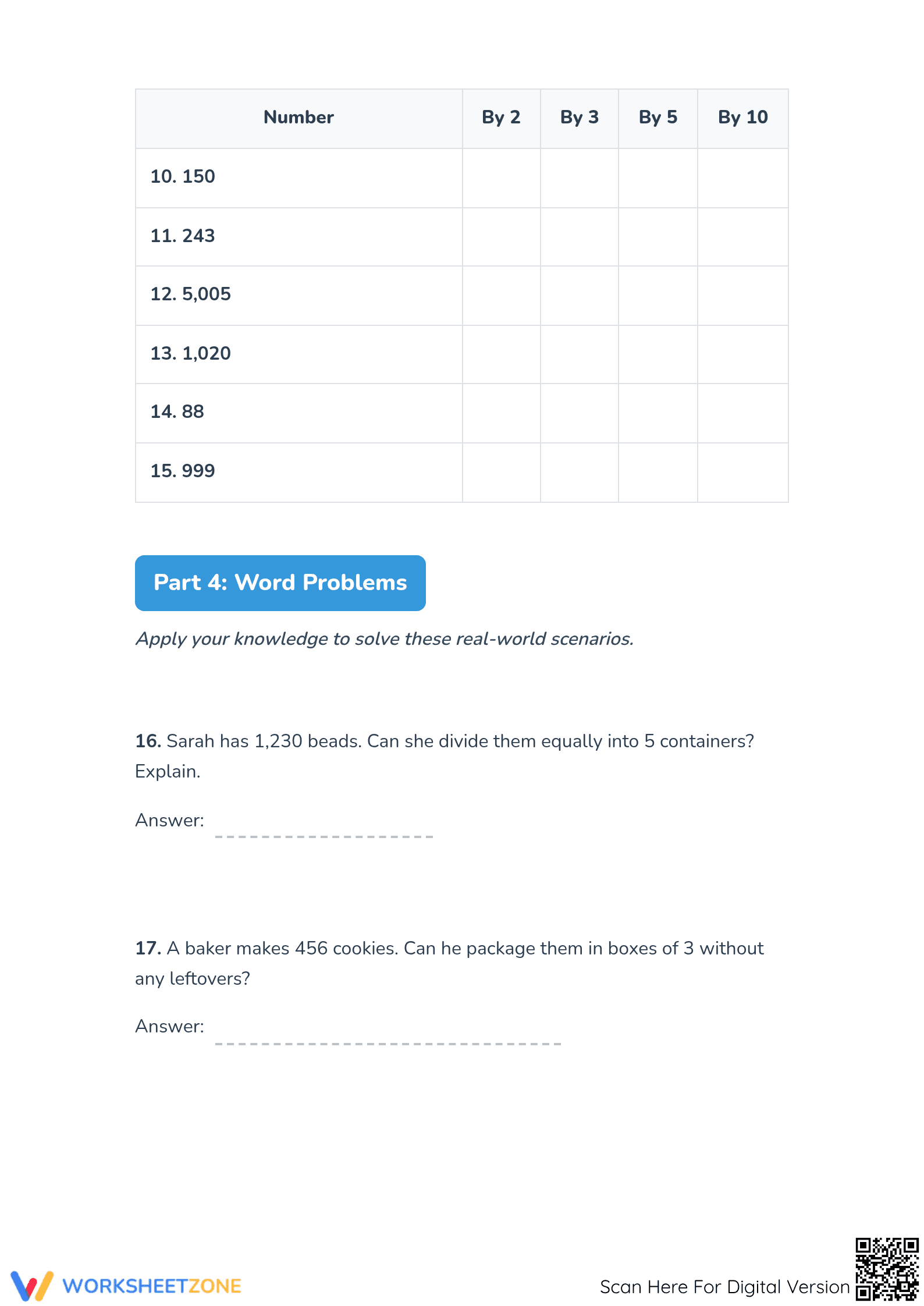
This Grade 5 divisibility rules worksheet helps students quickly determine if numbers are divisible by 2, 3, 4, 5, 6, 9, or 10 without performing long division. By mastering these mental shortcuts, learners improve division fluency and number sense, building confidence for complex multi-step problems. Students learn to identify factors efficiently using proven numerical strategies.
At a Glance
- Grade: 5 · Subject: Math
- Standard:
CCSS.MATH.CONTENT.5.NBT.B.6— Find whole-number quotients of whole numbers with up to four-digit dividends- Skill Focus: Divisibility Rules
- Format: 5 pages · 45 problems · Answer key included · PDF
- Best For: Independent practice or small group review
- Time: 30–45 minutes
What's Inside
This comprehensive 5-page resource includes detailed rule charts followed by structured practice sets. Students encounter 45 problems ranging from basic identification to complex factor analysis. The PDF format includes a complete answer key for rapid checking and self-assessment, ensuring students can work through the Week 6 curriculum independently. It is perfect for both classroom use and home learning environments.
Zero-Prep Workflow
The zero-prep workflow for this worksheet is designed for maximum teacher efficiency. First, print the 5-page set (30 seconds). Second, distribute the packets to students for independent work (1 minute). Third, use the included answer key to review responses in real-time or as a final check (1 minute). Total teacher preparation time is under two minutes, making this an ideal choice for busy mornings or sub-plan suitability.
Standards Alignment
Aligned to CCSS.MATH.CONTENT.5.NBT.B.6, this resource focuses on quotients and strategies based on the relationship between multiplication and division. Divisibility rules serve as a foundational strategy for identifying factors of multi-digit numbers. Both standard codes can be copied directly into lesson plans, IEP goals, or district curriculum mapping tools, ensuring full alignment with national educational frameworks and assessment goals.
How to Use It
Use this worksheet during the guided practice phase of a lesson or as a follow-up to direct instruction. It works exceptionally well as a formative assessment tool; observe how students apply the sum of digits rule for 3 and 9 to identify areas where they may need help with mental addition. Students typically complete the packet within 30 to 45 minutes, providing a clear window into their division proficiency.
Who It's For
Primarily designed for Grade 5 students, this material also serves as an excellent Grade 4 extension or Grade 6 remediation tool. It supports diverse learners by providing clear, visual rules before asking for independent application. This worksheet pairs naturally with a division anchor chart or a short lesson on prime factorization, helping students connect mental math strategies to broader mathematical concepts.
According to the RAND AIRS 2024 report on mathematics instructional materials, the use of explicit strategy instruction—such as divisibility rules—significantly enhances student ability to navigate complex division tasks by reducing cognitive load. This worksheet focuses on the standard code CCSS.MATH.CONTENT.5.NBT.B.6, providing students with the mental frameworks necessary to identify factors and quotients efficiently. By practicing with these rules, learners develop a more robust number sense, which is a key predictor of success in middle school algebra. The resource translates technical standards into plain-English student actions, such as identifying if a number is even to determine divisibility by 2. This alignment ensures that classroom practice directly contributes to the mastery of state and national frameworks. Educators can rely on this structured approach to provide the repetitive practice required for fluency while maintaining a high level of engagement through clear, actionable tasks. This resource is essential for any Grade 5 curriculum focused on numerical operations.


