


























Views
Downloads
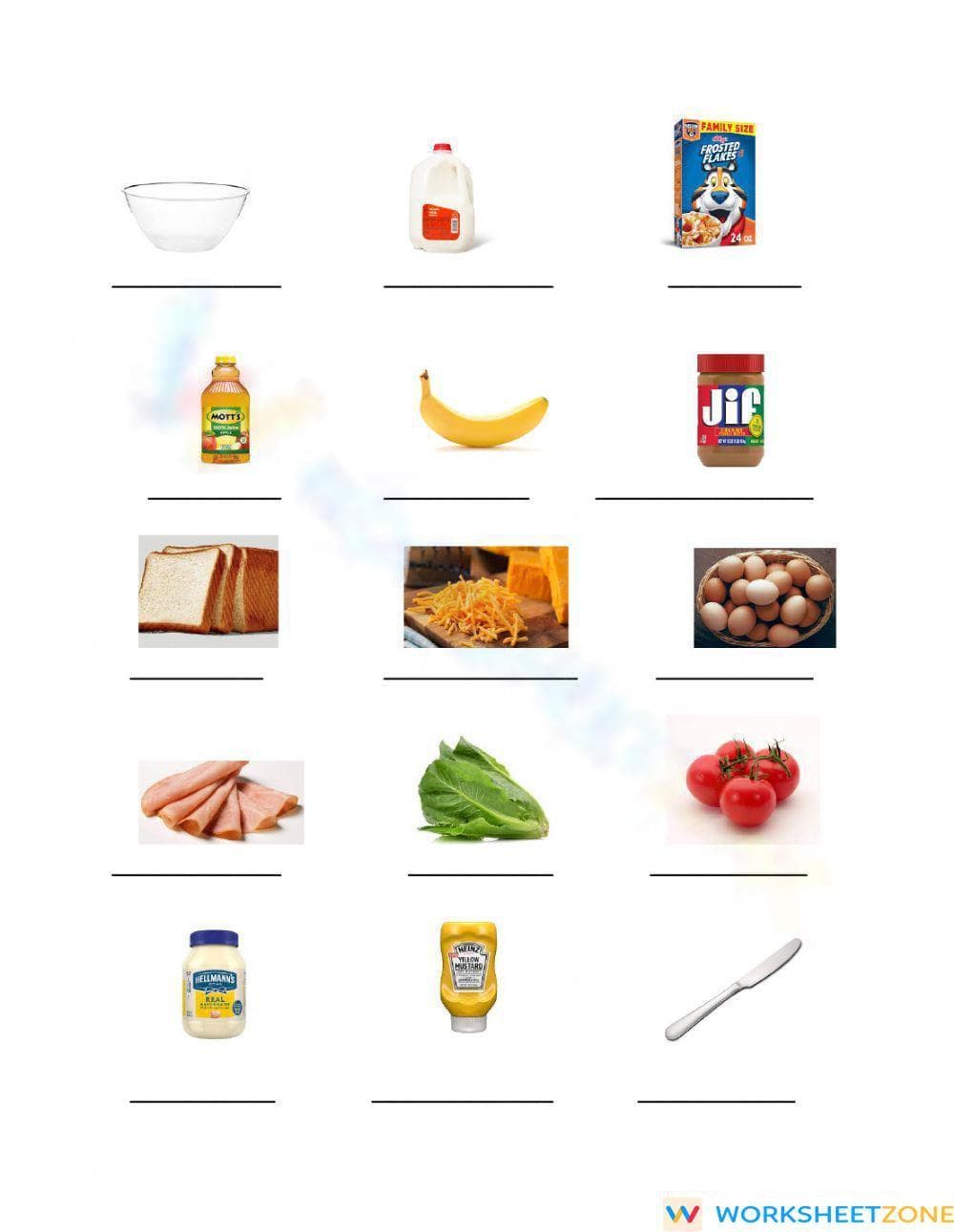

Grade 3 Food Vocabulary — Printable No-Prep Worksheet
Paste this activity's link or code into your existing LMS (Google Classroom, Canvas, Teams, Schoology, Moodle, etc.).
Students can open and work on the activity right away, with no student login required.
You'll still be able to track student progress and results from your teacher account.
Identifying and spelling common food words is the core focus of this Grade 3 ELA worksheet, which empowers students to master 15 essential household nouns. By connecting visual cues with written language, learners strengthen their lexical retrieval and orthographic skills. This resource is perfect for daily warm-ups, ELL support, or independent vocabulary practice during English Language Arts rotations.
At a Glance
- Grade: 3 · Subject: English Language Arts
- Standard:
CCSS.ELA-LITERACY.L.3.2— Demonstrate command of the conventions of standard English spelling when writing- Skill Focus: Food and Kitchen Vocabulary
- Format: 1 page · 15 problems · Answer key included · PDF
- Best For: Zero-prep vocabulary practice and spelling drills
- Time: 10–15 minutes
This single-page PDF features 15 high-quality photographic images of common food and kitchen items, such as milk, eggs, bread, and peanut butter. Beneath each image, a clear horizontal line provides ample space for students to write the corresponding word. The clean, uncluttered layout is highly accessible for diverse learners, including those in special education or English Language Learner (ELL) programs.
Implementing this worksheet requires zero lead time. Follow these three simple steps: Print the document in under 30 seconds, distribute copies to students in one minute, and review the 15 answers together in five minutes. This predictable format makes it an ideal "grab-and-go" resource for substitute folders or emergency lesson plans when teacher preparation time is under two minutes.
Aligned to `CCSS.ELA-LITERACY.L.3.2`, this activity requires students to demonstrate command of the conventions of standard English spelling when writing common words. By identifying the object and producing the correct spelling, students engage with foundational language standards. This standard code can be copied directly into lesson plans, IEP goals, or district curriculum mapping tools.
Use this worksheet during the "Independent Practice" phase of a vocabulary lesson to assess student recognition of everyday nouns. Alternatively, assign it as a quick morning work task to settle the class while taking attendance. A great formative-assessment tip is to observe whether students struggle more with the phonemic identification of the object or the specific orthographic spelling patterns of the words.
This resource is designed for Grade 3-6 students who need targeted practice in functional vocabulary and spelling. It is particularly effective for students in Special Education settings who benefit from clear visual prompts and ELL students building their basic English lexicon. Pair this worksheet with a "Kitchen Scavenger Hunt" or a "Healthy Eating" reading passage for a comprehensive thematic unit.
According to Fisher & Frey (2014), visual scaffolds in vocabulary acquisition significantly improve retention rates for Tier 1 words. This worksheet utilizes high-frequency food vocabulary aligned to `CCSS.ELA-LITERACY.L.3.2`, ensuring students build foundational spelling skills necessary for complex writing tasks. Research from the NAEP highlights that consistent practice with common nouns helps bridge the gap between oral recognition and written production. By providing 15 visual stimuli, this resource encourages students to generalize spelling knowledge across various categories. The straightforward "see and write" mechanism reduces cognitive load, allowing learners to focus exclusively on the targeted skill of accurate orthography. This task is essential for establishing the lexical base required for Grade 3 ELA mastery. It serves as a foundational tool for literacy development across multiple grade levels.


