


























Views
Downloads
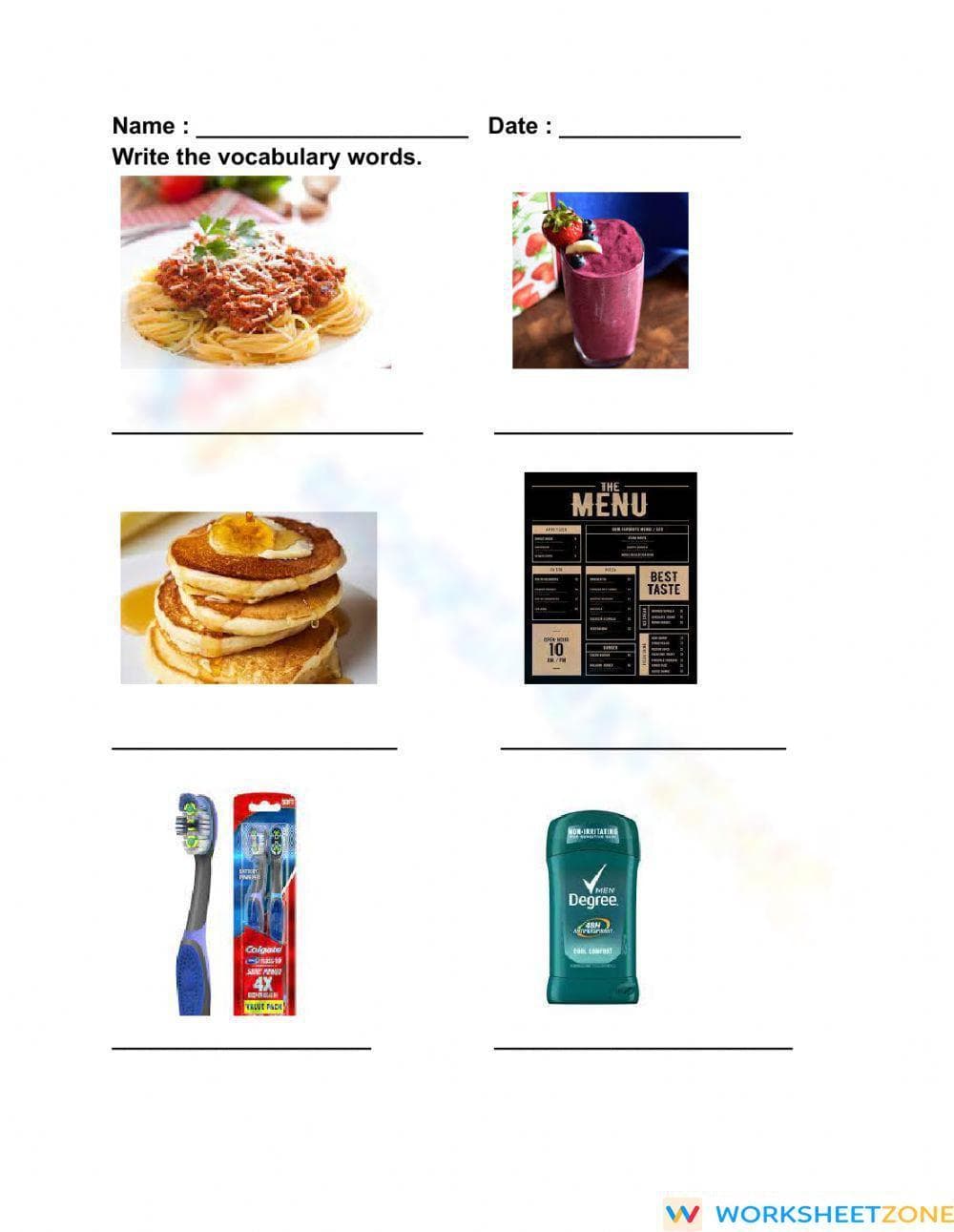


Grades 3-6 Everyday Vocabulary — Printable No-Prep Worksheet
Paste this activity's link or code into your existing LMS (Google Classroom, Canvas, Teams, Schoology, Moodle, etc.).
Students can open and work on the activity right away, with no student login required.
You'll still be able to track student progress and results from your teacher account.
Identify everyday objects and master spelling with this comprehensive vocabulary practice tool. This worksheet helps students bridge the gap between visual recognition and written expression by focusing on common household and food items. Students will strengthen their mental lexicon through direct association with clear, recognizable imagery.
At a Glance
- Grade: 3-6 · Subject: English Language Arts
- Standard:
CCSS.ELA-LITERACY.L.3.6— Acquire and use accurately grade-appropriate conversational and general academic words- Skill Focus: Everyday object identification and spelling
- Format: 2 pages · 11 problems · Answer key included · PDF
- Best For: Independent practice or vocabulary assessment
- Time: 15–20 minutes
What's Inside
This resource features two pages containing eleven high-quality visual prompts designed to stimulate immediate word recall. The selection includes varied categories such as food (spaghetti, smoothies, pancakes), everyday tools (toothbrush, deodorant), and household appliances (microwave). Each image is paired with a distinct horizontal line to ensure organized and legible student responses.
Zero-Prep Workflow
This worksheet is designed for immediate classroom integration with three simple steps: 1. Print the two-page document (30 seconds), 2. Distribute to your students (1 minute), and 3. Review the answers using the provided key (5 minutes). The total teacher preparation time is under two minutes, making this an ideal solution for emergency sub plans or quick morning work sessions.
Standards Alignment
This resource is meticulously aligned with CCSS.ELA-LITERACY.L.3.6, which requires students to acquire and use accurately grade-appropriate conversational and general academic words. By focusing on concrete nouns and their correct orthography, the activity supports foundational literacy goals across the intermediate grades. Both standard codes can be copied directly into lesson plans, IEP goals, or district curriculum mapping tools.
How to Use It
Deploy this worksheet as a bell-ringer activity to activate prior knowledge at the start of an ELA block. Alternatively, use it as a formative exit ticket to assess spelling accuracy after a unit on functional vocabulary. Teachers should observe whether students can identify specific items like the "smoothie" or "microwave" correctly, using these observations to guide future vocabulary instruction.
Who It's For
This practice is specifically tailored for students in grades 3 through 6, including English Language Learners (ELL) and special education students who benefit from concrete visual supports. The clear layout prevents overstimulation, making it accessible for diverse learners. It pairs naturally with an "Objects Around the House" anchor chart or a descriptive writing lesson.
Aligned to CCSS.ELA-LITERACY.L.3.6, this worksheet facilitates the acquisition of conversational and general academic words. Fisher & Frey (2014) emphasize the importance of visual-to-verbal transitions in vocabulary development, noting that concrete noun identification serves as a foundational layer for more complex linguistic structures. This resource provides 11 targeted tasks that reinforce spelling through visual association, ensuring students build a robust mental lexicon of high-frequency objects. By providing clear, isolated images, the worksheet minimizes cognitive load while maximizing focus on orthographic accuracy. Educators can utilize this assessment to identify gaps in basic functional vocabulary and spelling patterns. The structured format ensures that students spend more time practicing and less time interpreting complex instructions, leading to higher rates of task completion and skill retention. Furthermore, the use of realistic photography instead of abstract clip art provides authentic context that is essential for real-world application, a strategy supported by ScienceDirect TpT Analysis of successful instructional designs.


