


























Views
Downloads



Essential Cooking Verbs Worksheet | Grade 10 ELA
Paste this activity's link or code into your existing LMS (Google Classroom, Canvas, Teams, Schoology, Moodle, etc.).
Students can open and work on the activity right away, with no student login required.
You'll still be able to track student progress and results from your teacher account.
This comprehensive vocabulary worksheet focuses on essential cooking verbs, providing tenth-grade students with high-utility domain-specific language practice. By engaging with unscrambling tasks, sentence completion, and recipe reconstruction, learners solidify their understanding of technical culinary terms. This resource ensures students can accurately use and identify cooking actions in real-world contexts and academic reading materials.
At a Glance
- Grade: 10 · Subject: ELA
- Standard:
CCSS.ELA-LITERACY.L.9-10.6— Acquire and use domain-specific words and phrases accurately in context- Skill Focus: Cooking verbs and functional vocabulary
- Format: 3 pages · 33 problems · Answer key included · PDF
- Best For: Functional literacy and technical writing units
- Time: 25–35 minutes
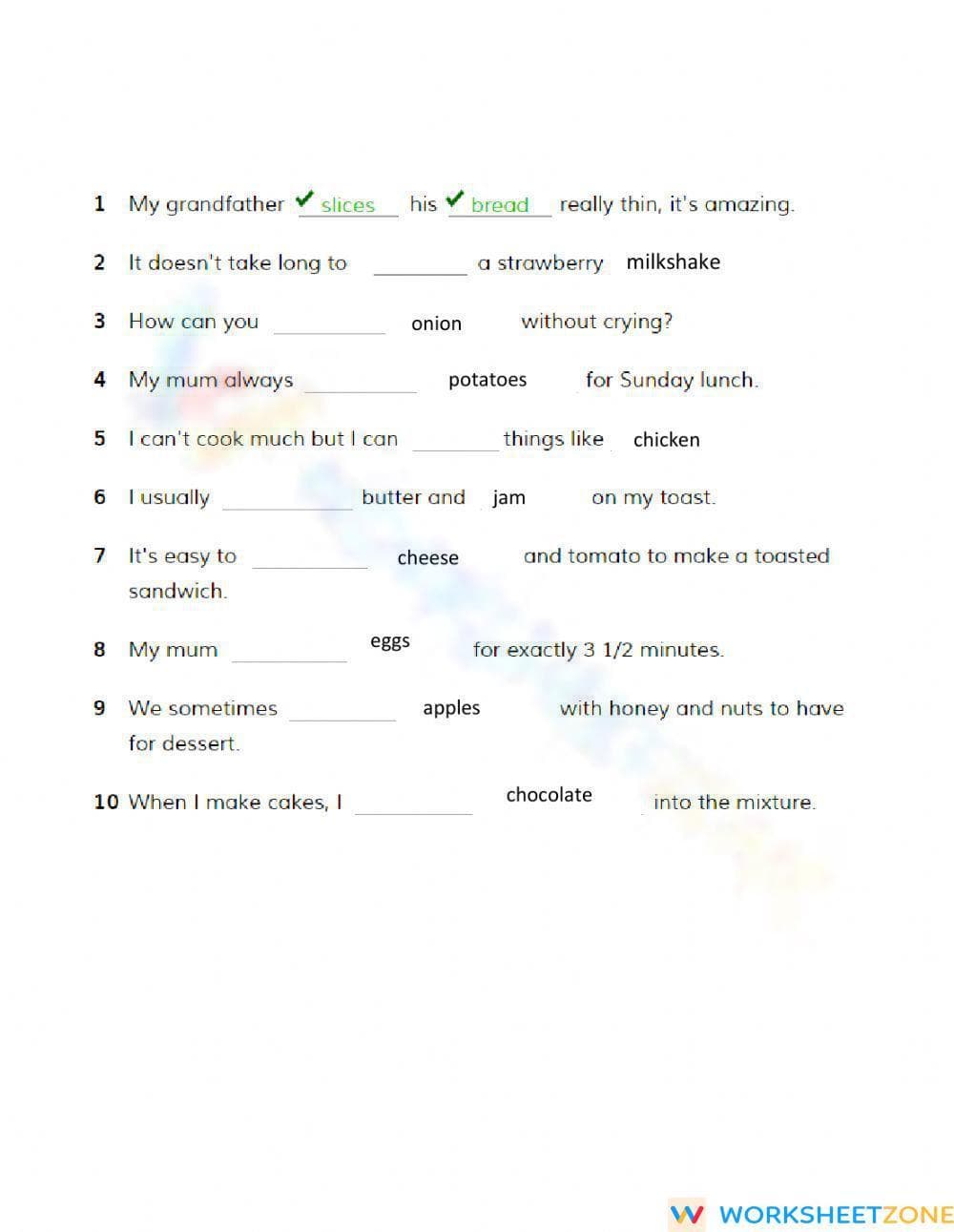
Inside the 3-page PDF, teachers will find a logical progression of 33 vocabulary tasks. The worksheet begins with 10 word-scramble challenges to build orthographic awareness, followed by 10 sentence-level application items. The final page features 13 blanks within three distinct recipe formats—pizza, potato salad, and macaroni cheese—to test functional literacy and sequencing skills.
- Guided practice: Initial word unscrambling (10 items) provides a low-stakes entry point, allowing students to recognize the visual structure of verbs like "grill," "roast," and "slice" with minimal cognitive load.
- Supported practice: Sentence-level exercises (10 items) introduce semantic context, requiring students to match verbs to specific food items and cooking durations, such as boiling eggs for a set time.
- Independent practice: The recipe completion section (13 items) demands full integration of vocabulary knowledge, as students must determine the correct sequence of actions to produce a finished dish.
This gradual-release model moves students from simple recognition to complex, functional application.
This resource is specifically designed to meet CCSS.ELA-LITERACY.L.9-10.6, which requires students to acquire and use accurately general academic and domain-specific words and phrases. It also supports informational text standards by mimicking technical manuals. Both standard codes can be copied directly into lesson plans, IEP goals, or district curriculum mapping tools.
Use this as a bell-ringer during a unit on technical writing or as a summative vocabulary check following a food-themed literary study. For a formative check, observe if students struggle with the sequencing in the recipe section, as this often indicates a gap in understanding the temporal relationship between different cooking actions. Expected completion time is approximately 30 minutes.
Designed for tenth-grade intermediate English learners, this worksheet provides the necessary scaffolding for students building functional literacy. It pairs excellently with authentic recipes or technical demonstration videos to provide a multi-modal learning experience for diverse classroom populations, including those in vocational or life-skills tracks.
According to Fisher & Frey (2014), the integration of domain-specific vocabulary into functional tasks—such as the recipe reconstruction found in this resource—is critical for long-term retention and cognitive transfer. This Grade 10 worksheet targets CCSS.ELA-LITERACY.L.9-10.6 by moving beyond rote memorization into contextualized use of cooking verbs. By providing 33 distinct opportunities for engagement across three pages, the material ensures that students encounter technical terms in multiple formats, building the "word wealth" necessary for navigating complex informational texts and technical documentation. The structured approach mirrors best practices in gradual release, ensuring that learners are prepared to use these essential cooking terms accurately in both spoken and written communication. This targeted practice is essential for building the linguistic precision required in higher-level secondary English Language Arts courses and beyond in professional technical environments where clear, procedural instructions are paramount for success.


