


























Views
Downloads

Ecology for Kids Vocabulary Worksheet | Grade 4 Printable
Paste this activity's link or code into your existing LMS (Google Classroom, Canvas, Teams, Schoology, Moodle, etc.).
Students can open and work on the activity right away, with no student login required.
You'll still be able to track student progress and results from your teacher account.
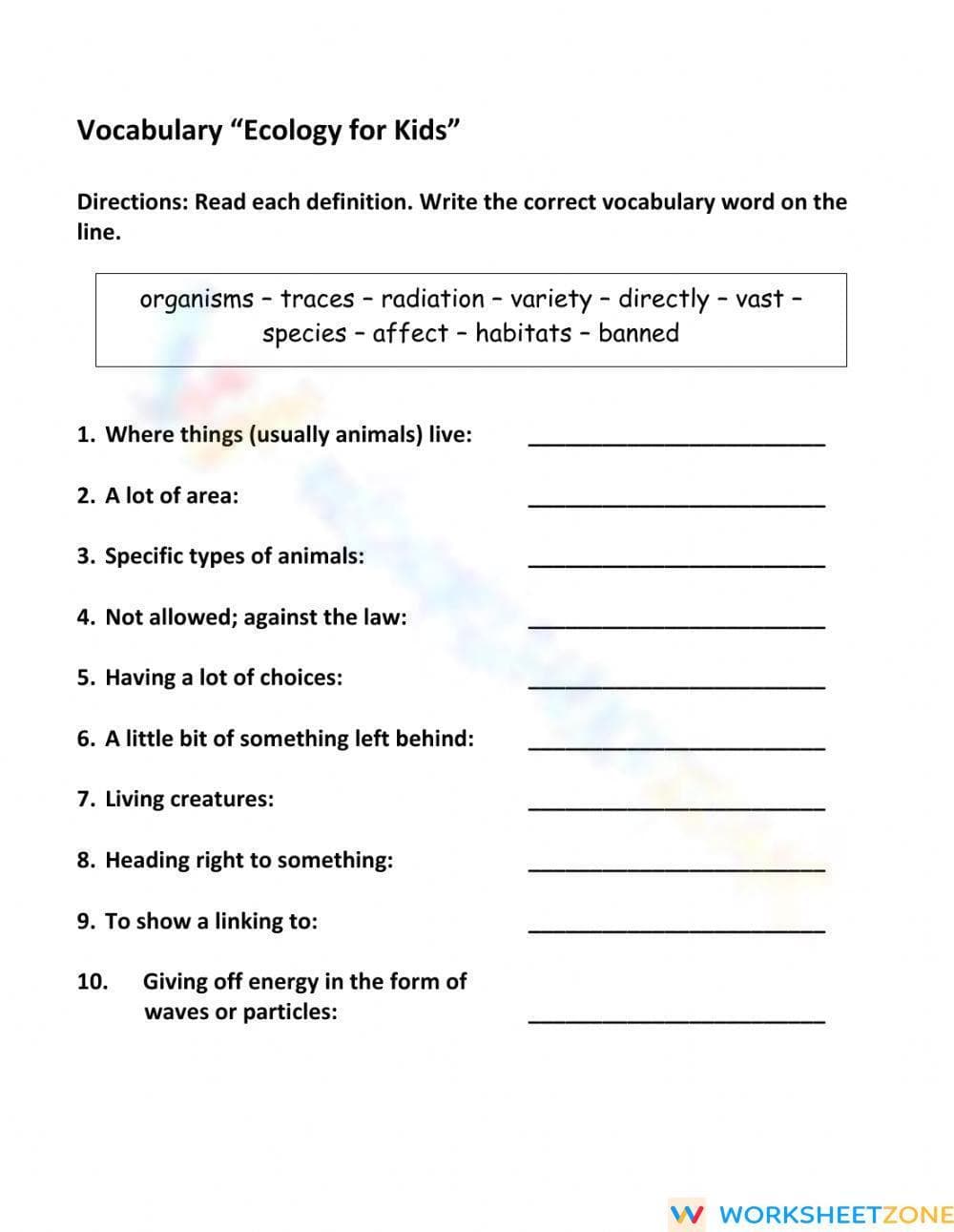
This Grade 4 vocabulary worksheet targets essential domain-specific terms from the "Ecology for Kids" text to improve reading comprehension and scientific literacy. Students match ten complex definitions to their corresponding vocabulary words, reinforcing their ability to use academic language in context. This printable resource ensures learners master critical environmental concepts before engaging with informational texts or science reports.
At a Glance
- Grade: 4 · Subject: English Language Arts (ELA)
- Standard:
CCSS.ELA-LITERACY.L.4.6— Acquire and use grade-appropriate general academic and domain-specific words and phrases- Skill Focus: Vocabulary Acquisition & Definition Matching
- Format: 1 page · 10 problems · Answer key included · PDF
- Best For: Reading comprehension support and science-themed literacy
- Time: 10–15 minutes
Inside this focused one-page resource, teachers will find a clear word bank containing ten high-frequency academic terms: organisms, traces, radiation, variety, directly, vast, species, affect, habitats, and banned. Each term is paired with a student-friendly definition task that requires careful reading and semantic analysis. The worksheet includes a dedicated answer key for rapid grading and features a clean, distraction-free layout optimized for both digital viewing and physical printing.
The zero-prep workflow for this resource is designed for maximum efficiency in busy classrooms. First, print the single-page PDF, which takes less than thirty seconds. Second, distribute the worksheet to students for independent practice; most learners complete the matching in approximately twelve minutes. Third, review the answers as a whole group using the provided key, allowing for immediate feedback and clarification of misunderstood terms. Total teacher preparation time is under two minutes.
This worksheet is primarily aligned with CCSS.ELA-LITERACY.L.4.6, which requires students to acquire and use accurately grade-appropriate general academic and domain-specific words and phrases. It also supports CCSS.ELA-LITERACY.RI.4.4 by helping students determine the meaning of words relevant to a Grade 4 topic. Both standard codes can be copied directly into lesson plans, IEP goals, or district curriculum mapping tools to ensure instructional compliance and student growth.
Use this worksheet during the "Introduction to Vocabulary" phase of a literacy block to familiarize students with core concepts before reading "Ecology for Kids." Alternatively, assign it as a post-reading check to assess mastery. For a formative-assessment observation tip, watch for students who struggle with "species" versus "organisms." Completion takes 15 minutes.
This resource is ideal for Grade 4 general education students, English Language Learners (ELLs) requiring explicit vocabulary support, and Grade 5 students needing a review of environmental terminology. It naturally pairs with science passages about ecosystems or anchor charts defining the roles of organisms within their habitats. The structured format provides necessary scaffolding for students with reading comprehension challenges by narrowing lexical choices.
Mastering domain-specific vocabulary is a prerequisite for understanding complex informational texts. According to Fisher & Frey (2014), explicit vocabulary instruction that includes definition-matching significantly enhances long-term retention of academic language. This worksheet focuses on CCSS.ELA-LITERACY.L.4.6 by providing ten targeted opportunities for students to bridge the gap between abstract scientific definitions and concrete terminology like "radiation" and "habitats." Isolating these terms reduces cognitive load, allowing learners to build the semantic networks required for Grade 4 literacy success. Research from NAEP indicates that students with higher academic word knowledge consistently outperform peers in reading comprehension assessments. This self-contained practice tool provides the structured repetition necessary for students to move these words from receptive to expressive vocabularies, ensuring they are prepared for more rigorous evidence-based writing and discussion tasks.


