


























Views
Downloads



Essential Vocabulary & Spelling Worksheet | Grade 4 ELA
Paste this activity's link or code into your existing LMS (Google Classroom, Canvas, Teams, Schoology, Moodle, etc.).
Students can open and work on the activity right away, with no student login required.
You'll still be able to track student progress and results from your teacher account.
This Grade 4 worksheet assesses academic language through Dr. Martin Luther King Jr.'s life. Students master ten Tier 2 words and twenty-five spelling terms, defining and applying language in context. This resource bridges mechanical spelling and deep reading comprehension.
At a Glance
- Grade: Grade 4 · Subject: English Language Arts (ELA)
- Standard:
CCSS.ELA-LITERACY.L.4.4— Determine the meaning of unknown words using context clues and definitions- Skill Focus: Academic Vocabulary & Spelling
- Format: 2 pages · 45 problems · Answer key included · PDF
- Best For: Biography units and weekly vocab practice
- Time: 25–35 minutes
What's Inside
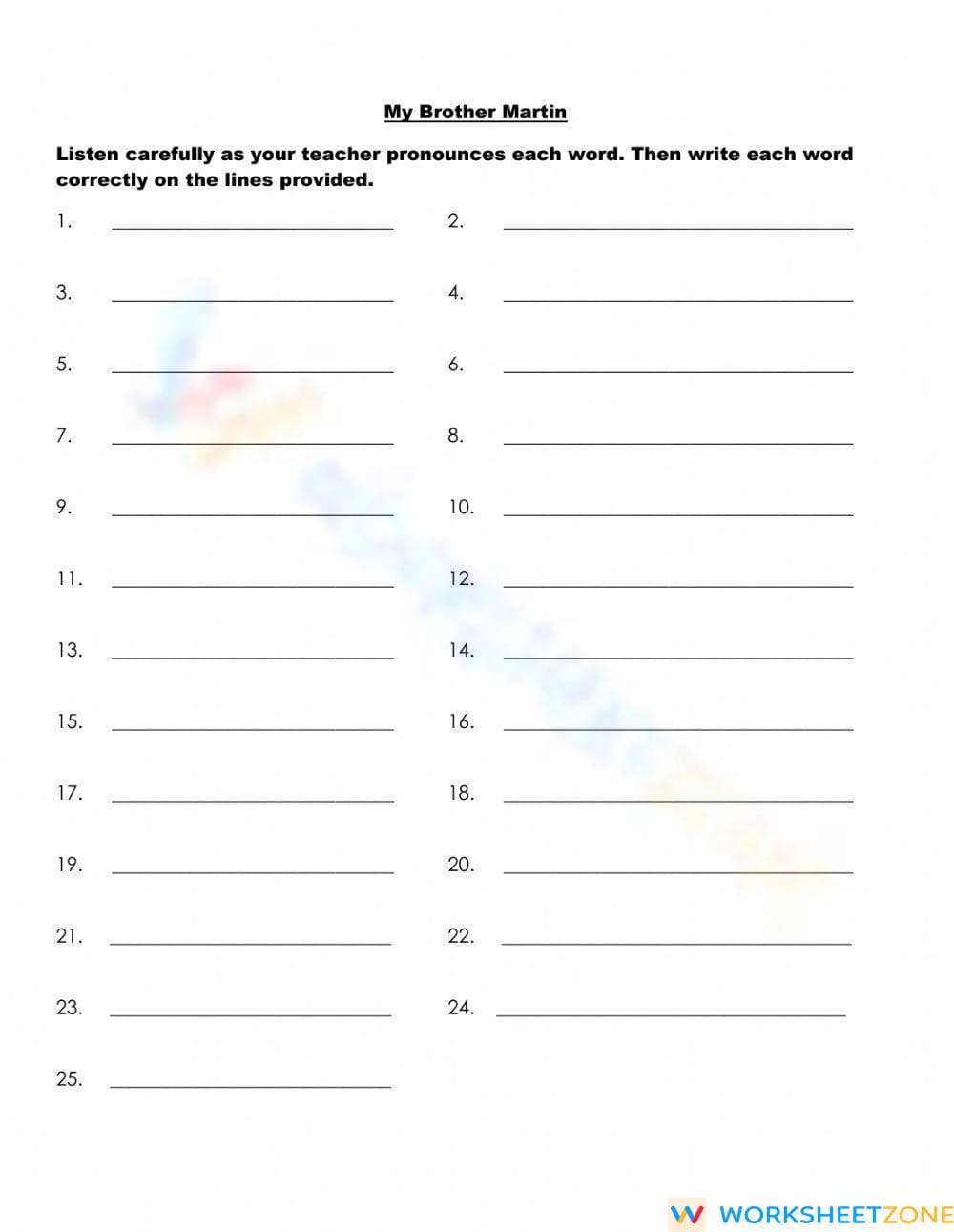
The download includes two pages. Page one features a 25-line spelling list for teacher-led dictation. Page two introduces ten vocabulary terms, including 'segregation' and 'injustice,' via a matching section and a biographical cloze paragraph. An answer key is included.
Skill Progression
- Guided Practice: The spelling dictation section (25 tasks) allows for immediate teacher feedback on phonetic patterns and orthographic accuracy.
- Supported Practice: Definition matching (10 tasks) provides students with a semantic safety net, helping them clarify word meanings before application.
- Independent Practice: The biographical cloze paragraph (10 tasks) requires students to evaluate context clues to insert the correct vocabulary into a narrative about Dr. King.
This three-stage progression ensures students move from recognition to application, following a gradual release model.
Standards Alignment
This resource is explicitly aligned to CCSS.ELA-LITERACY.L.4.4, focusing on determining the meaning of unknown words and phrases. It specifically addresses sub-standard 4.4a by requiring the use of context clues within a paragraph as a clue to the meaning of a word. These standard codes can be copied directly into lesson plans, IEP goals, or district curriculum mapping tools.
How to Use It
Deploy this worksheet as a summative assessment following a read-aloud of 'My Brother Martin' or as a stand-alone unit during Black History Month. During the matching phase, circulate to observe if students are using elimination strategies—a key formative indicator of verbal reasoning. Expect a completion time of 25 to 35 minutes depending on the student's prior knowledge of the topic.
Who It's For
This content is specifically designed for Grade 4 ELA classrooms but remains highly accessible for Grade 3 enrichment or Grade 5 intervention. It is particularly effective for students requiring structured literacy supports, such as English Language Learners, as it provides clear definitions. Pair this with a digital biography of Dr. King or an anchor chart on Civil Rights terminology for maximum impact.
According to the RAND AIRS 2024 analysis, the integration of thematic vocabulary within biographical contexts significantly enhances retention compared to isolated word lists. This Grade 4 English Language Arts worksheet leverages the high-interest subject of Dr. Martin Luther King Jr. to ground the acquisition of standard CCSS.ELA-LITERACY.L.4.4. By combining a 25-word spelling assessment with targeted definition matching and a cloze paragraph, the resource forces students to apply linguistic logic across varying levels of cognitive demand. Research indicates that when students interact with Tier 2 vocabulary—such as 'injustice' and 'segregation'—within a narrative framework, they develop deeper semantic maps that transfer more effectively to independent reading tasks. This multi-modal approach ensures that the 45 unique tasks provided not only build technical proficiency in spelling but also foster the critical thinking skills necessary for comprehending complex informational texts in the upper elementary years and beyond.


