




























Views
Downloads

Essential Virus Life Cycle Worksheet | Grade 8-11 Science

Paste this activity's link or code into your existing LMS (Google Classroom, Canvas, Teams, Schoology, Moodle, etc.).
Students can open and work on the activity right away, with no student login required.
You'll still be able to track student progress and results from your teacher account.
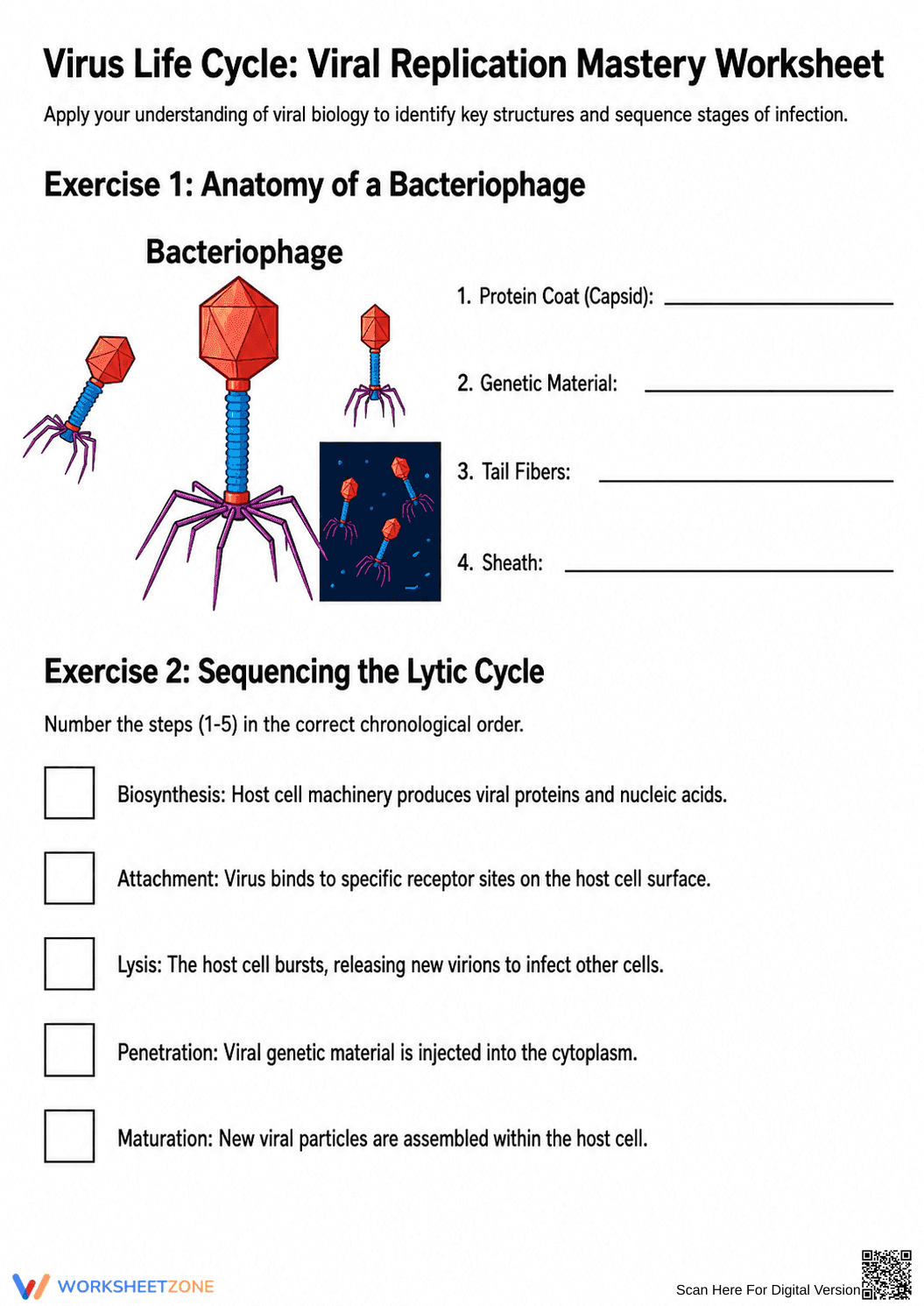
This viral replication worksheet provides a framework for students to identify bacteriophage structures and sequence lytic cycle stages. Through anatomical labeling and comparative analysis, learners understand how viruses hijack host cellular machinery to replicate. It transforms abstract biological processes into a logical progression, ensuring mastery of virology fundamentals.
At a Glance
- Grade: 8-11 · Subject: Biology / Life Science
- Standard:
HS-LS1-1— Explain how the structure of DNA determines the structure of proteins- Skill Focus: Viral replication cycles and bacteriophage anatomy
- Format: 2 pages · 20 tasks · Answer key included · PDF
- Best For: High school biology and microbiology units
- Time: 30–45 minutes
What's Inside
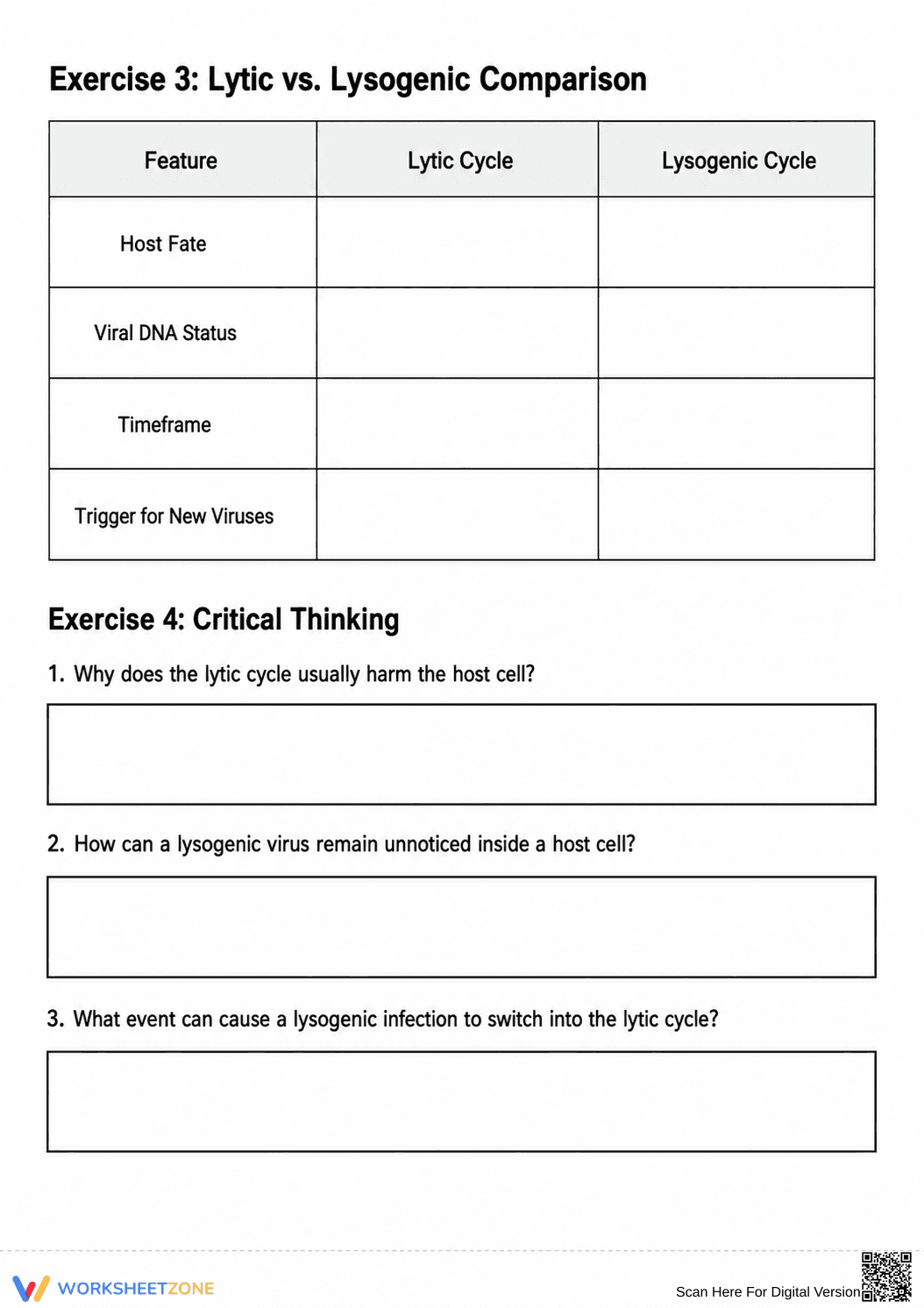
This 2-page PDF features four exercises to build conceptual depth. Exercise 1 focuses on bacteriophage anatomy with a diagram for labeling the capsid, genetic material, tail fibers, and sheath. Exercise 2 requires students to sequence five stages of the lytic cycle. Exercise 3 provides a comparison table for lytic versus lysogenic cycles, while Exercise 4 offers critical thinking prompts to assess higher-order understanding of viral infection mechanisms.
Zero-Prep Workflow
- Print: Select the 2-page document and print enough copies for your class (1 minute).
- Distribute: Hand out the worksheets as an independent practice or guided notes supplement during your virology unit (1 minute).
- Review: Use the provided answer key to review the completed diagrams and comparison tables, addressing misconceptions in real-time.
Total preparation time is under 2 minutes, making it an ideal sub-plan.
Standards Alignment
The primary focus is HS-LS1-1, requiring students to explain how DNA structure determines protein structure to carry out life functions. This worksheet addresses how viral genetic material redirects host cell functions. Standard codes can be copied directly into lesson plans or IEP goals.
How to Use It
Use this worksheet as a formative assessment following a virology lecture. It serves as an excellent check for understanding, ensuring students distinguish between the lytic cycle's immediate destruction and the lysogenic cycle's dormant nature. Alternatively, assign it as a collaborative partner activity where students justify sequencing choices. Expect completion within 35 to 45 minutes.
Who It's For
Tailored for Grade 8 advanced life science and Grade 9-11 biology students, this resource is highly effective for visual learners who benefit from diagram labeling. It pairs naturally with microscopic image galleries or video animations of viral entry to provide a multi-modal learning experience.
Structured sequencing tasks and comparative graphic organizers significantly improve the retention of complex biological pathways. This worksheet utilizes these evidence-based strategies to help students master the HS-LS1-1 standard by breaking down the viral life cycle into discrete steps. By requiring students to differentiate between lytic and lysogenic cycles, the resource moves beyond rote memorization toward conceptual mastery. Scaffolded practice is essential for developing the technical vocabulary and logical reasoning required in high school microbiology. The inclusion of critical thinking questions ensures students understand the functional consequences of viral infection on host cell homeostasis, making it a reliable tool for diverse classroom settings.


