


























Views
Downloads
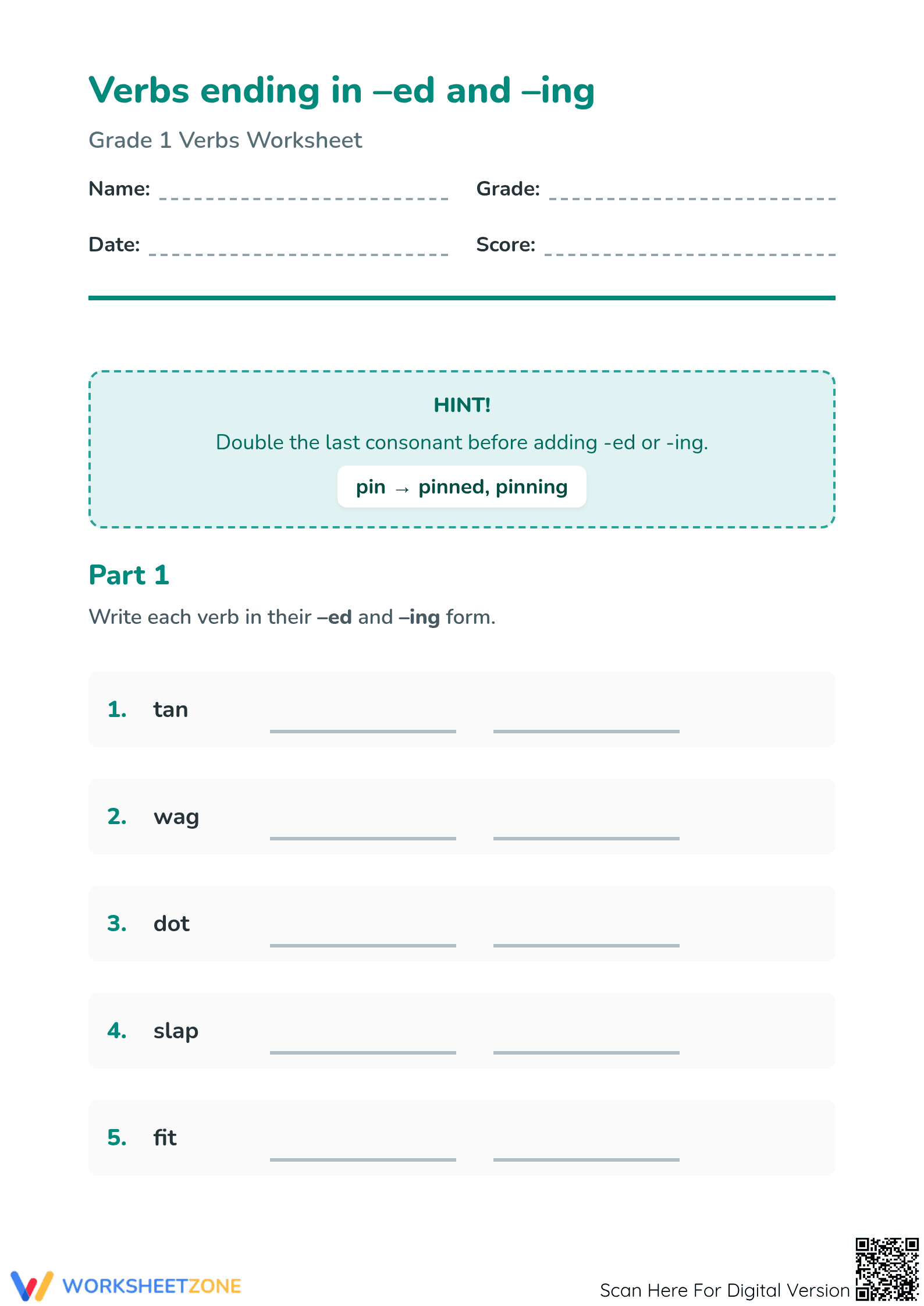


Essential Grade 1 Verbs Worksheet: -ed and -ing Tenses
Paste this activity's link or code into your existing LMS (Google Classroom, Canvas, Teams, Schoology, Moodle, etc.).
Students can open and work on the activity right away, with no student login required.
You'll still be able to track student progress and results from your teacher account.
Help your first-grade students master the tricky rules of inflectional endings with this targeted verb tense worksheet. This resource focuses specifically on the "double the consonant" rule for past and present continuous forms. By completing these structured exercises, learners develop the phonemic awareness and orthographic mapping skills necessary for spelling proficiency and morphological understanding.
At a Glance
- Grade: Grade 1 · Subject: English Language Arts
- Standard:
CCSS.ELA-LITERACY.L.1.4.C— Identify root words and their inflectional forms such as looked and looking- Skill Focus: Consonant doubling with -ed and -ing suffixes
- Format: 3 pages · 20 problems · Answer key included · PDF
- Best For: Independent practice and phonics reinforcement
- Time: 15–25 minutes
This comprehensive three-page PDF contains 20 distinct practice opportunities. Each item presents a CVC (consonant-vowel-consonant) root word like "tan," "wag," or "skip." Students are prompted to write both the past tense (-ed) and present continuous (-ing) forms. A clear "Hint!" box at the top of the first page provides a visual model (pin → pinned, pinning) to support independent work and reduce teacher intervention during the activity. A complete answer key is provided for rapid grading or student self-correction.
This worksheet is designed for maximum efficiency in busy classrooms. Teachers can simply print the three pages, which takes less than 30 seconds. Distributing the materials to a standard-sized class requires about one minute. Because the instructions and hints are self-contained, students can begin working immediately with minimal verbal direction. Reviewing the 20 tasks using the provided answer key takes under two minutes, making this an ideal solution for sub plans, morning work, or quick literacy centers.
The primary focus of this activity is CCSS.ELA-LITERACY.L.1.4.C, which requires students to identify root words and their inflectional forms. Additionally, it supports CCSS.ELA-LITERACY.L.1.2.E by encouraging students to spell words phonetically while applying learned spelling conventions for suffixes. Both standard codes can be copied directly into lesson plans, IEP goals, or district curriculum mapping tools to ensure instructional alignment and documentation accuracy.
Assign this worksheet as a summative check after a direct instruction lesson on the 1-1-1 doubling rule. It serves as a reliable formative assessment; observe students as they work to identify those who forget to double the consonant or who add suffixes incorrectly. Expect most Grade 1 students to complete the 20-verb sequence in approximately 20 minutes, depending on their handwriting speed and familiarity with the target vocabulary.
This resource is tailored for first-grade students who have moved beyond simple CVC spelling and are beginning to explore morphological changes. It provides excellent remediation for second-grade students who still struggle with spelling consistency when adding endings. This worksheet pairs naturally with a classroom anchor chart displaying the consonant-doubling rule or a decodable text featuring high-frequency -ed and -ing words.
Mastery of inflectional endings is a critical milestone in early literacy development, as noted in the RAND AIRS 2024 reports on foundational reading skills. This worksheet addresses the specific orthographic challenge of consonant doubling when adding suffixes to CVC root words. By engaging with 20 high-frequency verbs, students reinforce the connection between morphology and phonology, a key component of the Science of Reading. Research by Fisher & Frey (2014) emphasizes the importance of guided-to-independent practice cycles in cementing these spelling rules. This resource provides the necessary repetition to move students toward automaticity in writing past and present continuous tenses. Standard CCSS.ELA-LITERACY.L.1.4.C defines this skill as the ability to recognize and produce inflected forms of root words, a prerequisite for more advanced suffixation in higher grades. This evidence-based approach ensures that learners build a stable foundation for lifelong spelling and reading fluency.


