


























Views
Downloads


Essential Verb Tense Shifts Worksheet | Grade 5 ELA
Paste this activity's link or code into your existing LMS (Google Classroom, Canvas, Teams, Schoology, Moodle, etc.).
Students can open and work on the activity right away, with no student login required.
You'll still be able to track student progress and results from your teacher account.
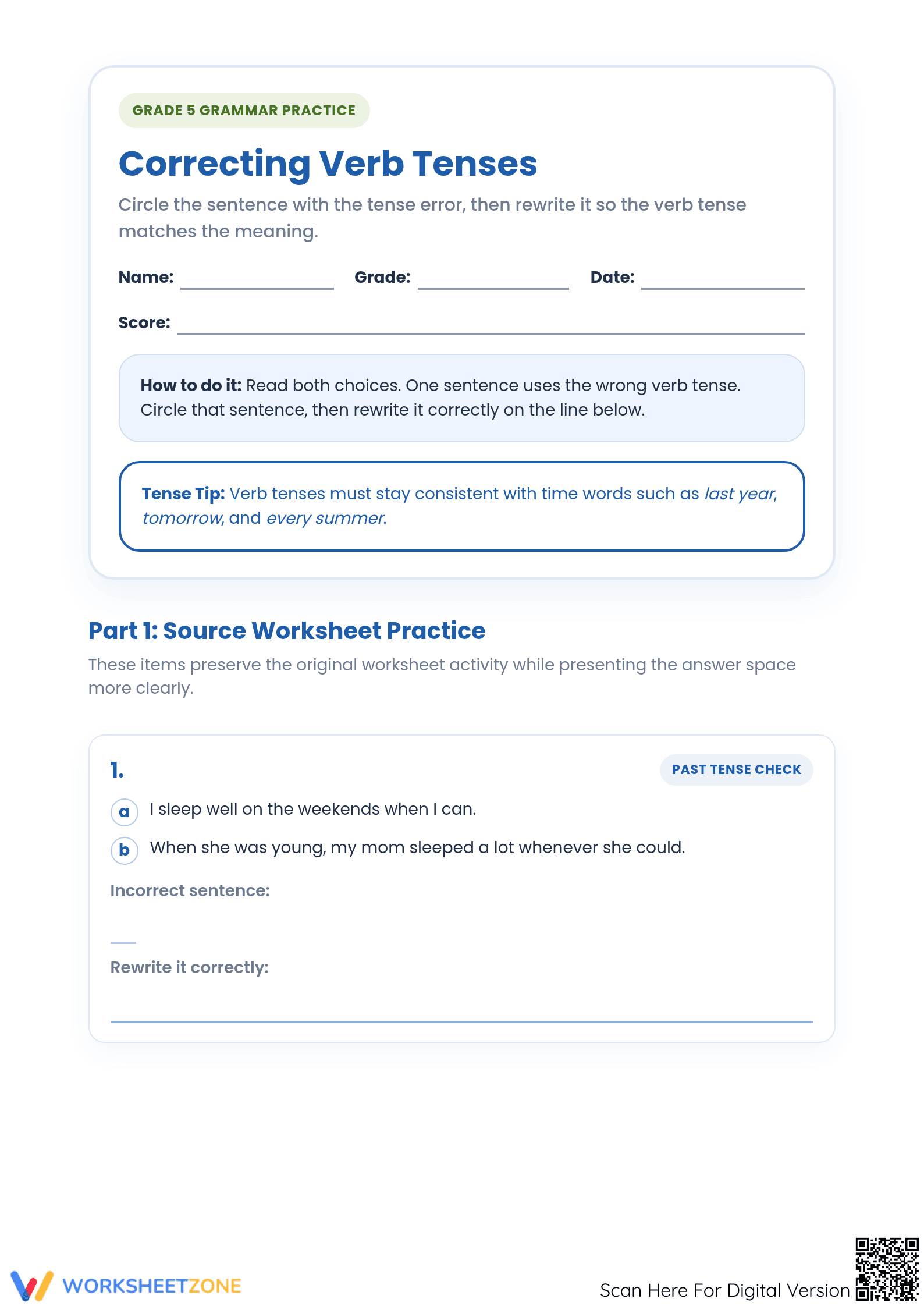
This Grade 5 grammar worksheet helps students identify and correct inappropriate shifts in verb tense. By analyzing sentence pairs, learners develop the linguistic precision required to maintain temporal consistency in their writing. This resource ensures students can distinguish between habitual actions and specific past events while mastering irregular verb forms for clearer communication.
At a Glance
- Grade: 5 · Subject: ELA
- Standard:
CCSS.ELA-LITERACY.L.5.1.C— Use verb tense to convey various times, sequences, states, and conditions- Skill Focus: Verb Tense Consistency
- Format: 4 pages · 10 problems · Answer key included · PDF
- Best For: Independent grammar practice or homework
- Time: 20–30 minutes
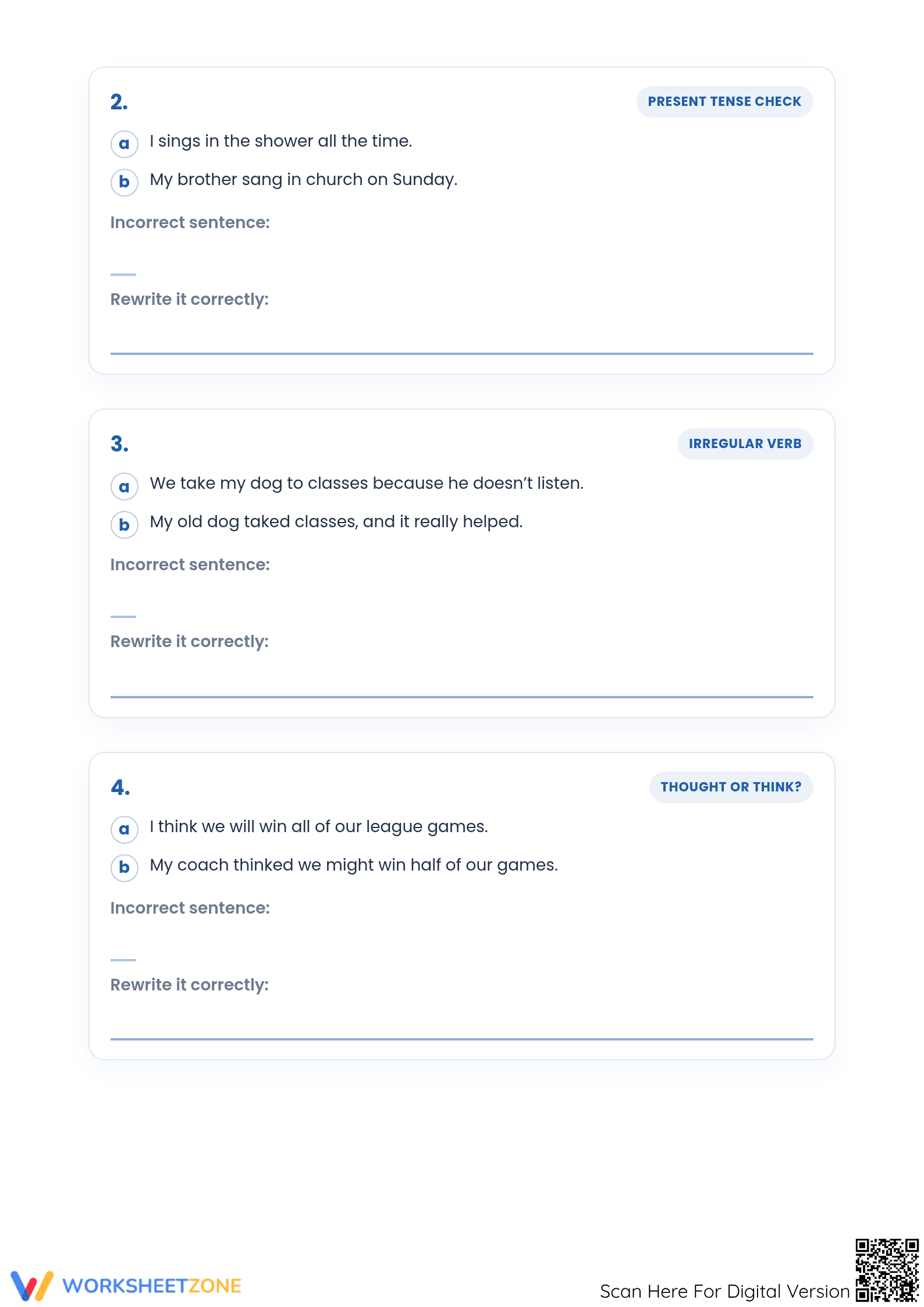
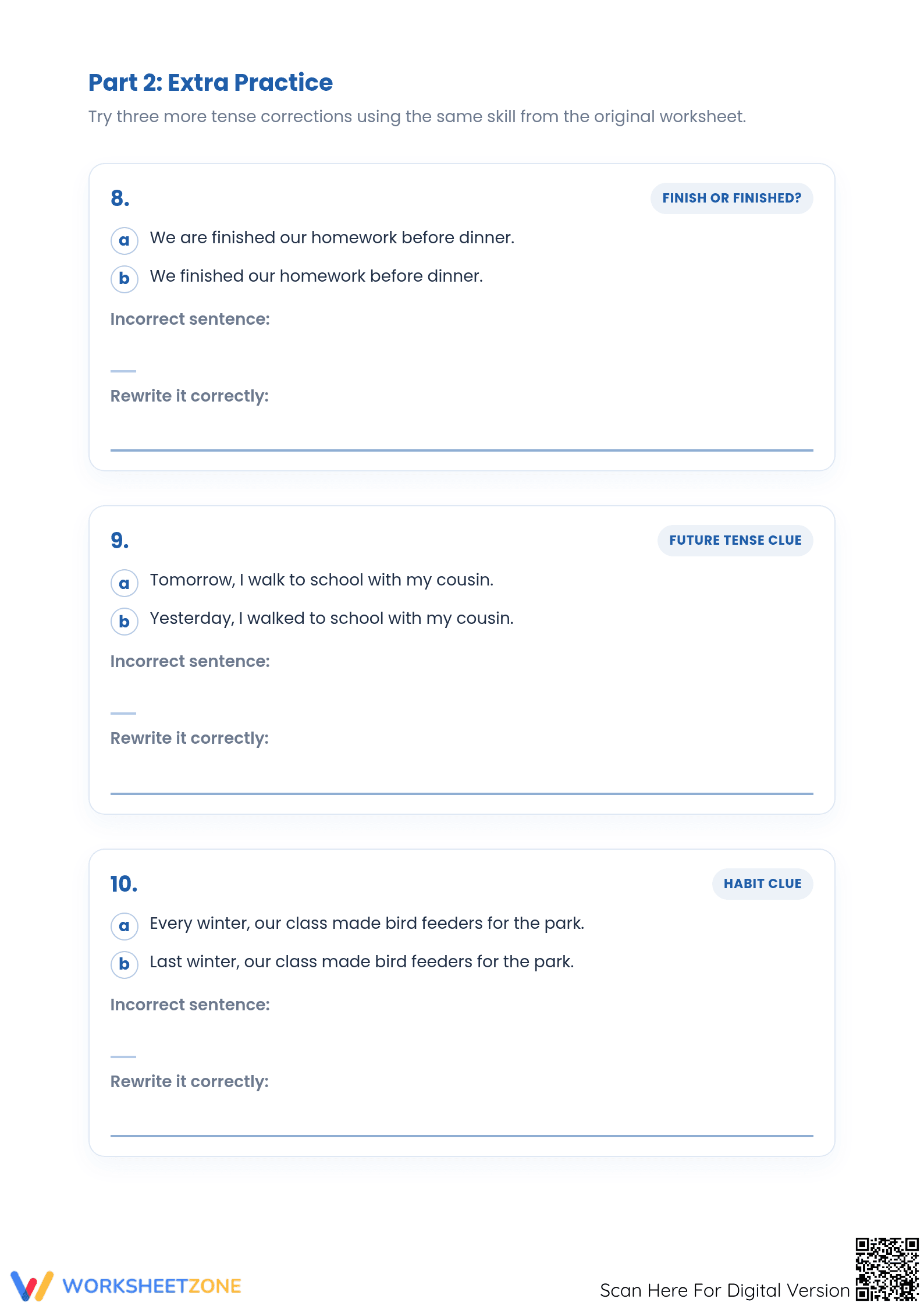
The packet contains four pages of structured exercises divided into two distinct parts. Part 1 features seven problems that present students with two sentence options, requiring them to isolate the error and perform a full rewrite. Part 2 provides three items to reinforce mastery. The layout includes clear headers for specific tense checks, such as "Irregular Verb" and "Helping Verb Check," alongside a comprehensive answer key for immediate feedback.
Skill Progression
- Guided practice: The initial items provide explicit "Tense Tips" and category labels to help students recognize common pitfalls like "sleeped" versus "slept."
- Supported practice: Mid-worksheet tasks challenge students to evaluate "Habit vs. Past" scenarios, requiring them to use context clues like "every summer" to determine the correct form.
- Independent practice: The final section removes specific category scaffolding, forcing students to apply their knowledge of future and past tense clues autonomously.
This gradual-release model moves students from simple identification to complex sentence reconstruction through 10 targeted problems.
Standards Alignment
This resource is aligned with CCSS.ELA-LITERACY.L.5.1.C, which requires students to use verb tense to convey various times and sequences. It also supports L.5.1.D by helping students recognize and correct inappropriate shifts in verb tense. Both standard codes can be copied directly into lesson plans, IEP goals, or district curriculum mapping tools.
How to Use It
Use this worksheet during the "You Do" phase of a grammar lesson after introducing irregular past tense verbs. It serves as an excellent formative assessment; teachers should observe if students struggle more with irregular forms or with time-marker consistency. Expect students to complete the 10-item set in approximately 25 minutes. This can also be assigned as a zero-prep homework assignment to reinforce classroom instruction.
Who It's For
This practice is designed for fifth-grade students but is effective for fourth-grade enrichment or sixth-grade remediation. It is particularly useful for English Language Learners (ELLs) who often struggle with the nuances of English tense shifts. Pair this with a mentor text passage to help students find similar tense patterns in professional writing.
Maintaining verb tense consistency is a foundational skill for middle-grade writing proficiency. This worksheet addresses the common developmental hurdle of "tense drifting," where young writers inadvertently switch between past and present within a single paragraph. By requiring students to not only identify errors but also rewrite the sentences correctly, the resource reinforces the cognitive link between reading for errors and producing accurate syntax. Research emphasizes that this type of corrective feedback and reconstruction is vital for moving grammar knowledge from short-term recognition to long-term application. Educators can utilize these 10 tasks to provide the high-repetition, low-stakes environment necessary for mastering complex irregular verb forms.


