


























Views
Downloads


Printable Math Quiz: Large Numbers & Operations — Grade 6-10
Paste this activity's link or code into your existing LMS (Google Classroom, Canvas, Teams, Schoology, Moodle, etc.).
Students can open and work on the activity right away, with no student login required.
You'll still be able to track student progress and results from your teacher account.
This comprehensive Math Quiz provides a rigorous assessment of large number literacy and multi-digit computation for middle and high school students. By engaging with 28 structured problems, learners demonstrate mastery in reading, writing, and calculating with values extending into the trillions. This essential resource ensures students can fluently manipulate complex numerical systems while validating accuracy.
At a Glance
- Grade: 6-10 · Subject: Math
- Standard:
CCSS.MATH.CONTENT.6.NS.B.3— Fluently add, subtract, and multiply multi-digit numbers using the standard algorithm- Skill Focus: Large number literacy and computation
- Format: 5 pages · 28 problems · Answer key included · PDF
- Best For: Formal assessment, review, or diagnostic testing
- Time: 45–60 minutes
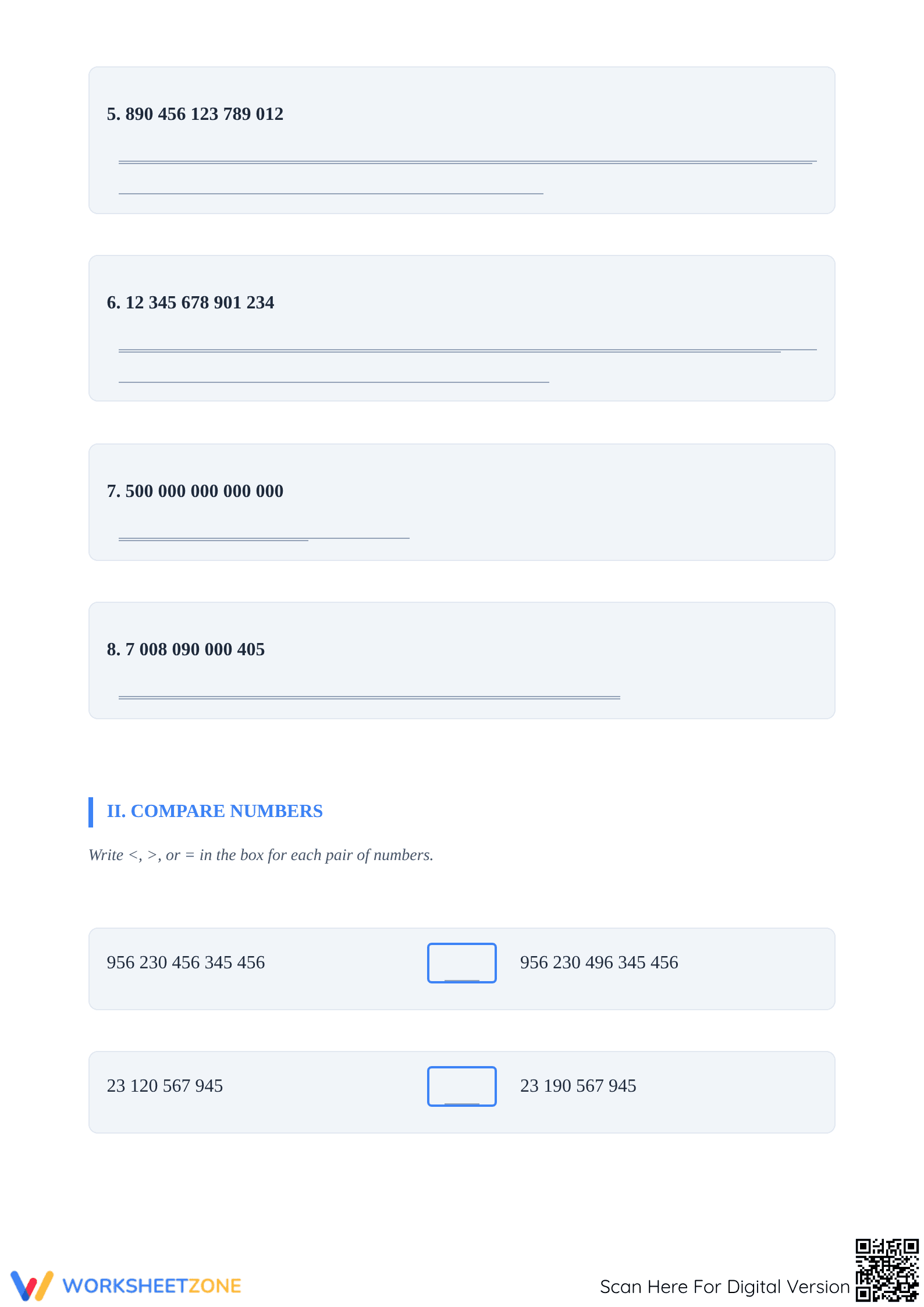
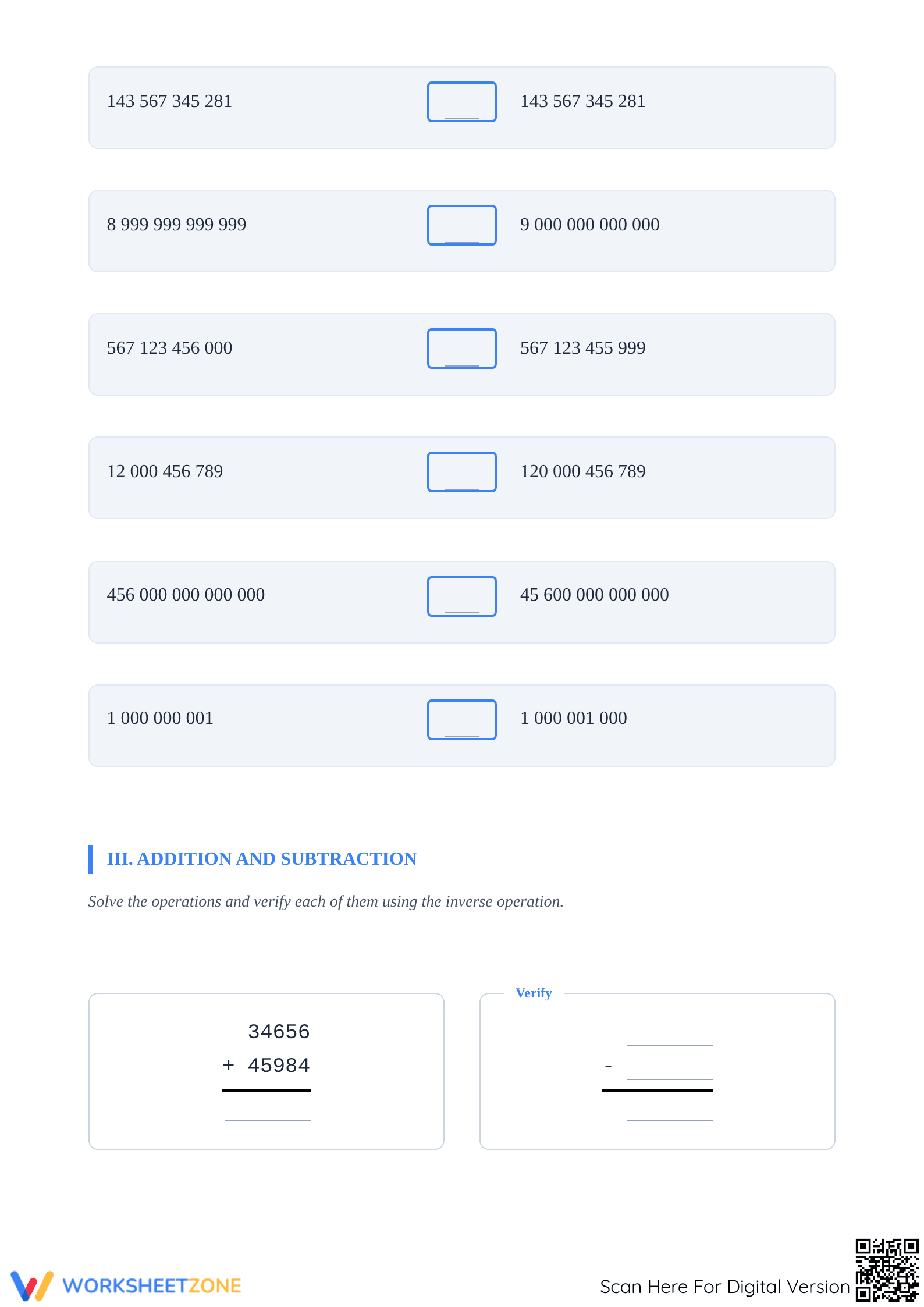
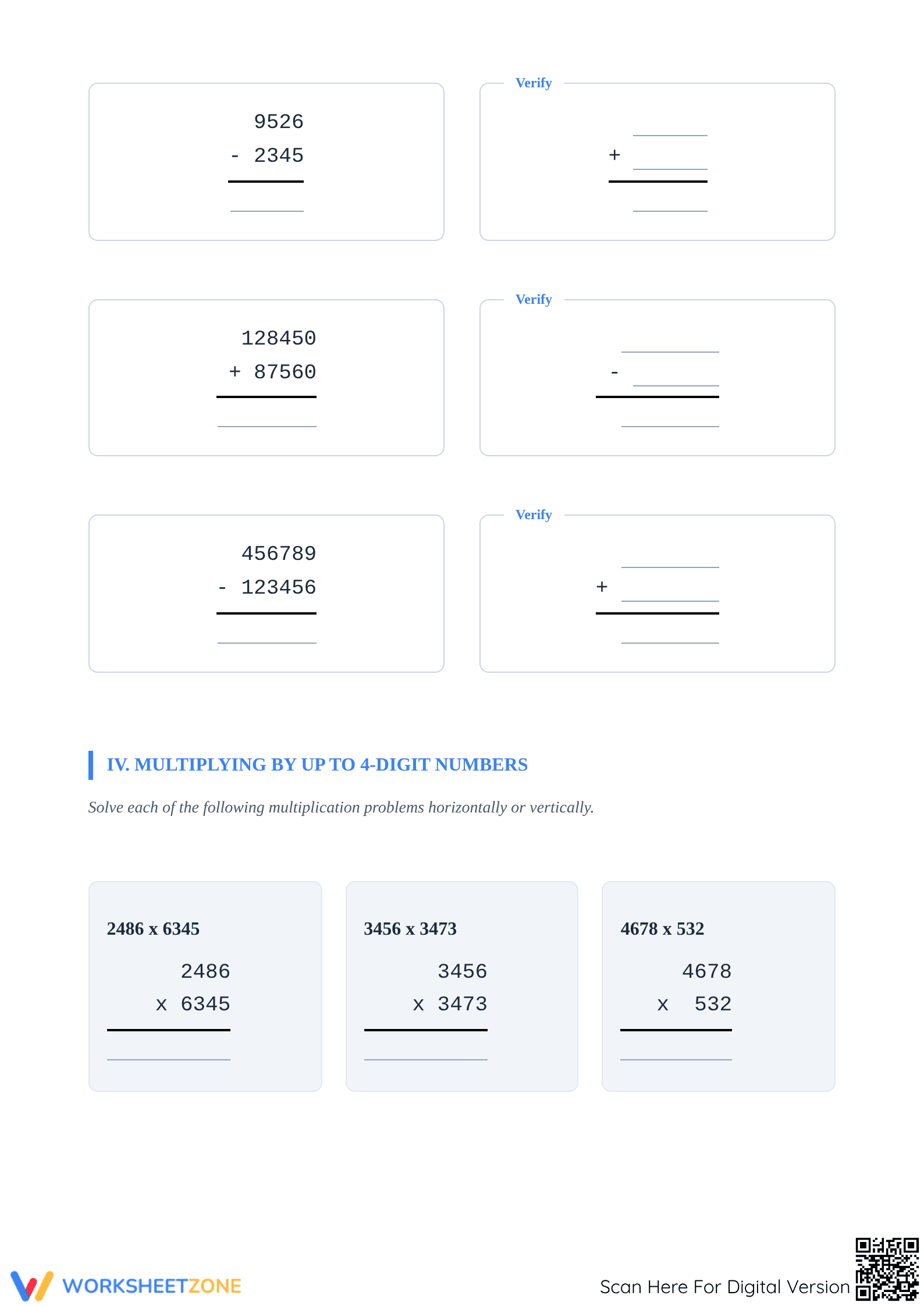
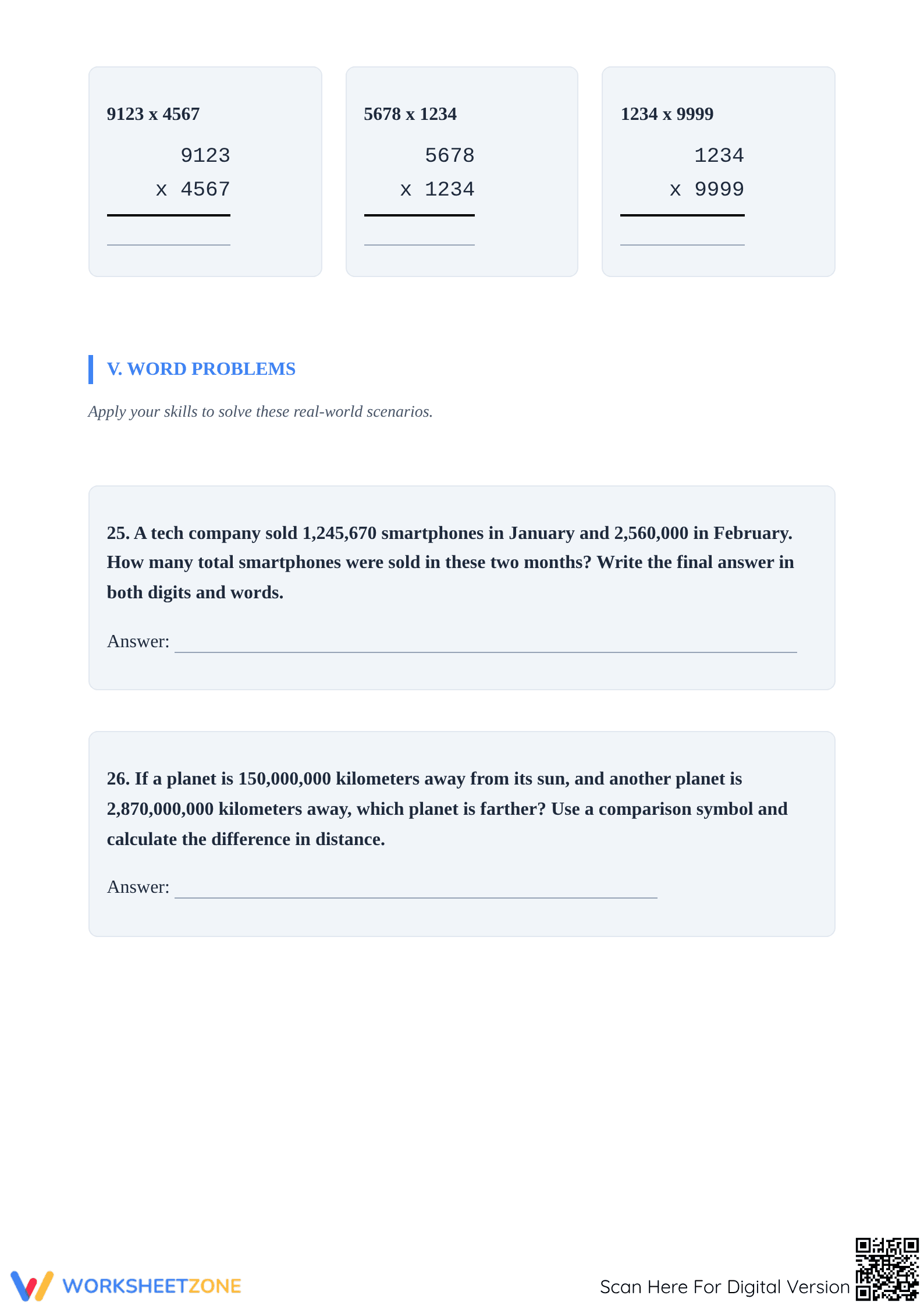
What's Inside: This 5-page assessment features 28 targeted tasks divided into five logical sections. Students move from word-form notation to comparison logic, followed by multi-digit addition, subtraction, and vertical multiplication. Each computational section includes dedicated space for inverse operation verification, ensuring a high level of mathematical precision and accountability for every answer provided.
Skill Progression
- Guided Practice: Writing large numbers up to the trillions in word form using provided lines to demonstrate place value awareness. (8 problems)
- Supported Practice: Comparing complex numerical values and executing multi-digit addition and subtraction with explicit verification prompts. (12 problems)
- Independent Practice: Solving 4-digit vertical multiplication problems and multi-step real-world word problems involving millions and billions. (8 problems)
This structure follows a gradual-release model that allows educators to identify specific points of algorithmic failure or conceptual misunderstanding.
Standards Alignment
This worksheet is aligned to CCSS.MATH.CONTENT.6.NS.B.3: Fluently add, subtract, multiply, and divide multi-digit numbers using the standard algorithm for each operation. While the problems focus on whole numbers, the scale of values and the requirement for verification meet the rigorous fluency demands of middle school mathematics. This standard code can be copied directly into lesson plans, IEP goals, or district curriculum mapping tools.
How to Use It
Use this resource as a formal mid-unit quiz or a diagnostic tool at the start of the semester to gauge place value retention. During administration, observe student work in Section III to ensure they are using inverse operations to verify their results. This formative observation tip helps catch regrouping errors early. Expected completion time is approximately 50 minutes.
Who It's For
This assessment is designed for students in Grades 6 through 10 who require evidence of fluency with large numbers. It serves as an excellent tool for general education classrooms, RTI groups, or special education students working toward place value mastery. It pairs naturally with a place value anchor chart or a direct instruction lesson on standard algorithms.
The development of numerical fluency with large numbers is a cornerstone of middle school mathematics, as highlighted by EdReports 2024. This assessment aligns with CCSS.MATH.CONTENT.6.NS.B.3 by requiring students to not only execute algorithms but also verify their results using inverse operations. Research from the NAEP indicates that students who can fluidly transition between word form and standard notation demonstrate a deeper conceptual understanding of place value, which is essential for success in higher-order algebraic thinking. By incorporating multi-digit multiplication and complex word problems, this worksheet provides the rigorous practice necessary to move from procedural knowledge to adaptive reasoning. The inclusion of 28 structured tasks ensures a broad sampling of student ability across five distinct cognitive domains. Educators can utilize these findings to identify specific gaps in place value logic or algorithmic execution before proceeding to decimal or fraction operations.


