


























Views
Downloads
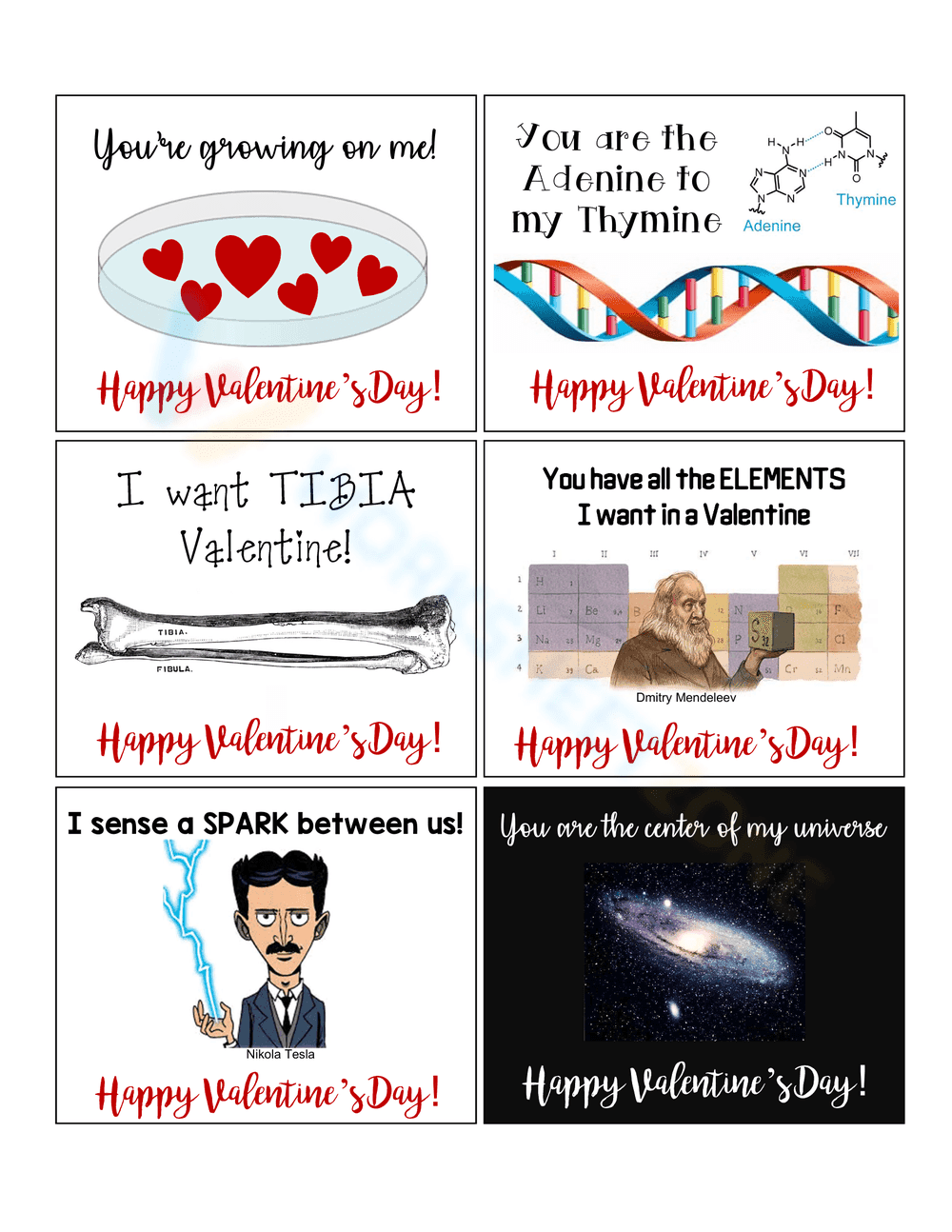

Science Valentine Puns Printable | Grade 6-12 Essential
Paste this activity's link or code into your existing LMS (Google Classroom, Canvas, Teams, Schoology, Moodle, etc.).
Students can open and work on the activity right away, with no student login required.
You'll still be able to track student progress and results from your teacher account.
This Grade 6-12 science pun worksheet provides students with 6 unique, printable Valentine's Day cards that blend scientific concepts with clever wordplay. By connecting complex topics like DNA base pairing and the periodic table to social-emotional themes, students reinforce their vocabulary in a lighthearted, memorable way. It is the perfect seasonal activity for secondary science classrooms.
At a Glance
- Grade: 6-12 · Subject: Science & English
- Standard:
MS-PS1-1— Develop models to describe the atomic composition of simple molecules and extended structures.- Skill Focus: Scientific Puns & Vocabulary
- Format: 1 page · 6 cards · No-prep · PDF
- Best For: Seasonal science activity or classroom decor
- Time: 5–10 minutes
This single-page PDF contains 6 high-quality printable cards. Each card features a specific scientific discipline, including microbiology (Petri dish), genetics (DNA structure), anatomy (skeletal system), chemistry (periodic table), physics (electricity), and astronomy (galactic structures). The cards are designed with clear borders for easy cutting and include space for students to write personalized messages on the back.
The workflow for this resource is designed for maximum efficiency. First, print the single-page document (30 seconds). Second, distribute the sheet to students or place them in a central station (1 minute). Third, allow students to cut and personalize their favorite cards (5 minutes). Total teacher preparation time is under 2 minutes, making this an ideal addition to a sub plan during February.
This resource aligns with `MS-PS1-1` by referencing the periodic table and atomic elements, as well as `CCSS.ELA-LITERACY.L.8.5` through the use of figures of speech and puns. While primarily a seasonal supplement, it encourages students to recognize scientific terminology in non-academic contexts. Both standard codes can be copied directly into lesson plans, IEP goals, or district curriculum mapping tools.
Use this worksheet during the final 10 minutes of a lab period or as a warm-up activity on February 14th. It serves as an excellent formative assessment tool; ask students to explain the science behind the pun on their chosen card to verify their understanding of the underlying concept. Expected completion time for cutting and signing is approximately 8 minutes.
This resource is tailored for middle and high school students who have a foundational understanding of general science terms. It is particularly effective for English Language Learners (ELLs) to practice idioms and double meanings. Pair this with a periodic table anchor chart or a genetics unit review for a cohesive instructional experience.
According to the RAND AIRS 2024 report on student engagement, integrating seasonal themes with core academic content can significantly increase student motivation and retention of specialized vocabulary. This worksheet utilizes 6 distinct scientific puns to bridge the gap between abstract concepts—like Adenine-Thymine pairing—and relatable social interactions. By engaging with these science valentines, students in grades 6 through 12 practice identifying wordplay and applying scientific terminology in creative contexts. Research from Fisher & Frey (2014) suggests that such interdisciplinary activities help solidify the academic language required for mastery of standards like MS-PS1-1 and MS-LS1-1. This printable resource provides a low-stakes, high-interest way to celebrate the holiday while maintaining a focus on scientific literacy and conceptual connections across biology, chemistry, and physics.


