


























Views
Downloads

Valentine Science Puns Worksheet | Grade 6-12 Essential
Paste this activity's link or code into your existing LMS (Google Classroom, Canvas, Teams, Schoology, Moodle, etc.).
Students can open and work on the activity right away, with no student login required.
You'll still be able to track student progress and results from your teacher account.
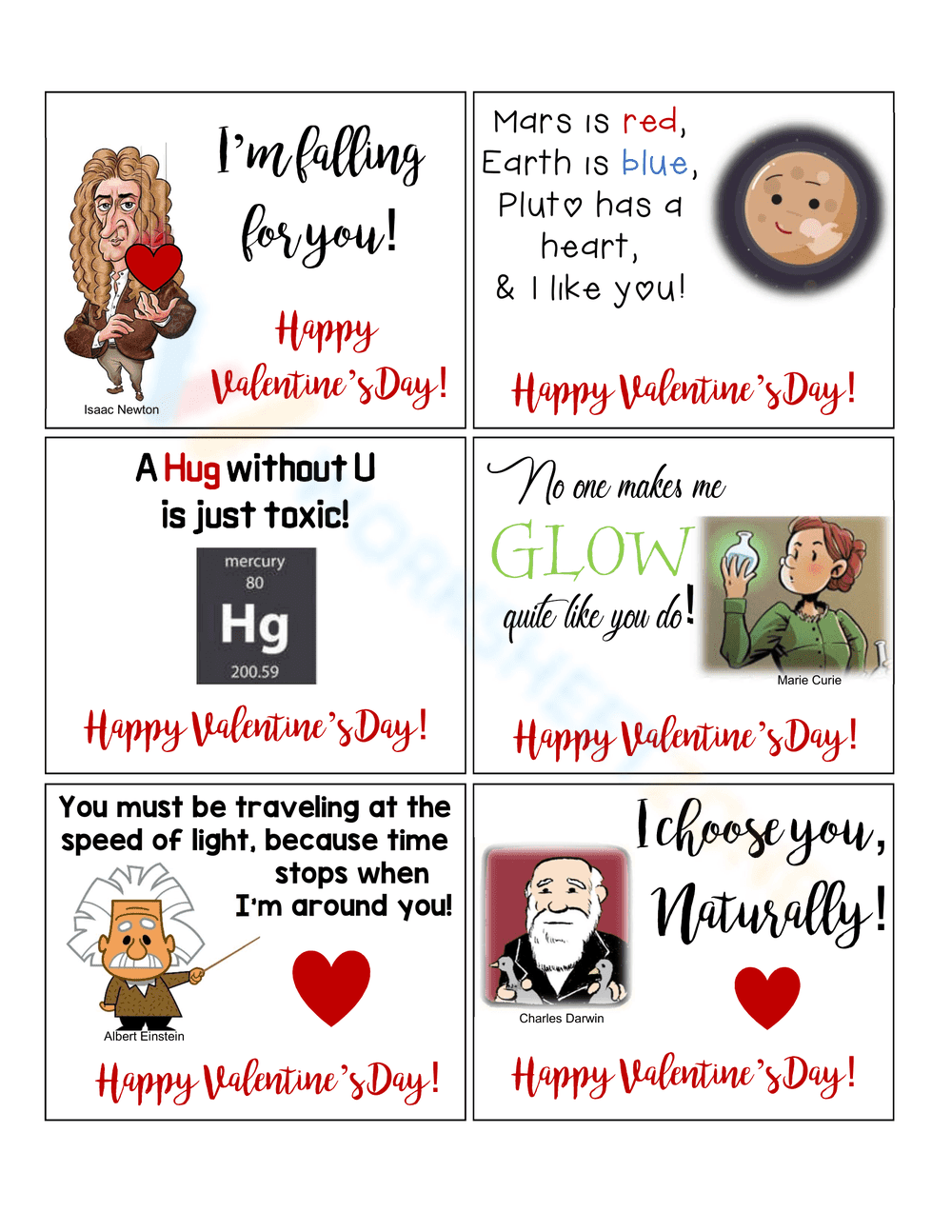
This Grade 6-12 science Valentine worksheet provides students with six clever puns that bridge scientific concepts and creative wordplay. By engaging with figures like Newton and Einstein, students reinforce their understanding of gravity and chemical symbols through a festive lens that encourages classroom community and scientific literacy.
At a Glance
- Grade: 6–12 · Subject: Science
- Standard:
CCSS.ELA-LITERACY.L.8.5— Demonstrate understanding of figurative language, word relationships, and nuances in word meanings- Skill Focus: Science Puns & Wordplay
- Format: 1 page · 6 cards · Answer key included · PDF
- Best For: Seasonal Bell-Ringer or Reward
- Time: 5–10 minutes
What's Inside
One single-page PDF containing six printable Valentine's Day cards. Each card features a distinct scientific theme: Isaac Newton, planetary facts, chemistry, Marie Curie, Albert Einstein, and Charles Darwin. The layout is optimized for quick cutting and distribution with clear, high-contrast graphics and professional typography.
Zero-Prep Workflow
- 1. Print: Select the single-page PDF and print copies for your roster (30 seconds).
- 2. Distribute: Hand out sheets for students to cut out cards or use them as a matching activity (1 minute).
- 3. Review: Discuss the scientific principle behind each pun to turn a seasonal moment into a quick review (5 minutes).
Total prep time is under two minutes. This resource is also an ideal addition to emergency sub plans, as it requires no prior knowledge of the week's specific curriculum to be effective.
Standards Alignment
The primary focus of this activity is CCSS.ELA-LITERACY.L.8.5, which requires students to demonstrate understanding of figurative language, word relationships, and nuances in word meanings. This also supports CCSS.ELA-LITERACY.RST.6-8.4 by focusing on symbols and key terms in a scientific context. Both standard codes can be copied directly into lesson plans, IEP goals, or district curriculum mapping tools.
How to Use It
Use this as a bell-ringer on February 14th to settle the class while maintaining content focus. Alternatively, assign it as a creative exit ticket where students explain the scientific truth behind one pun. Completion typically takes 5–10 minutes depending on the depth of discussion.
Who It's For
This resource is designed for middle and high school science students in Chemistry, Physics, or Biology. It serves as an excellent tool for students who benefit from visual learning and humor. Pair this with a short biography of the featured scientists or a periodic table review.
Research by Fisher & Frey (2014) emphasizes that using humor and wordplay in content areas increases student engagement and retention of complex vocabulary. This worksheet leverages the CCSS.ELA-LITERACY.L.8.5 standard by requiring students to decode puns that rely on specific scientific knowledge, such as the symbol for Mercury (Hg) or natural selection. By integrating seasonal themes with academic rigor, educators foster a positive classroom culture without sacrificing instructional time. The use of historical figures like Marie Curie and Isaac Newton provides a humanizing context for scientific discovery, a key component of modern science literacy. According to the RAND AIRS 2024 report, interdisciplinary materials that combine ELA skills with STEM content are highly effective for secondary learners. This printable resource offers a structured way to implement these findings in any Grade 6-12 classroom.


