


























Views
Downloads


Grade 6-8 Dichotomous Key — Essential No-Prep Worksheet
Paste this activity's link or code into your existing LMS (Google Classroom, Canvas, Teams, Schoology, Moodle, etc.).
Students can open and work on the activity right away, with no student login required.
You'll still be able to track student progress and results from your teacher account.
This comprehensive science packet helps students master the logic of biological classification through hands-on practice. Students will read about taxonomy, use binary choice trees to identify real and fictional organisms, and eventually construct their own functional keys. It provides a clear pathway from understanding scientific naming conventions to applying logical branching in biology.
At a Glance
- Grade: 6–8 · Subject: Science
- Standard:
MS-LS4-2— Use classification tools to identify organisms based on observable physical characteristics- Skill Focus: Dichotomous Key Construction
- Format: 6 pages · 18 problems · Reading passage included · PDF
- Best For: Middle school biology classification units
- Time: 45–60 minutes
What's Inside
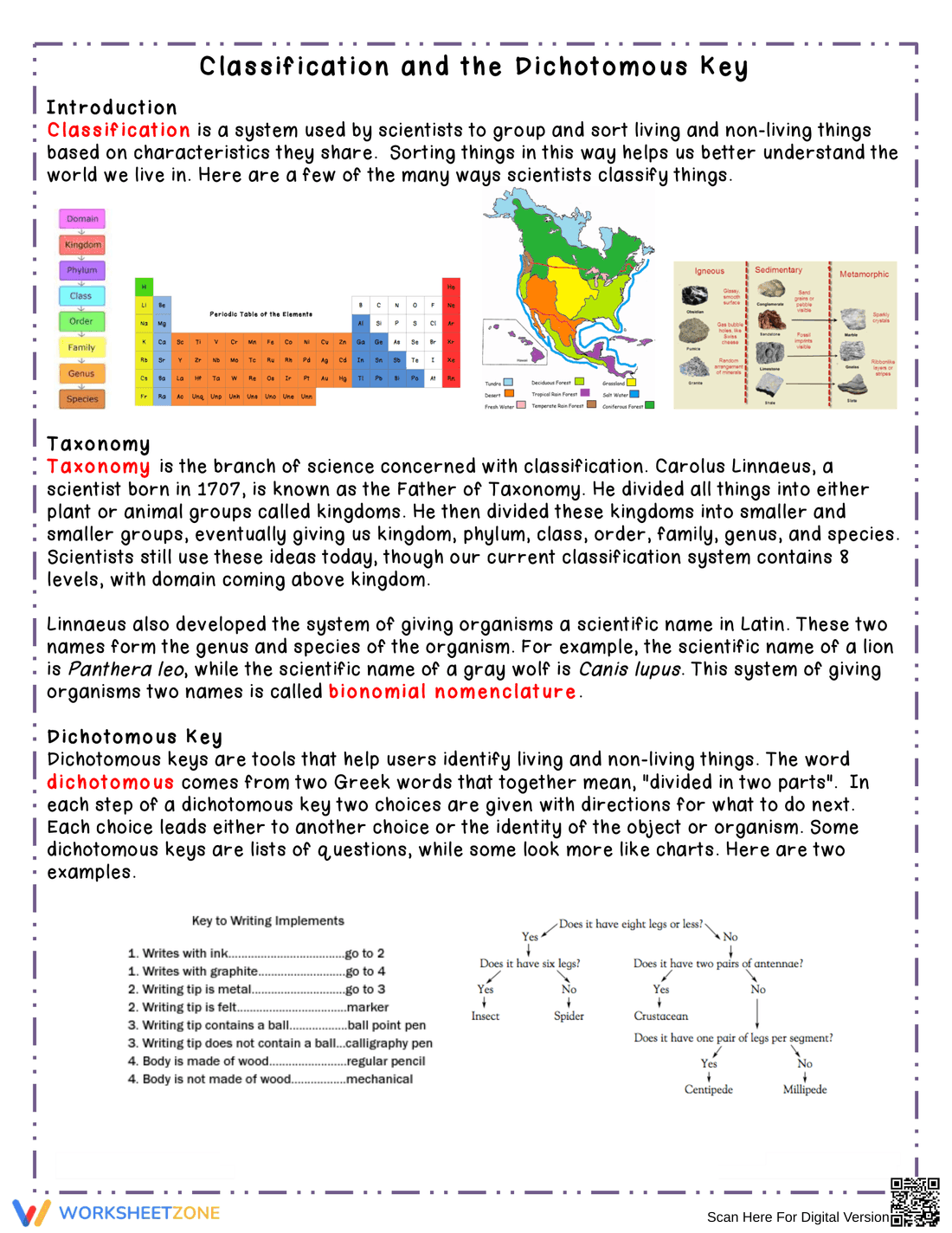
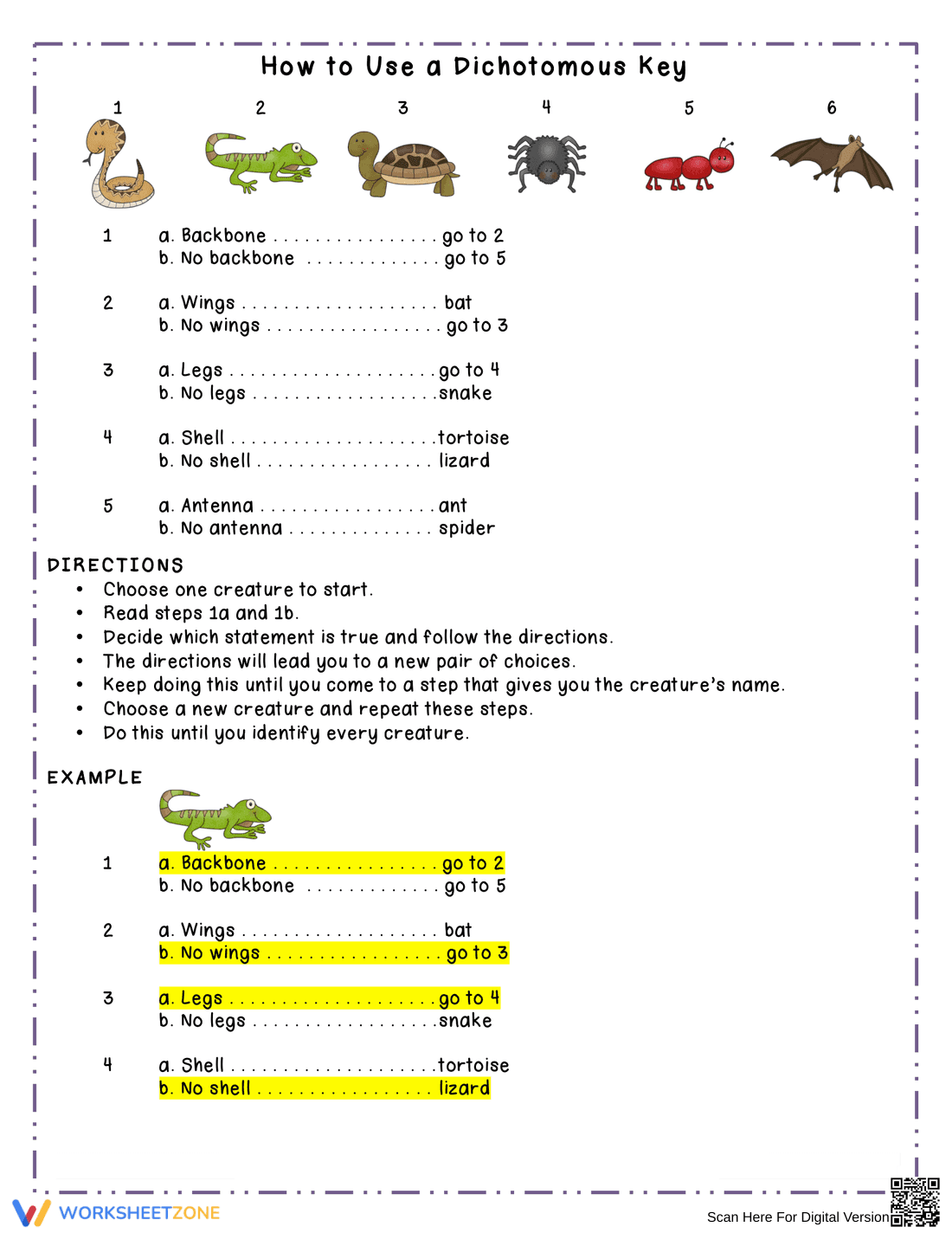
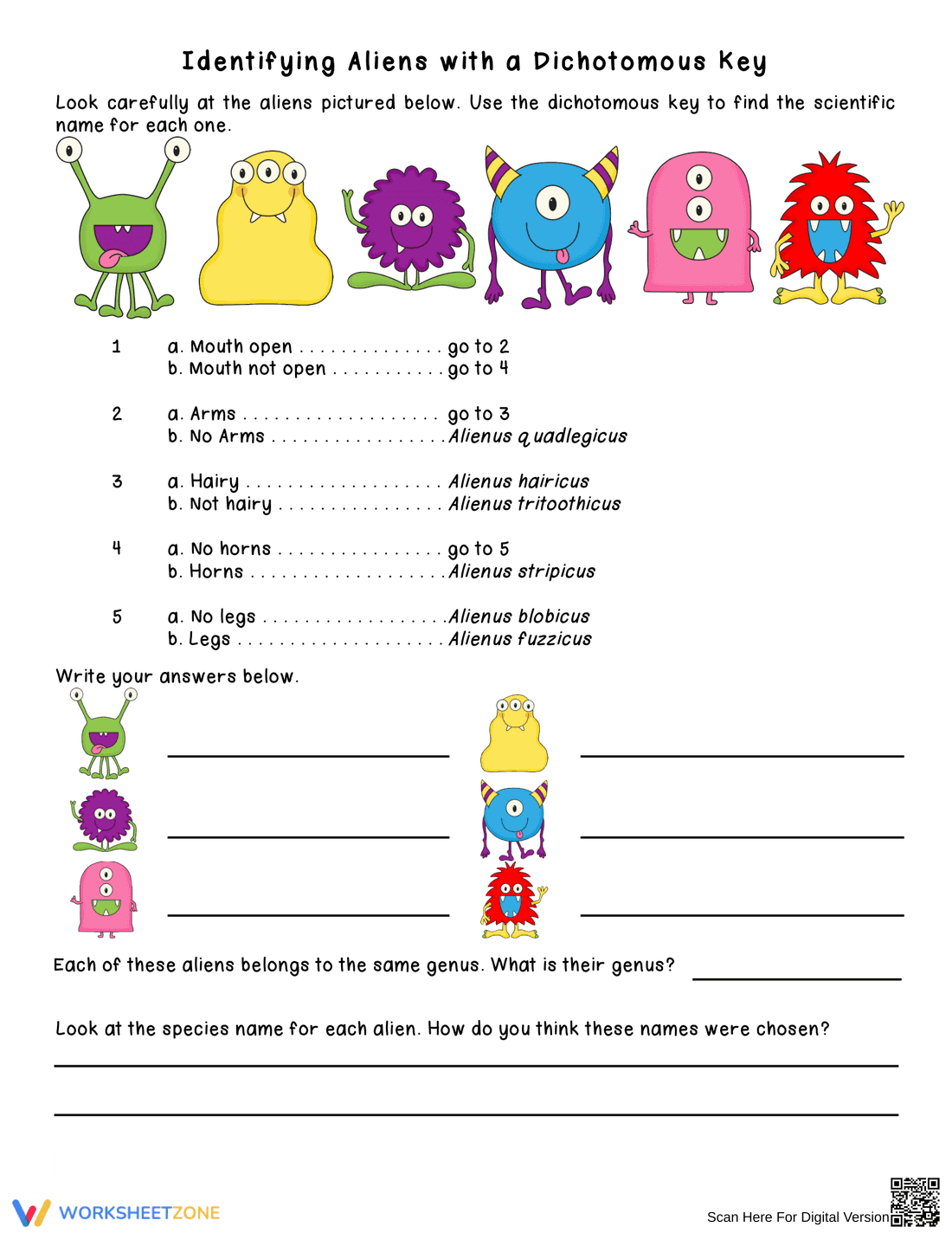
This 6-page instructional set includes a detailed reading passage covering the history of taxonomy and Carolus Linnaeus. Students are guided through the mechanics of binomial nomenclature before moving into active practice. The packet features two distinct identification worksheets—one focused on common animals and another using whimsical "alien" creatures to test logic—alongside a step-by-step guide for students to build their own classification key from scratch.
Zero-Prep Workflow
This resource is designed for immediate classroom implementation with three simple steps:
- Print: Select the 6-page PDF and print enough copies for your class in under 30 seconds.
- Distribute: Hand out the reading passage and worksheets as a complete packet for a self-contained lesson.
- Review: Use the provided examples to walk students through the first identification task before letting them work independently.
Total teacher preparation time is estimated at under 2 minutes, making this an ideal solution for busy educators or emergency sub plans.
Standards Alignment
This worksheet aligns primarily with MS-LS4-2, which requires students to apply scientific ideas to construct an explanation based on evidence for anatomical similarities and differences among organisms. By analyzing specific traits to navigate a key, students demonstrate mastery of phenotypic observation. Both standard codes can be copied directly into lesson plans, IEP goals, or district curriculum mapping tools.
How to Use It
Use this packet during the middle of a unit on classification or biodiversity. It works exceptionally well as a transition from direct instruction on taxonomy to independent lab work. For a formative assessment, observe students as they attempt the "Make Your Own" section; their ability to create mutually exclusive binary choices is a high-level indicator of conceptual mastery. Expect students to spend approximately 50 minutes for full completion.
Who It's For
This resource is tailored for middle school life science students in grades 6 through 8. It is particularly effective for visual learners who benefit from the clear illustrations of animals and creatures. It pairs naturally with an introductory lecture on the five kingdoms or an anchor chart detailing the levels of taxonomic hierarchy from domain down to species.
The use of dichotomous keys in middle school science is a foundational practice for developing observational skills and understanding biological taxonomy. According to Fisher & Frey (2014), scaffolded instructional materials that move from guided identification to independent creation—as seen in this 6-page packet—significantly improve student retention of complex scientific systems. By engaging with the MS-LS4-2 standard through both animal and "alien" classification, students move beyond rote memorization of kingdom and phylum into the application of logical branching. Research from the NAEP indicates that hands-on classification tasks help bridge the gap between abstract biological concepts and concrete evidence-based reasoning. This resource provides the necessary structure for students to master binomial nomenclature and the mechanics of binary choice trees, ensuring they can accurately categorize diverse organisms based on specific morphological traits. It is a comprehensive tool for any life science curriculum focusing on the diversity of life.


