




























Views
Downloads

Grade 7 Indonesian Vocabulary: Essential Fantasy Story Words

Paste this activity's link or code into your existing LMS (Google Classroom, Canvas, Teams, Schoology, Moodle, etc.).
Students can open and work on the activity right away, with no student login required.
You'll still be able to track student progress and results from your teacher account.
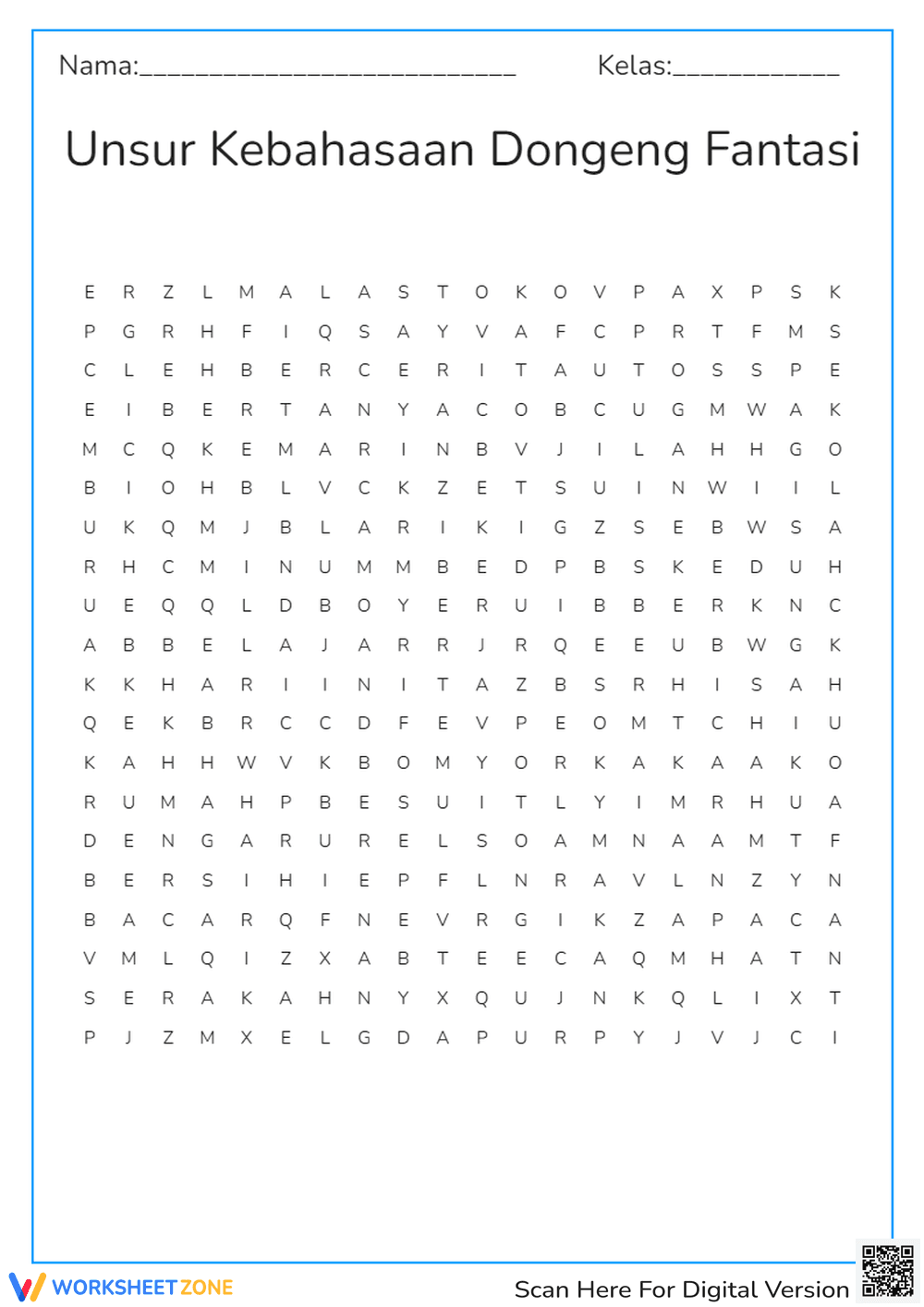
This Grade 7 Indonesian vocabulary worksheet provides a focused approach to mastering the linguistic elements of fantasy stories. Students engage with 40 key terms, including verbs, adjectives, and adverbs, to improve their reading comprehension and narrative writing skills. By identifying these words in a word search format, learners build familiarity with the specific terminology used in Indonesian fantasy tales.
At a Glance
- Grade: 7 · Subject: Indonesian
- Standard:
CCSS.ELA-LITERACY.L.7.4— Determine or clarify the meaning of unknown and multiple-meaning words and phrases- Skill Focus: Indonesian Vocabulary (Verbs, Adjectives, Adverbs)
- Format: 2 pages · 40 problems · Answer key included · PDF
- Best For: Vocabulary reinforcement and fast-finisher tasks
- Time: 15–25 minutes
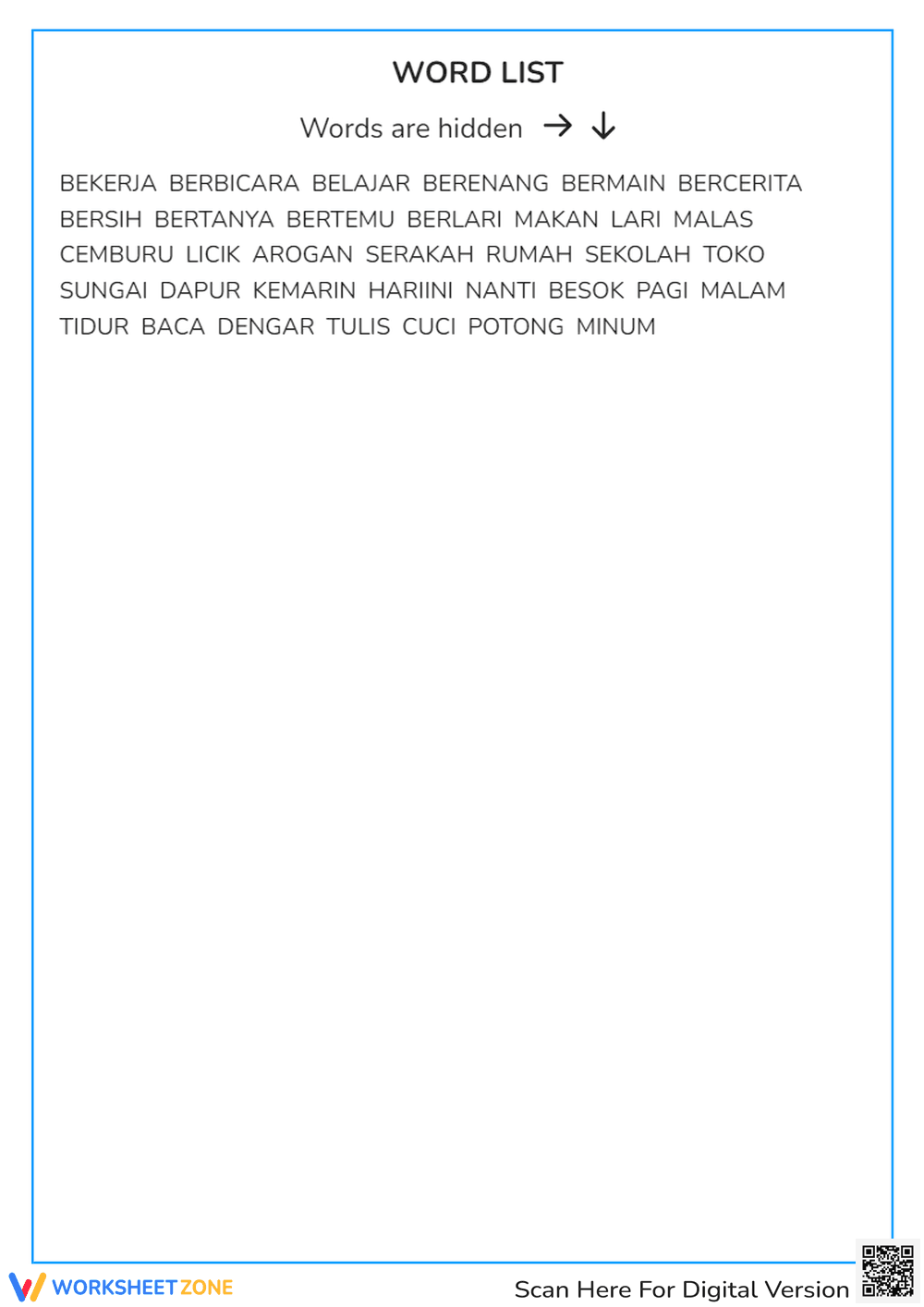
The resource consists of a 20x20 letter grid and a comprehensive word list. It features 40 distinct Indonesian words such as "bercerita" (to tell a story), "serakah" (greedy), and "besok" (tomorrow). The two-page layout ensures clarity, with the first page dedicated to the puzzle and the second providing the word list for easy reference or self-checking during independent work time.
This classroom-ready resource requires minimal teacher intervention. First, print the PDF, which takes less than one minute. Second, distribute the sheets to students as they enter the room for an immediate, quiet start. Third, use the completed word search as a springboard for a five-minute review on word categorization by part of speech. Total teacher prep time is under two minutes.
Aligned to CCSS.ELA-LITERACY.L.7.4, this activity requires students to determine or clarify the meaning of unknown and multiple-meaning words and phrases. It specifically targets vocabulary acquisition within a thematic context. Both standard codes can be copied directly into lesson plans, IEP goals, or district curriculum mapping tools to ensure instructional alignment.
Assign this worksheet as a warm-up activity during a unit on Indonesian literature or as a productive "fast-finisher" task. For formative assessment, observe which students struggle to locate specific parts of speech, such as adverbs of time like "nanti" or "pagi." Expected completion time ranges from 15 to 25 minutes depending on student proficiency levels.
This resource is designed for Grade 7 students in Indonesian language arts or learners in BIPA (Bahasa Indonesia bagi Penutur Asing) programs. It pairs naturally with a direct instruction lesson on narrative structure or a reading passage featuring a traditional Indonesian fable. The worksheet provides necessary scaffolding for students to recognize linguistic patterns in fantasy texts.
According to Fisher & Frey (2014), word-rich environments and intentional vocabulary practice are fundamental to developing literacy in any language. This Grade 7 Indonesian worksheet supports this research by providing a structured way for students to interact with 40 essential terms related to fantasy tales. By focusing on linguistic elements, the activity aligns with CCSS.ELA-LITERACY.L.7.4, ensuring that students are not just finding letters but are reinforcing their mental lexicon of verbs, adjectives, and adverbs. Research from the NAEP suggests that vocabulary knowledge is a primary predictor of long-term reading success. This word search serves as a low-stakes entry point for students to build the confidence needed for more complex textual analysis. By integrating these terms into their active vocabulary, students are better prepared to decode Indonesian fantasy narratives and apply these linguistic tools in their own creative writing assignments.


