


























Views
Downloads
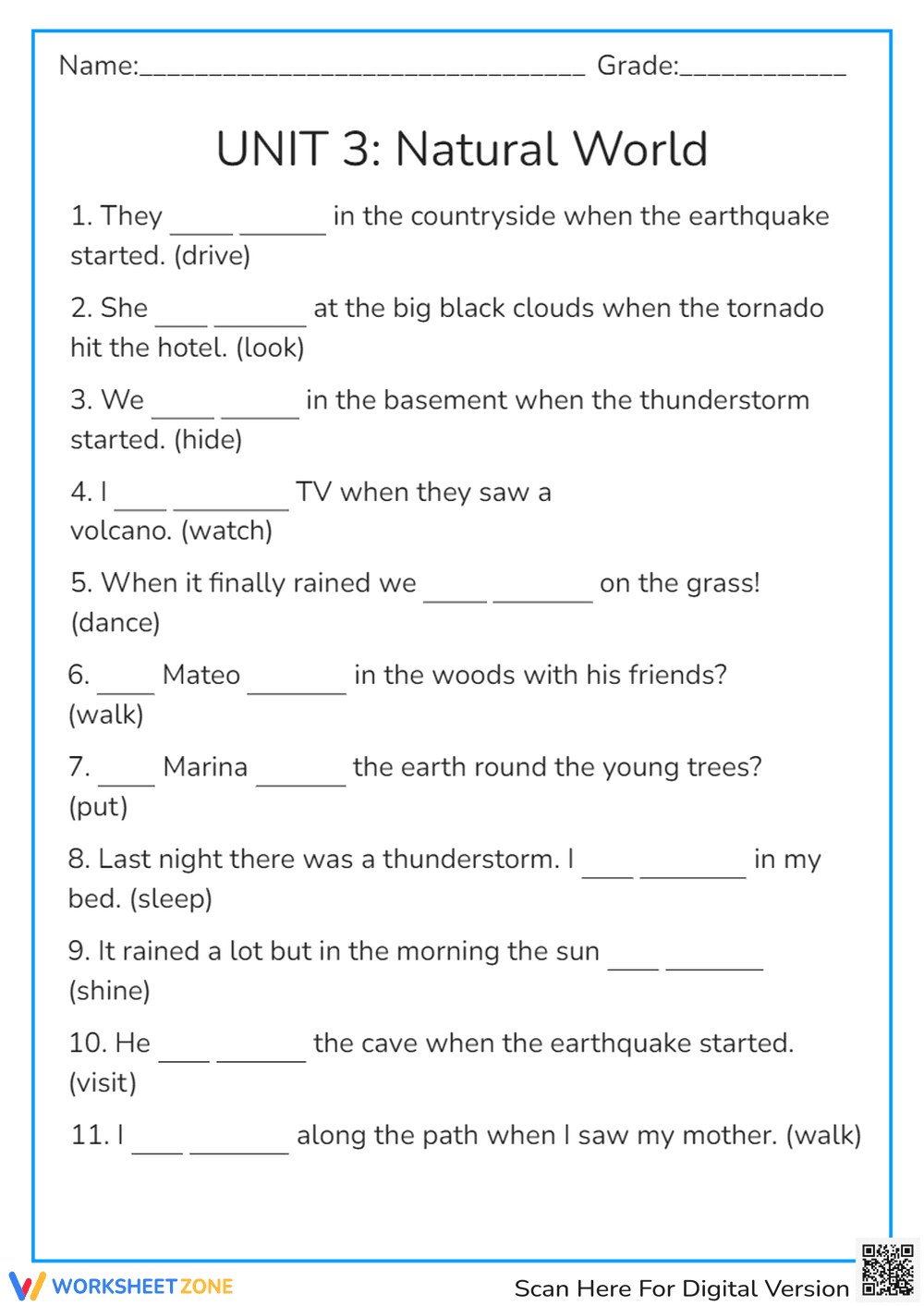

Past Continuous Worksheet | Grade 6 Essential Practice
Paste this activity's link or code into your existing LMS (Google Classroom, Canvas, Teams, Schoology, Moodle, etc.).
Students can open and work on the activity right away, with no student login required.
You'll still be able to track student progress and results from your teacher account.
Past continuous tense is a vital building block for narrative writing and descriptive accuracy. This Grade 6 worksheet provides targeted practice in forming the past continuous using "was/were" and the "-ing" verb form. Students apply these rules to 11 sentences themed around the natural world and weather events, ensuring they can describe ongoing actions in the past.
At a Glance
At a Glance
- Grade: 6 · Subject: ELA
- Standard:
CCSS.ELA-LITERACY.L.6.1— Demonstrate command of the conventions of standard English grammar and usage when writing- Skill Focus: Past Continuous Tense
- Format: 1 page · 11 problems · Answer key included · PDF
- Best For: Independent grammar practice or quick review
- Time: 10–15 minutes
What's Inside
This single-page PDF features 11 structured sentences focused on the "Natural World" theme, including scenarios involving earthquakes, tornadoes, and thunderstorms. Each sentence contains a blank space for the past continuous verb and provides the base verb in parentheses (e.g., "drive," "look," "hide"). The layout is clean and distraction-free, including a full answer key for rapid grading or student self-correction.
Zero-Prep Workflow
This resource is designed for immediate classroom implementation with a total teacher preparation time of under 2 minutes. Step 1: Print the single-page PDF (30 seconds). Step 2: Distribute the sheets as a bell-ringer or warm-up activity (30 seconds). Step 3: Review the 11 answers as a whole group to provide immediate feedback (5 minutes). Its self-contained nature makes it an ideal sub-plan component.
Standards Alignment
The primary focus is CCSS.ELA-LITERACY.L.6.1, which requires students to demonstrate command of the conventions of standard English grammar and usage. By correctly identifying when to use "was" versus "were" and appending the correct suffix, students solidify their understanding of verb tenses. Both standard codes can be copied directly into lesson plans, IEP goals, or district curriculum mapping tools.
How to Use It
Assign this worksheet during the "You Do" phase of a gradual release lesson on verb tenses. It serves as an excellent formative assessment to check if students understand subject-verb agreement in the progressive aspect. Expect students to complete the 11 tasks in approximately 12 minutes. This worksheet is particularly effective for identifying students who struggle with irregular spelling changes when adding suffixes.
Who It's For
This resource is tailored for Grade 6 students but is also highly effective for older English Language Learners (ELL) who need to master English verb structures. It pairs naturally with a short story about nature or a science lesson on weather patterns, allowing for cross-curricular reinforcement of vocabulary and grammar.
Effective grammar instruction relies on contextualized practice rather than isolated rote memorization. According to Fisher & Frey (2014), the gradual release of responsibility model is most effective when students have high-quality, focused materials to practice specific linguistic structures like the past continuous tense. This worksheet aligns with those findings by providing 11 specific opportunities for students to apply CCSS.ELA-LITERACY.L.6.1 within a thematic context. By using the "Natural World" theme, the worksheet reduces cognitive load, allowing students to focus entirely on the grammatical transformation of the base verbs provided. This resource provides the necessary scaffolding for Grade 6 learners to achieve fluency in complex verb forms. Furthermore, the inclusion of an answer key supports the immediate feedback loop essential for correcting misconceptions before they become habitual errors in student writing.


