


























Views
Plays


Main Idea & Supporting Details | Grade 6 Essential
Paste this activity's link or code into your existing LMS (Google Classroom, Canvas, Teams, Schoology, Moodle, etc.).
Students can open and work on the activity right away, with no student login required.
You'll still be able to track student progress and results from your teacher account.
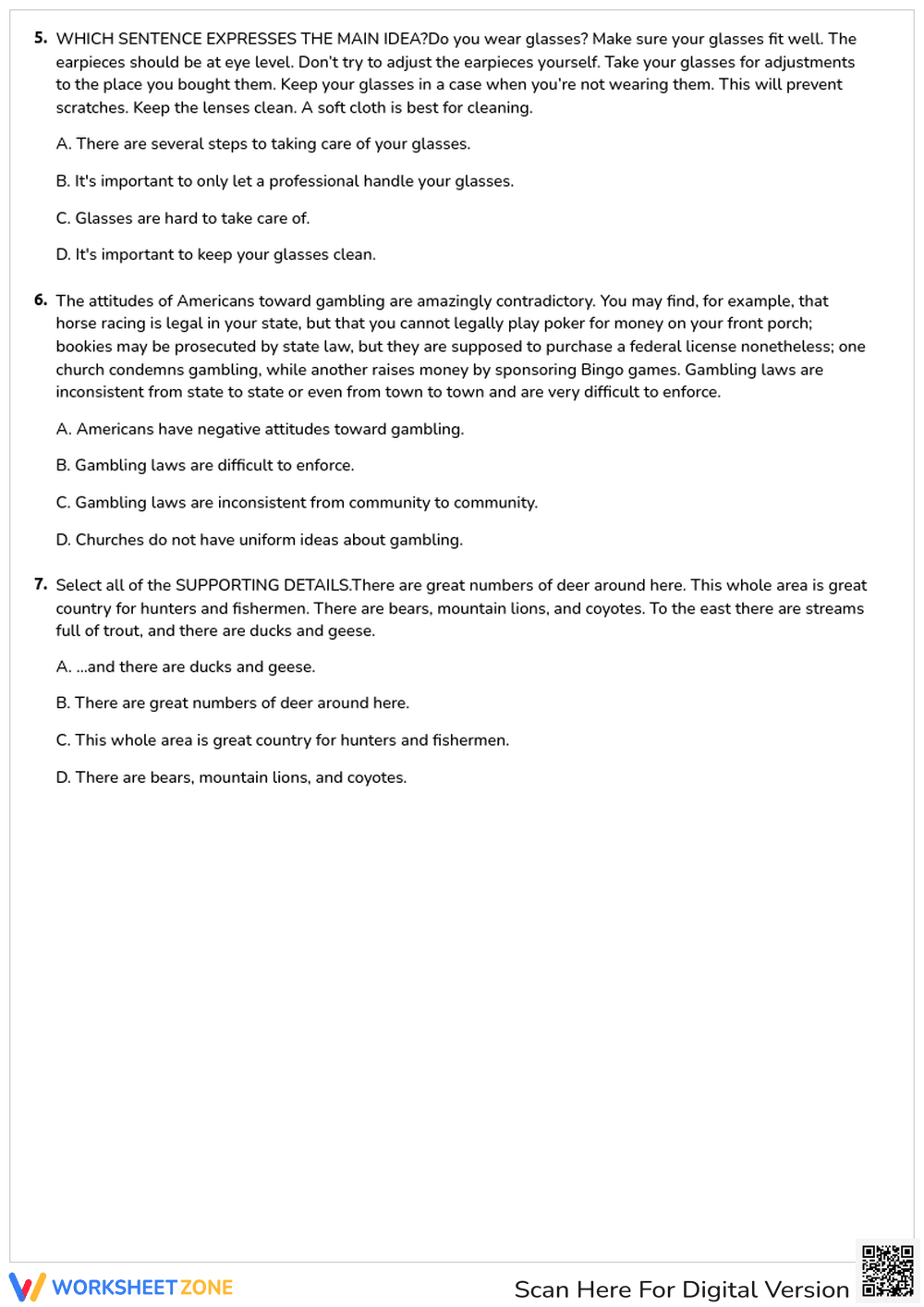
This Grade 6 ELA worksheet provides targeted practice in identifying the central message and supporting evidence within informational paragraphs. Students analyze 7 unique text segments to determine what the author is mostly talking about and which specific sentences provide the necessary proof. This resource ensures students can distinguish between the primary claim and the details that build it.
At a Glance
- Grade: 6 · Subject: ELA
- Standard:
CCSS.ELA-LITERACY.RI.6.2— Determine a central idea of a text and how it is conveyed through details- Skill Focus: Main Idea & Supporting Details
- Format: 2 pages · 7 problems · Answer key included · PDF
- Best For: Quick formative assessment or sub plans
- Time: 15–20 minutes
The document consists of 2 pages featuring 7 high-interest paragraphs covering topics from social dynamics to environmental issues. Each task is presented in a clear multiple-choice format, requiring students to either select the sentence that expresses the main idea or identify all relevant supporting details. The layout includes a dedicated space for names and grades, ensuring organized classroom management and easy tracking of student progress.
Zero-Prep Workflow
- Print: Generate the 2-page PDF for each student in under 1 minute.
- Distribute: Assign the worksheet as a silent bell-ringer or a mid-lesson check for understanding.
- Review: Grade the 7 multiple-choice questions using the included answer key to provide immediate feedback.
This streamlined workflow makes it an ideal candidate for emergency sub plans or transition periods where teacher prep time is limited to under 2 minutes.
Standards Alignment
This resource is primarily aligned with `CCSS.ELA-LITERACY.RI.6.2`, which requires students to determine a central idea of a text and how it is conveyed through particular details. It also supports RI.5.2 by asking students to summarize the text. Both standard codes can be copied directly into lesson plans, IEP goals, or district curriculum mapping tools.
How to Use It
Use this worksheet as a "ticket out the door" after a lesson on text structure to gauge individual student mastery. During direct instruction, teachers can project the first paragraph and use it for a "think-aloud" to model the elimination of distractors. Expect students to complete the 7 items within 15 to 20 minutes depending on reading speed. This provides a clear data point for formative assessment.
Who It's For
This material is designed for 5th and 6th-grade students who are refining their informational reading skills. It is particularly effective for English Language Learners (ELLs) due to the concise paragraph lengths and clear options. Pair this worksheet with a graphic organizer or an anchor chart on "The Main Idea Umbrella" for a comprehensive literacy block.
Research by Fisher & Frey (2014) emphasizes that identifying the central idea is a foundational literacy skill that requires students to distinguish between essential information and interesting but non-essential details. This Grade 6 worksheet targets CCSS.ELA-LITERACY.RI.6.2 by providing 7 distinct paragraph contexts where students must isolate the primary claim from its supporting evidence. According to NAEP data, students who master the relationship between main ideas and supporting details demonstrate significantly higher overall reading comprehension scores. By utilizing multiple-choice formats, this resource allows for rapid diagnostic feedback, helping educators identify specific gaps in textual analysis. The structured approach ensures that learners practice the cognitive shift from literal reading to inferential synthesis, a critical transition in middle school ELA. This tool provides the necessary repetition to move students toward mastery of complex informational texts.


