


























0
Views
0
Downloads

0.0
0
Save
0 Likes
Understanding Atomic Models Through Comparison and Analysis
0 Views
0 Downloads
Paste this activity's link or code into your existing LMS (Google Classroom, Canvas, Teams, Schoology, Moodle, etc.).
Students can open and work on the activity right away, with no student login required.
You'll still be able to track student progress and results from your teacher account.
Information
Description
What It Is:
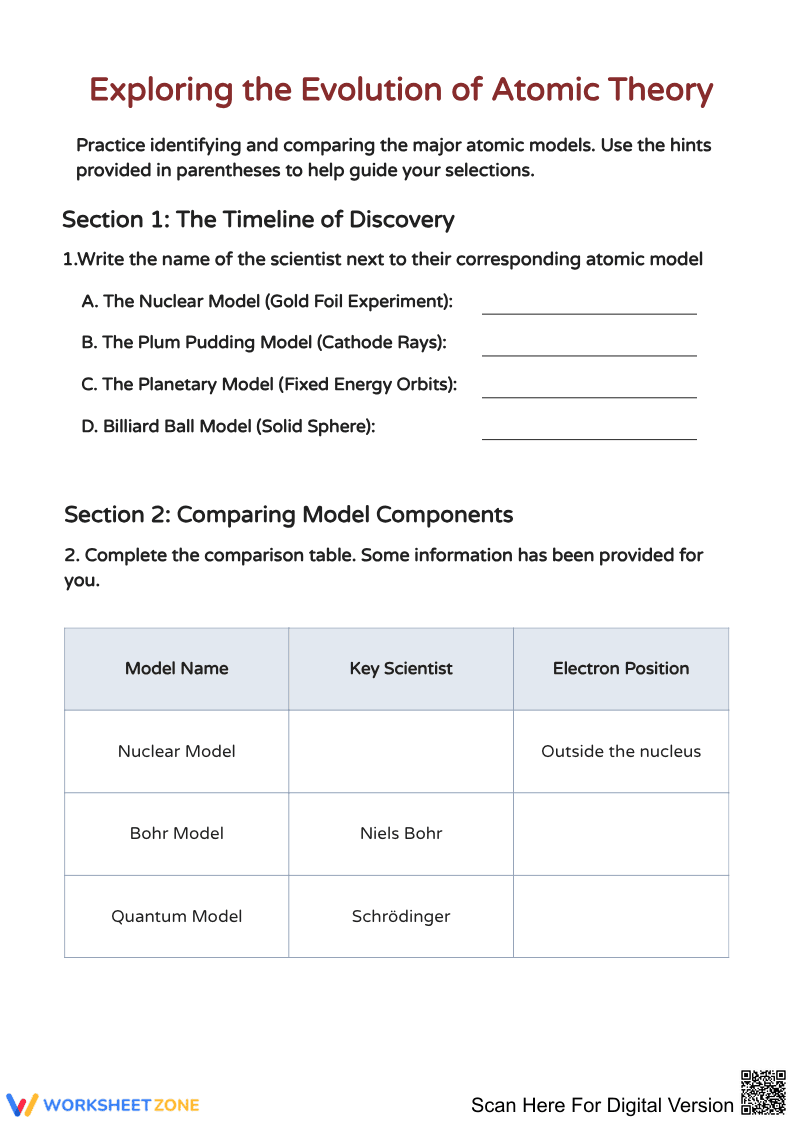
This Grade 11 worksheet guides students in understanding the evolution of atomic theory, comparing major atomic models by scientists such as Rutherford, Thomson, Bohr, and Schrödinger. Students will identify which scientist corresponds to each atomic model and compare key components such as electron position in each model.
Why Use It:
This worksheet helps students learn the historical progression of atomic theory, supporting critical thinking and reinforcing their understanding of foundational scientific models in chemistry and physics.
How to Use It:
• Identify which scientist belongs to which atomic model in the timeline of discovery.
• Complete a comparison table by matching key scientists to the atomic models and their respective electron positions.
• Compare and contrast the models to highlight key differences in atomic theory.
Grade Suitability:
Best suited for Grade 11 students.
• Students studying atomic theory in chemistry, physics, or general science courses.
Target Users:
Grade 11 students and educators, particularly those teaching atomic theory, atomic structure, and the historical development of scientific models.
This Grade 11 worksheet guides students in understanding the evolution of atomic theory, comparing major atomic models by scientists such as Rutherford, Thomson, Bohr, and Schrödinger. Students will identify which scientist corresponds to each atomic model and compare key components such as electron position in each model.
Why Use It:
This worksheet helps students learn the historical progression of atomic theory, supporting critical thinking and reinforcing their understanding of foundational scientific models in chemistry and physics.
How to Use It:
• Identify which scientist belongs to which atomic model in the timeline of discovery.
• Complete a comparison table by matching key scientists to the atomic models and their respective electron positions.
• Compare and contrast the models to highlight key differences in atomic theory.
Grade Suitability:
Best suited for Grade 11 students.
• Students studying atomic theory in chemistry, physics, or general science courses.
Target Users:
Grade 11 students and educators, particularly those teaching atomic theory, atomic structure, and the historical development of scientific models.


