


























Views
Downloads



Printable Under the Sea Counting Activity | Grade K
Paste this activity's link or code into your existing LMS (Google Classroom, Canvas, Teams, Schoology, Moodle, etc.).
Students can open and work on the activity right away, with no student login required.
You'll still be able to track student progress and results from your teacher account.
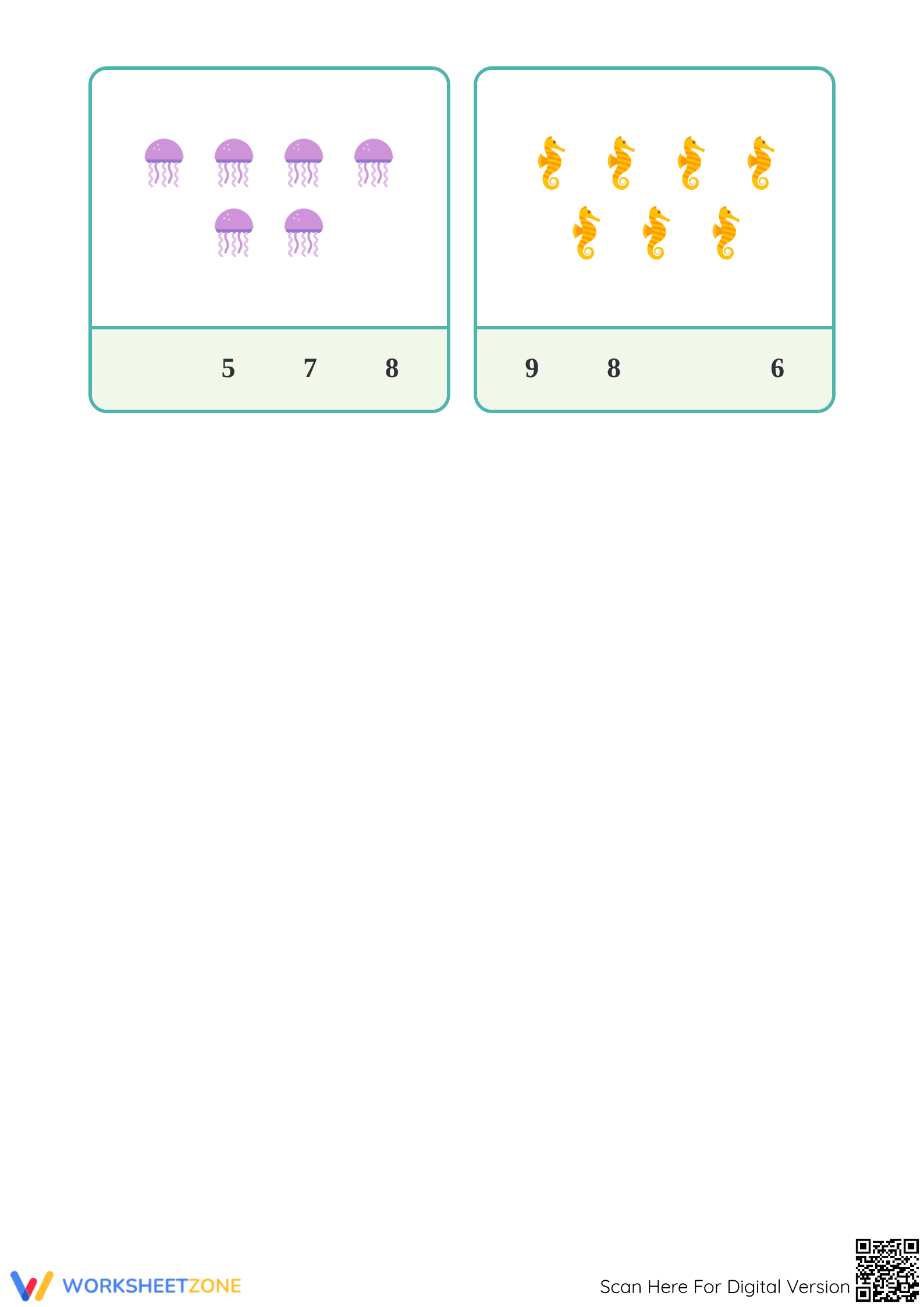
This printable Kindergarten worksheet helps young learners master counting and cardinality through an engaging underwater theme. Students count various sea creatures—including clownfish, starfish, and seahorses—and circle the correct numeric representation. It provides focused practice for developing one-to-one correspondence and number recognition in a visually stimulating format designed for immediate classroom use.
At a Glance
- Grade: K · Subject: Math
- Standard:
CCSS.MATH.CONTENT.K.CC.B.5— Count to answer how many questions about as many as 20 things- Skill Focus: Counting and Cardinality
- Format: 3 pages · 8 problems · Answer key included · PDF
- Best For: Early math centers and independent practice
- Time: 10–15 minutes
The worksheet pack consists of three high-quality PDF pages featuring eight distinct counting boxes. Each box contains a group of sea creatures, such as octopuses, crabs, or turtles, with three multiple-choice number options below. A comprehensive answer key is provided for each page, ensuring quick grading or student self-correction. The clear layout and large illustrations make it accessible for beginning readers.
Implementing this activity requires minimal effort from the educator. First, Print the three-page set in about 30 seconds. Next, Distribute the worksheets to students during math centers or as a morning warm-up. Finally, Review the answers using the included key or through a quick whole-class check. Total teacher preparation time is less than two minutes, making it an ideal emergency sub plan or transition activity.
The primary focus is CCSS.MATH.CONTENT.K.CC.B.5: "Count to answer 'how many?' questions about as many as 20 things arranged in a line, a rectangular array, or a circle." This resource also supports K.CC.B.4 by reinforcing the understanding that the last number name said tells the number of objects counted. Both standard codes can be copied directly into lesson plans, IEP goals, or district curriculum mapping tools.
Use this worksheet during the "independent practice" phase of a lesson on counting to 10. For formative assessment, observe students as they count: notice if they use a finger to track each object, which indicates developing one-to-one correspondence. It also serves as an excellent quiet-time activity for students who finish other tasks early. Most Kindergarten students will complete the entire eight-problem set within 15 minutes.
This activity is specifically designed for Kindergarten students but is also appropriate for Pre-K learners ready for numeric symbols. It pairs naturally with an ocean-themed picture book or an anchor chart showing numbers 1-10. The clear visual boundaries of each counting box help students with spatial organization challenges focus on one task at a time, providing a structured environment for mastery.
According to the RAND AIRS 2024 report, high-quality supplemental materials that combine thematic engagement with specific skill targets significantly improve student retention of foundational math concepts. This activity directly addresses the CCSS.MATH.CONTENT.K.CC.B.5 standard by requiring students to count sets of objects and connect them to digits. Research from the NAEP highlights the importance of early cardinality skills as a predictor of later mathematical success, emphasizing the need for repeated, structured practice like that found in this resource. By using recognizable sea creature icons, the worksheet maintains high student interest while reinforcing the plain-English skill of accurately determining "how many" are in a group. This structured approach ensures that learners develop the necessary number sense to move toward more complex operations, provided in a ready-to-use printable format.


