


























Views
Plays


Essential ASVAB Automotive Knowledge Worksheet
Paste this activity's link or code into your existing LMS (Google Classroom, Canvas, Teams, Schoology, Moodle, etc.).
Students can open and work on the activity right away, with no student login required.
You'll still be able to track student progress and results from your teacher account.
This high school vocational worksheet provides targeted preparation for the ASVAB Automotive Knowledge subtest by evaluating student understanding of vehicle mechanics. Students analyze core automotive systems, engine operations, and component functions to build technical competency required for military and mechanical careers.
At a Glance
- Grade: 12 · Subject: Career Technical Education
- Standard:
HS-PS3-3— Design and refine a device that converts one form of energy into another.- Skill Focus: Automotive systems and mechanical operations
- Format: 2 pages · 10 problems · Answer key included · PDF
- Best For: ASVAB test prep and vocational review
- Time: 15–20 minutes
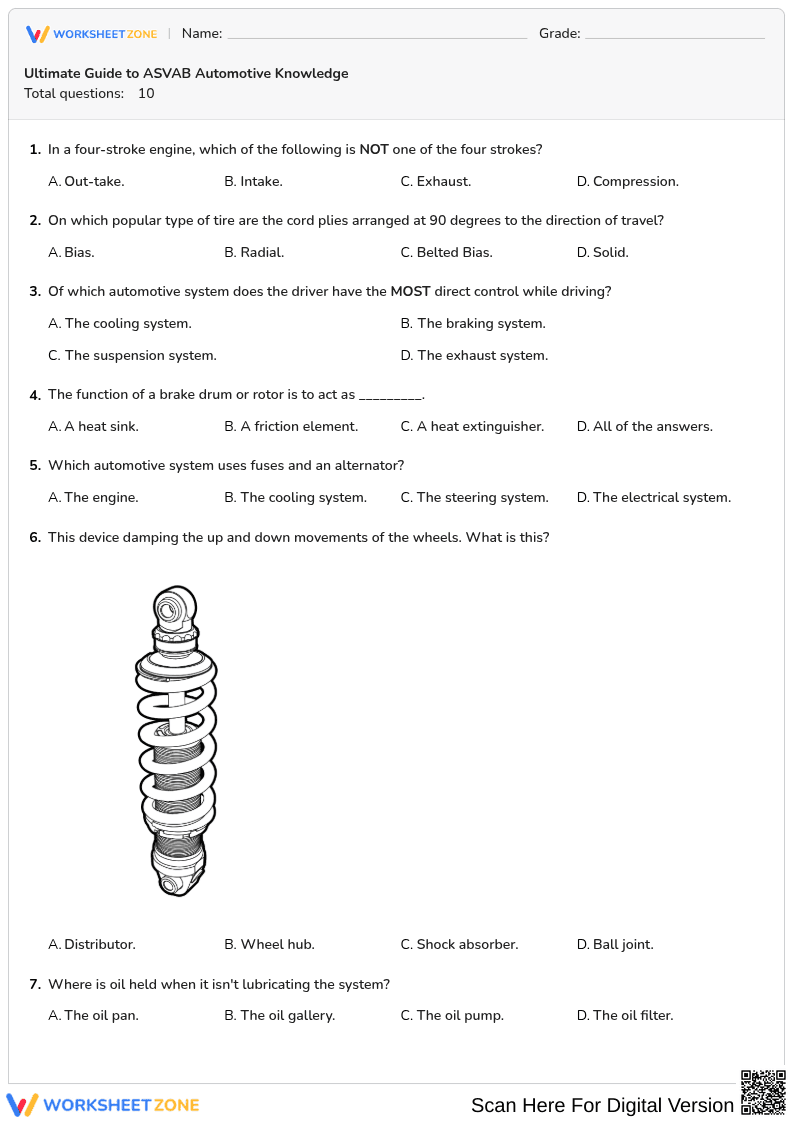
This 2-page assessment features 10 multiple-choice questions replicating the format of military entrance examinations. The layout includes clear diagrams, such as a shock absorber illustration, to test visual component identification alongside theoretical knowledge. Topics span four-stroke engine cycles, tire plies, electrical systems, and emission mechanisms. A complete answer key facilitates rapid grading.
Zero-Prep Classroom Workflow
This resource is engineered for immediate deployment. Teachers can execute a simple three-step workflow: print the two-page document in 1 minute, distribute copies for a focused 15-minute assessment, and review answers using the included key. Total teacher preparation time is under 2 minutes, making this an exceptional option for substitute plans or quick bell-ringers.
Standards Alignment
This worksheet aligns primarily with HS-PS3-3, where students analyze devices converting energy from one form to another, mirroring how internal combustion engines transform fuel into torque. It supports career and technical education frameworks focusing on transportation systems. Both standard codes can be copied directly into lesson plans, IEP goals, or district curriculum mapping tools.
How to Use It
Utilize this worksheet as a formative assessment following a unit on mechanical systems or during ASVAB preparation blocks. Instructors should observe student responses to note if learners struggle with specific subsystems like electrical or cooling mechanics. Completion time ranges from 15 to 20 minutes, allowing opportunity for post-quiz discussions regarding engine strokes.
Who It's For
This resource is tailored for grade 12 vocational learners and adult candidates preparing for military enlistment. It offers excellent differentiation for students pursuing automotive tracks. For optimal instructional impact, pair this worksheet with an interactive engine diagram anchor chart or a direct instruction lesson on internal combustion mechanics.
According to the NAEP vocational preparation frameworks, structured multiple-choice diagnostics that incorporate both conceptual questions and visual diagrams significantly improve technical retention among secondary learners. This 10-question assessment targets the mechanical aptitude benchmarks required for career readiness and military placement exams. By isolating specific automotive subsystems—such as suspension damping, electrical regulation, and thermal dissipation—the worksheet ensures students develop the precise vocabulary highlighted in the EdReports 2024 curriculum guidelines. Integrating these technical reviews within high school science tracks helps bridge the gap between theoretical physics and practical mechanical applications, ensuring students achieve mastery over standard HS-PS3-3. This resource provides an efficient, evidence-based pathway for evaluating student readiness, tracking individual progress, and reinforcing critical vocational competencies before high-stakes testing environments.


