




























Views
Downloads

Kindergarten Handwriting Practice | Essential Printable

Paste this activity's link or code into your existing LMS (Google Classroom, Canvas, Teams, Schoology, Moodle, etc.).
Students can open and work on the activity right away, with no student login required.
You'll still be able to track student progress and results from your teacher account.
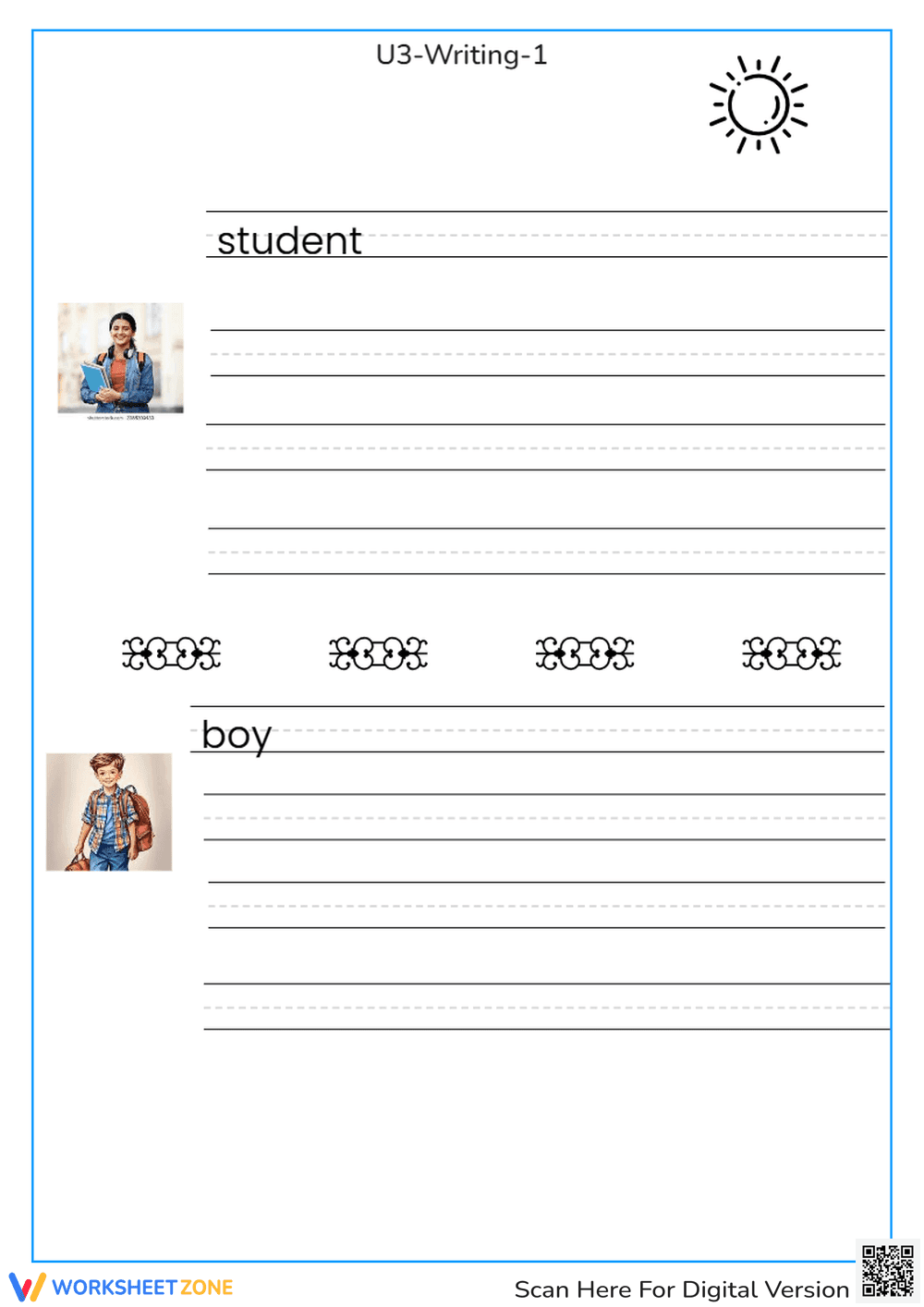
This Kindergarten handwriting worksheet provides structured practice for early writers to master letter formation and word spacing. By focusing on high-frequency nouns like "student" and "boy," students develop the fine motor control necessary for legible penmanship. This resource ensures young learners build confidence through repetitive, guided writing tasks on standard primary-ruled lines.
At a Glance
- Grade: Kindergarten · Subject: Handwriting
- Standard:
CCSS.ELA-LITERACY.L.K.1.A— Print many upper- and lowercase letters with proper formation- Skill Focus: Letter formation and word writing
- Format: 1 page · 8 practice lines · No answer key needed · PDF
- Best For: Morning work or independent writing centers
- Time: 10–15 minutes
The worksheet features a clean, distraction-free layout with two distinct sections. Each section includes a visual prompt paired with the target word in a clear font. Below each word, students find four primary-ruled lines featuring a solid top line, a dashed middle line, and a solid bottom line to guide proper letter height and placement. This 1-page PDF is designed for maximum clarity for emerging writers.
Teachers can implement this activity in under 2 minutes. Simply print the single-page PDF, distribute it to students with pencils, and provide a brief model of the first letter. Because the visual cues are self-explanatory, this worksheet functions perfectly as a grab-and-go sub plan or a quiet transition activity during literacy rotations. It requires zero teacher setup beyond the initial print job.
This resource aligns with `CCSS.ELA-LITERACY.L.K.1.A`, which requires students to print many upper- and lowercase letters. It specifically supports the development of vertical and horizontal stroke control through the repetition of specific letter shapes. Both standard codes can be copied directly into lesson plans, IEP goals, or district curriculum mapping tools.
Use this worksheet during the independent practice phase of a handwriting lesson after demonstrating the letters. As a formative assessment, observe student grip and stroke directionality while they complete the 8 lines of practice. Completion typically takes 10 to 15 minutes depending on fine motor development. It is an ideal tool for reinforcing the connection between phonics and written form.
This is designed for Kindergarten students or Pre-K learners ready for word-level writing. It serves as an excellent Tier 1 instructional tool or a Tier 2 intervention for students needing extra motor practice. Pair this with a letter formation anchor chart or a phonics lesson on people-related nouns to provide a comprehensive literacy experience.
According to the Fisher & Frey (2014) framework for gradual release of responsibility, structured independent practice is vital for motor skill acquisition in early childhood. This worksheet addresses CCSS.ELA-LITERACY.L.K.1.A by providing 8 lines of targeted practice for the words "student" and "boy." Research from the 2024 NAEP reports indicates that early mastery of handwriting is a significant predictor of later writing fluency and compositional quality. By utilizing primary-ruled lines, this resource helps students internalize spatial awareness and letter proportions. The inclusion of visual anchors supports vocabulary association while the repetitive nature of the task builds muscle memory. This printable PDF is a reliable tool for educators seeking to bridge the gap between letter recognition and functional writing in a Kindergarten classroom setting.


