


























Views
Downloads

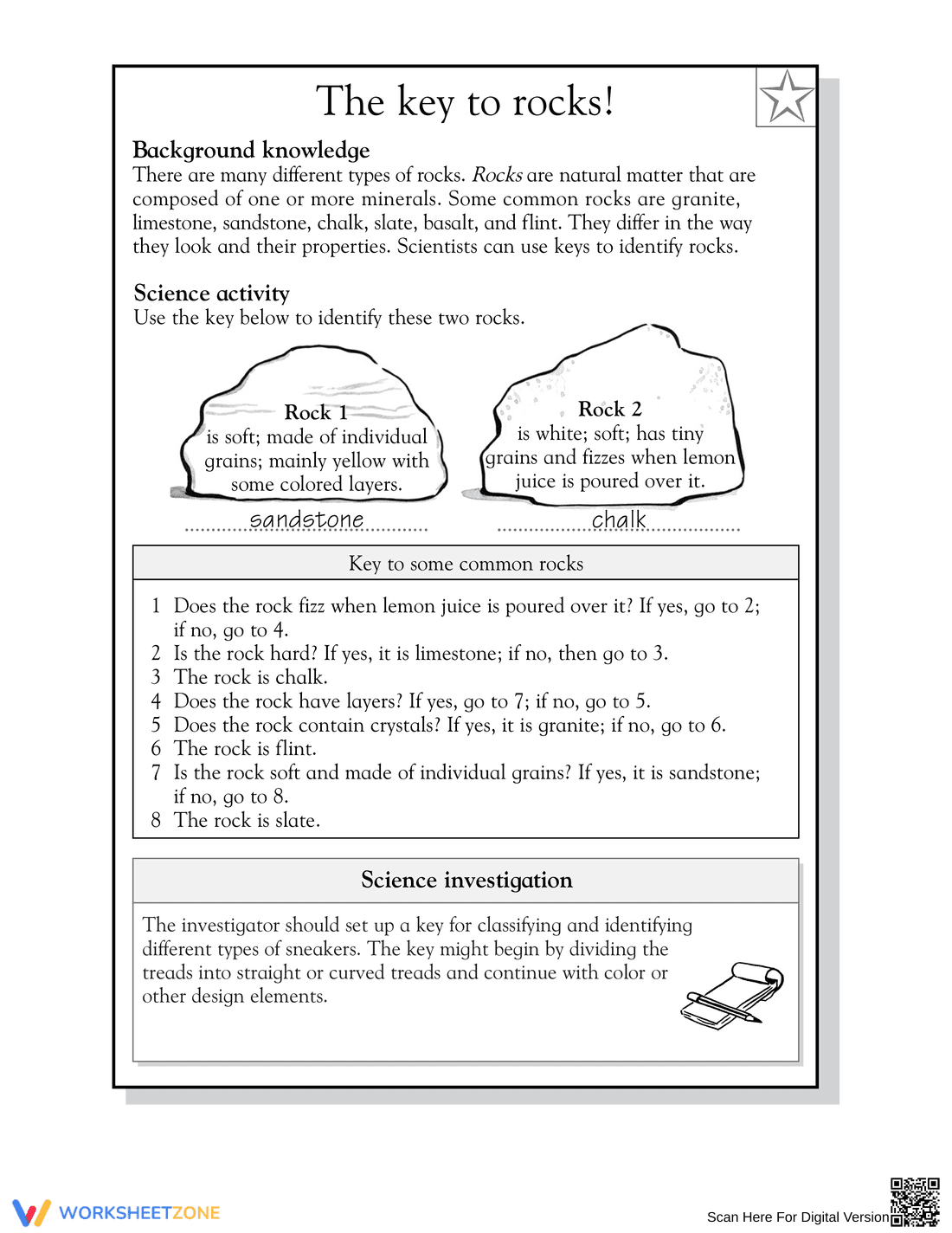

Types of Rocks Worksheet | Grade 5 Essential Science
Paste this activity's link or code into your existing LMS (Google Classroom, Canvas, Teams, Schoology, Moodle, etc.).
Students can open and work on the activity right away, with no student login required.
You'll still be able to track student progress and results from your teacher account.
This Grade 5 science worksheet empowers students to classify and identify earth materials through systematic observation. By applying a dichotomous key to specific rock samples, learners develop critical thinking skills necessary for geological study. Students move from reading background information to active identification and finally to creating their own classification systems.
At a Glance
- Grade: 5 · Subject: Science
- Standard:
5-PS1-3— Make observations and measurements to identify materials based on their properties- Skill Focus: Rock identification and classification keys
- Format: 1 page · 3 tasks · Answer key included · PDF
- Best For: Earth science units and inquiry practice
- Time: 20–30 minutes
This comprehensive 1-page PDF features a concise background knowledge section defining rocks and minerals. The core activity presents two distinct rock samples with detailed physical descriptions, including texture, composition, and chemical reactions. Students use a provided 8-step "Key to some common rocks" to identify the samples. The page concludes with a "Science investigation" prompt that challenges students to apply their knowledge by developing a custom identification key for everyday objects.
This resource is designed for immediate classroom implementation with a total teacher prep time of under 2 minutes. First, print the single-page PDF for your class. Second, distribute the sheets during your Earth Science block; the self-contained background text allows students to begin immediately without a lengthy lecture. Finally, review the identification results as a whole group to provide instant feedback on their logic and observation accuracy. This workflow makes it an ideal choice for emergency sub plans or supplemental practice.
The primary focus is 5-PS1-3, which requires students to identify materials based on specific properties like color, hardness, and reactivity. By testing for "fizzing" with lemon juice and observing grain size, students engage directly with the evidence-based practices outlined in the NGSS framework. This standard code can be copied directly into lesson plans, IEP goals, or district curriculum mapping tools.
Use this worksheet as a formative assessment after introducing the three main rock types. It serves as an excellent bridge between direct instruction and hands-on lab work. Teachers should observe if students can follow the branching logic of the key correctly. Completion typically takes 25 minutes, making it an ideal independent practice activity during science rotations or a quiet-work option for early finishers.
This resource is tailored for 5th-grade students but is highly effective for 4th-grade enrichment or 6th-grade review. It supports diverse learners through clear, structured text and visual rock representations. Pair this worksheet with a physical rock collection or a digital anchor chart on mineral properties to provide a multi-sensory learning experience for your students.
According to the RAND AIRS 2024 analysis of effective science pedagogy, structured inquiry tasks like dichotomous key identification significantly improve a student's ability to categorize complex natural data. This worksheet aligns with the 5-PS1-3 standard, which emphasizes the use of physical and chemical properties—such as grain size, hardness, and acid reactivity—to identify unknown substances. By engaging in the "Science investigation" task, students move beyond rote memorization into the higher-order thinking required for scientific modeling. Research from Fisher & Frey (2014) suggests that providing students with clear background knowledge before asking them to apply logic in a classification task reduces cognitive load and increases mastery of the subject matter. This resource provides that necessary scaffolding, ensuring that Grade 5 learners can successfully navigate the complexities of geology while building a foundation for middle school earth science concepts and systematic inquiry.


