


























Views
Downloads
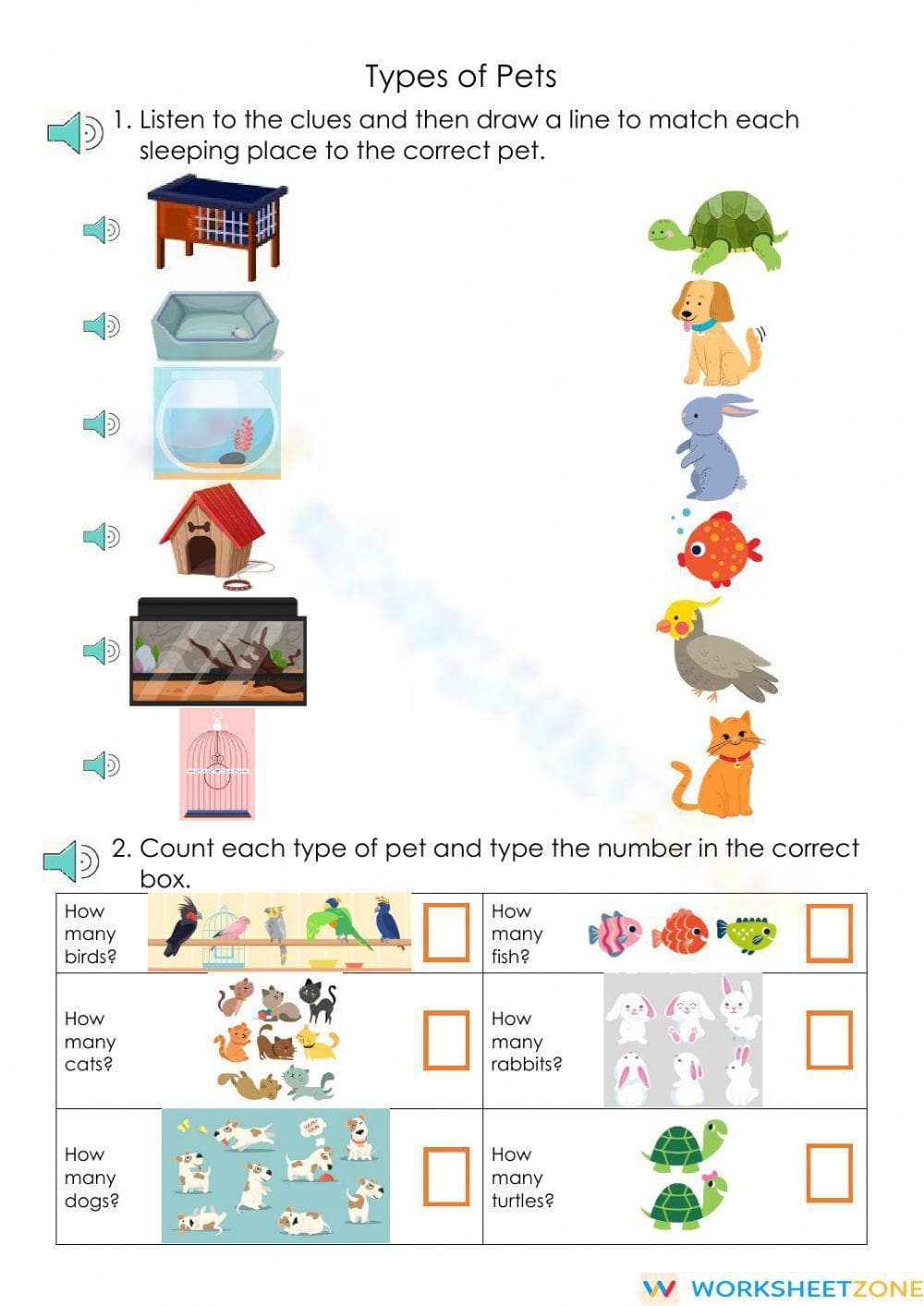

Types of Pets Worksheet | Grade K Essential Printable
Paste this activity's link or code into your existing LMS (Google Classroom, Canvas, Teams, Schoology, Moodle, etc.).
Students can open and work on the activity right away, with no student login required.
You'll still be able to track student progress and results from your teacher account.
This Types of Pets worksheet introduces early learners to common domestic animals through interactive matching and counting activities. Students develop essential vocabulary by identifying pets and their typical habitats while reinforcing one-to-one correspondence skills. This comprehensive resource ensures young children build a strong foundation in both language arts and early numeracy through engaging, visual-heavy tasks that maintain focus.
At a Glance
- Grade: Kindergarten · Subject: ELA & Math
- Standard:
CCSS.MATH.CONTENT.K.CC.B.4— Understand the relationship between numbers and quantities by counting objects in a set- Skill Focus: Pet identification and counting
- Format: 1 page · 12 problems · Answer key included · PDF
- Best For: Early finishers and morning work routines
- Time: 10–15 minutes
The worksheet features two distinct sections designed for maximum student engagement. The first section presents six matching problems where students draw lines between various pets—including a turtle, dog, rabbit, fish, bird, and cat—and their specific sleeping environments like cages, bowls, or beds. The second section provides six counting groups where students must observe colorful illustrations of animal clusters and record the total quantity for each species in a dedicated answer box.
This resource is designed for immediate classroom implementation with a total teacher preparation time of under two minutes. First, simply print the single-page PDF for your entire class or a small group. Second, distribute the materials along with crayons or pencils; no additional tools are required. Finally, review the completed worksheets using the included answer key for quick formative assessment. The intuitive layout makes it an ideal choice for substitute teacher plans or independent station work.
The primary alignment for this activity is CCSS.MATH.CONTENT.K.CC.B.4. Additionally, the matching component supports ELA standards regarding categorization and vocabulary acquisition. Both standard codes can be copied directly into lesson plans, IEP goals, or district curriculum mapping tools to ensure all instructional minutes are tied to rigorous academic expectations.
Use this worksheet as a concluding activity after a group discussion about different types of animals people keep at home. It serves as an excellent formative assessment tool to observe if students can accurately match objects or if they struggle with counting clusters of five or more items. Teachers should look for students who use a "touch and count" strategy to ensure accuracy. Completion typically takes ten to fifteen minutes depending on the student's fine motor speed.
This printable is specifically tailored for Preschool and Kindergarten students who are beginning to explore animal science and basic numeracy. It includes visual cues that support English Language Learners (ELL) and students with IEP accommodations requiring reduced text density. For a complete lesson experience, pair this worksheet with a picture book about pets or a classroom anchor chart displaying various animal homes and habitat names.
As established by Fisher & Frey (2014) in their research on the gradual release of responsibility, scaffolded tasks like these matching and counting exercises provide the necessary phases of learning. By focusing on the CCSS.MATH.CONTENT.K.CC.B.4 standard, the worksheet bridges the gap between abstract number names and concrete physical quantities. Data from NAEP and ScienceDirect TpT Analysis suggest that students who engage with high-interest, animal-themed content demonstrate higher task persistence and better retention of categorical vocabulary. This Types of Pets resource provides 12 specific opportunities for students to practice these critical skills in a low-stakes, printable format. The combination of visual identification and quantitative reasoning supports diverse learning styles while ensuring that early childhood educators can meet state-mandated curriculum benchmarks without extensive preparation time or specialized equipment. It stands as a reliable tool for classroom instruction.


