




























Views
Downloads
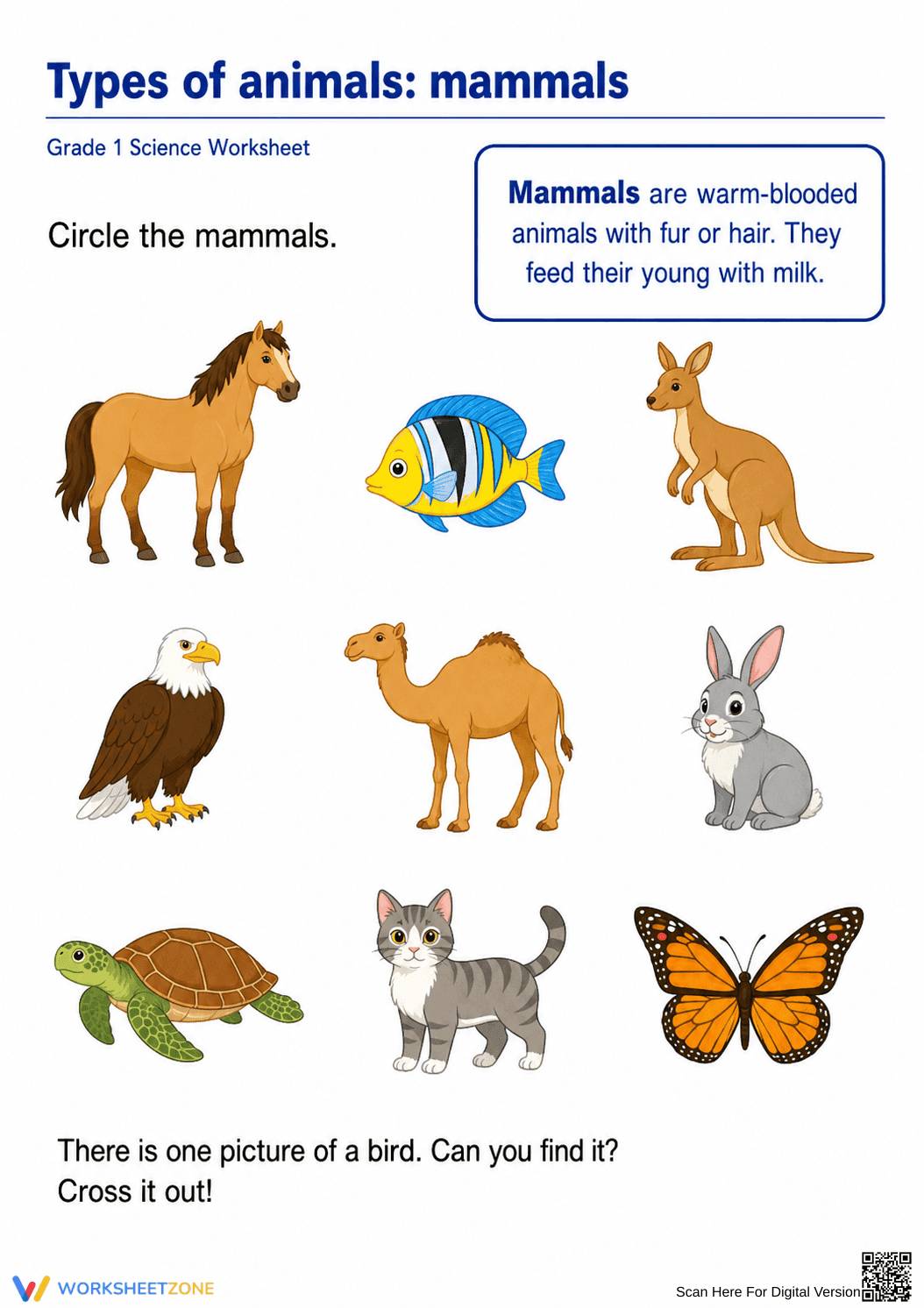

Grade 1 Mammals — Printable No-Prep Worksheet

Paste this activity's link or code into your existing LMS (Google Classroom, Canvas, Teams, Schoology, Moodle, etc.).
Students can open and work on the activity right away, with no student login required.
You'll still be able to track student progress and results from your teacher account.
This Grade 1 mammals worksheet helps students identify mammalian characteristics and distinguish them from other animal groups through visual recognition. By circling animals with fur and crossing out non-mammals, learners build foundational classification skills. Students develop a clear understanding of what makes an animal a mammal in this focused science activity.
At a Glance
- Grade: 1 · Subject: Living Things
- Standard:
1-LS3-1— Make observations to determine traits and similarities between different animal groups- Skill Focus: Mammal identification and trait recognition
- Format: 1 page · 10 problems · Answer key included · PDF
- Best For: Introduction to animal classification and traits
- Time: 10–15 minutes
Inside this printable resource, you will find a clean, one-page layout featuring nine distinct animal illustrations. The worksheet includes an instructional anchor box defining mammals by their warm-blooded nature, fur or hair, and nursing habits. Students engage with the content through two distinct tasks: a primary circling exercise and a secondary identification task to locate a bird.
This zero-prep worksheet is designed for immediate classroom deployment. Teachers follow a simple workflow: Print the single-page PDF, distribute to students, and review answers using the included key. Total teacher preparation time is under two minutes, making it an ideal choice for busy mornings or unexpected substitute teacher plans.
Standards Alignment
This resource aligns with 1-LS3-1, which requires students to make observations to construct an evidence-based account that animals have traits like their parents. By focusing on observable characteristics, the worksheet supports biological classification. This standard code can be copied directly into lesson plans, IEP goals, or district curriculum mapping tools.
How to Use It
Use this worksheet as a formative assessment after a direct instruction lesson on animal groups. It works well as a "check for understanding" activity to ensure students can apply the definition of a mammal to various examples. An observation tip for teachers is to watch for students who struggle to differentiate between the rabbit and the turtle, indicating a need for more support on trait identification.
Who It's For
This activity is specifically tailored for first-grade learners beginning their study of life science and living things. It offers visual scaffolds through clear illustrations, making it accessible for diverse learners and English Language Learners. This worksheet pairs naturally with a read-aloud about animal habitats or an anchor chart displaying the five major vertebrate groups.
This instructional material supports biological classification skills as outlined in the NGSS framework. According to a RAND AIRS 2024 analysis, early exposure to trait-based categorization improves later scientific reasoning. The worksheet provides 10 opportunities for students to evaluate animal characteristics against a provided definition, reinforcing the use of evidence in scientific claims. By identifying mammals like cats and kangaroos while excluding birds and fish, Grade 1 students internalize the specific criteria that define biological classes. This systematic approach ensures that learners move beyond simple naming toward a more nuanced understanding of living things. The inclusion of a clear instructional anchor box mirrors best practices for cognitive load management, allowing students to focus on application rather than just memorization. This scientific focus prepares students for more complex ecological studies in later grades.


