


























Views
Downloads

Essential Fish Identification Worksheet | Grade 1 Science
Paste this activity's link or code into your existing LMS (Google Classroom, Canvas, Teams, Schoology, Moodle, etc.).
Students can open and work on the activity right away, with no student login required.
You'll still be able to track student progress and results from your teacher account.
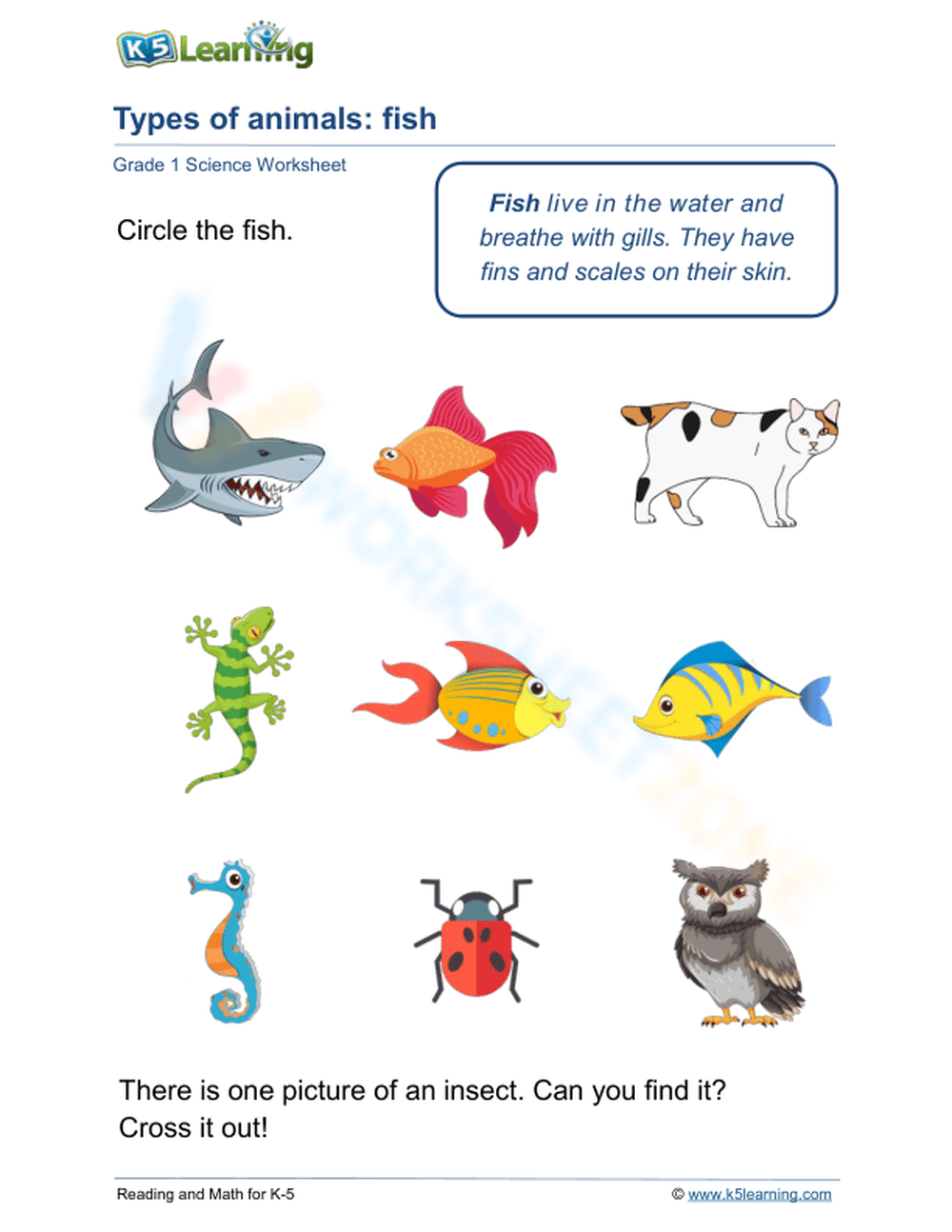
This worksheet helps Grade 1 students identify fish by observing physical traits like fins and scales. Students analyze animal images to determine which belong to the fish category and distinguish them from other animal classes. The activity reinforces biological vocabulary and scientific observation skills through high-quality visual aids that make learning concrete.
At a Glance
- Grade: 1 · Subject: Living Things
- Standard:
1-LS1-1— Use external animal parts to observe survival and growth needs- Skill Focus: Fish trait identification
- Format: 1 page · 9 problems · Answer key included · PDF
- Best For: First-grade introductory animal classification lessons
- Time: 10–15 minutes
What's Inside
One-page PDF featuring 9 vivid animal illustrations ranging from sharks to owls. It includes a reference box defining fish characteristics, such as water habitats, gills, fins, and scales. The worksheet presents two distinct tasks: circling aquatic vertebrates and identifying an outlier insect. A full answer key is provided for easy grading and self-correction.
Skill Progression
- Guided practice: Students read the characteristic reference box with the teacher to understand specific fish anatomy and environmental needs.
- Supported practice: Students evaluate 9 animal images, checking for visible fins and scales against the established criteria in the text box.
- Independent practice: Students identify the non-fish outlier (the ladybug insect) and cross it out to demonstrate mastery of classification concepts.
This gradual-release approach ensures students internalize biological traits before applying them independently to varied animal species, following the proven I Do, We Do, You Do instructional model.
Standards Alignment
This resource is aligned to 1-LS1-1. Students use observations of animal parts to recognize how they survive and meet their needs. By identifying gills, fins, and scales, students understand the external structures fish use to breathe and navigate their aquatic environment. Both standard codes can be copied directly into lesson plans, IEP goals, or district curriculum mapping tools.
How to Use It
Introduce this worksheet during the Explore phase of a life science unit on animal diversity. It works well as a follow-up to a direct lesson on vertebrates. For a formative assessment tip, observe if students correctly classify the seahorse, which is a common point of confusion for young learners. Expected completion time ranges from 10 to 15 minutes.
Who It's For
Designed for first-grade students learning basic biology. It is highly suitable for English Language Learners (ELL) due to the heavy reliance on visual support and clear, concise vocabulary. This activity pairs naturally with a marine life read-aloud or an anchor chart displaying various animal classes like mammals, birds, and reptiles.
This resource addresses the foundational biological concepts of animal classification as outlined in NGSS 1-LS1-1. By focusing on the relationship between physical structures like gills and fins and their functions such as breathing and swimming, the worksheet supports the development of observational skills necessary for scientific inquiry. According to the RAND AIRS 2024 report on elementary science pedagogy, visual classification tasks are critical for helping primary students build mental schemas of biological diversity. This worksheet provides 9 specific opportunities for students to apply trait-based logic to real-world examples, moving beyond rote memorization to evidence-based identification. The inclusion of an insect as a distractor further refines student understanding of non-fish characteristics, ensuring a robust grasp of the fish category within the broader kingdom of living things. This evidence-based approach aligns with current best practices for early childhood science education.


