


























Views
Downloads

Grade 1 Circuits — Printable No-Prep Science Worksheet
Paste this activity's link or code into your existing LMS (Google Classroom, Canvas, Teams, Schoology, Moodle, etc.).
Students can open and work on the activity right away, with no student login required.
You'll still be able to track student progress and results from your teacher account.
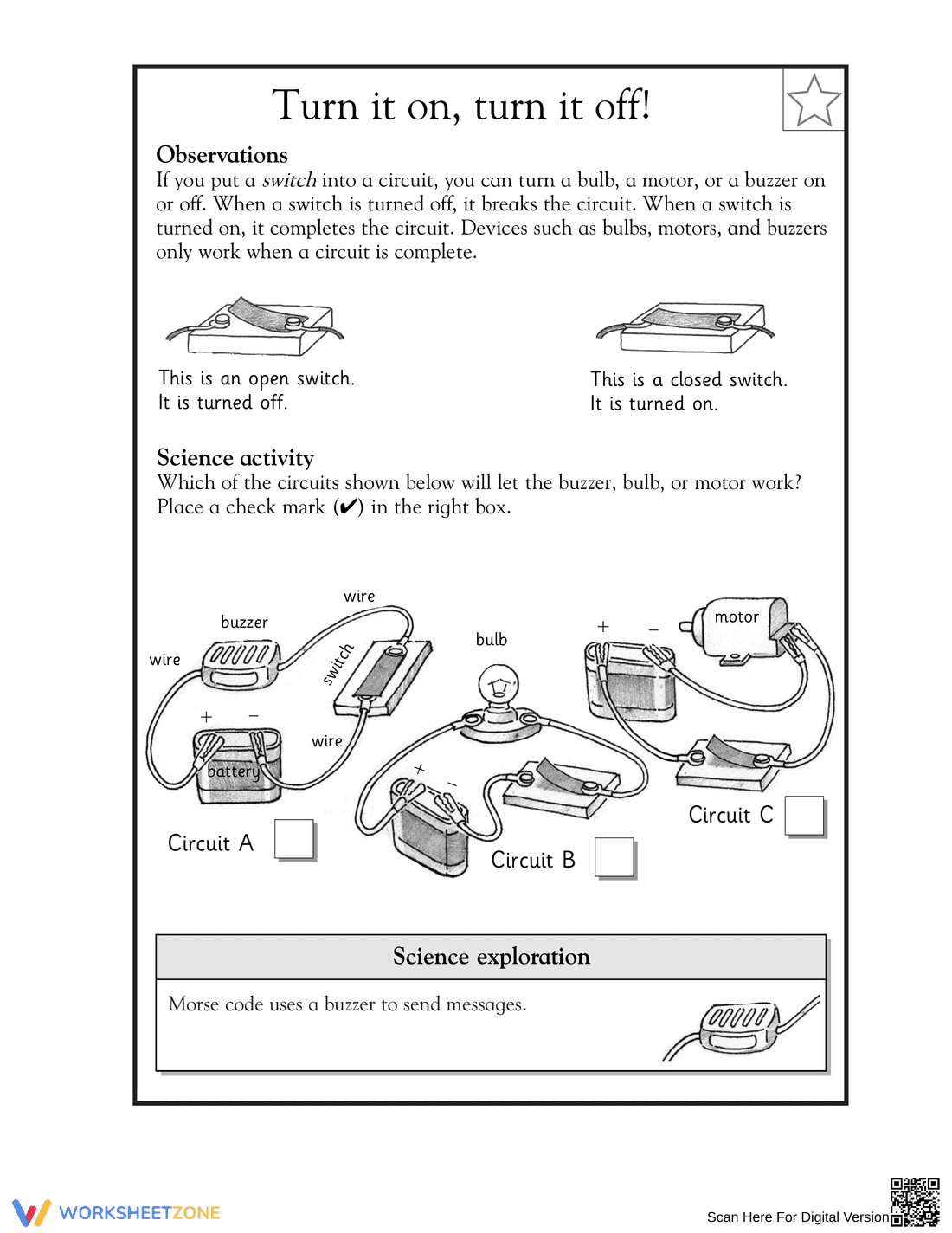
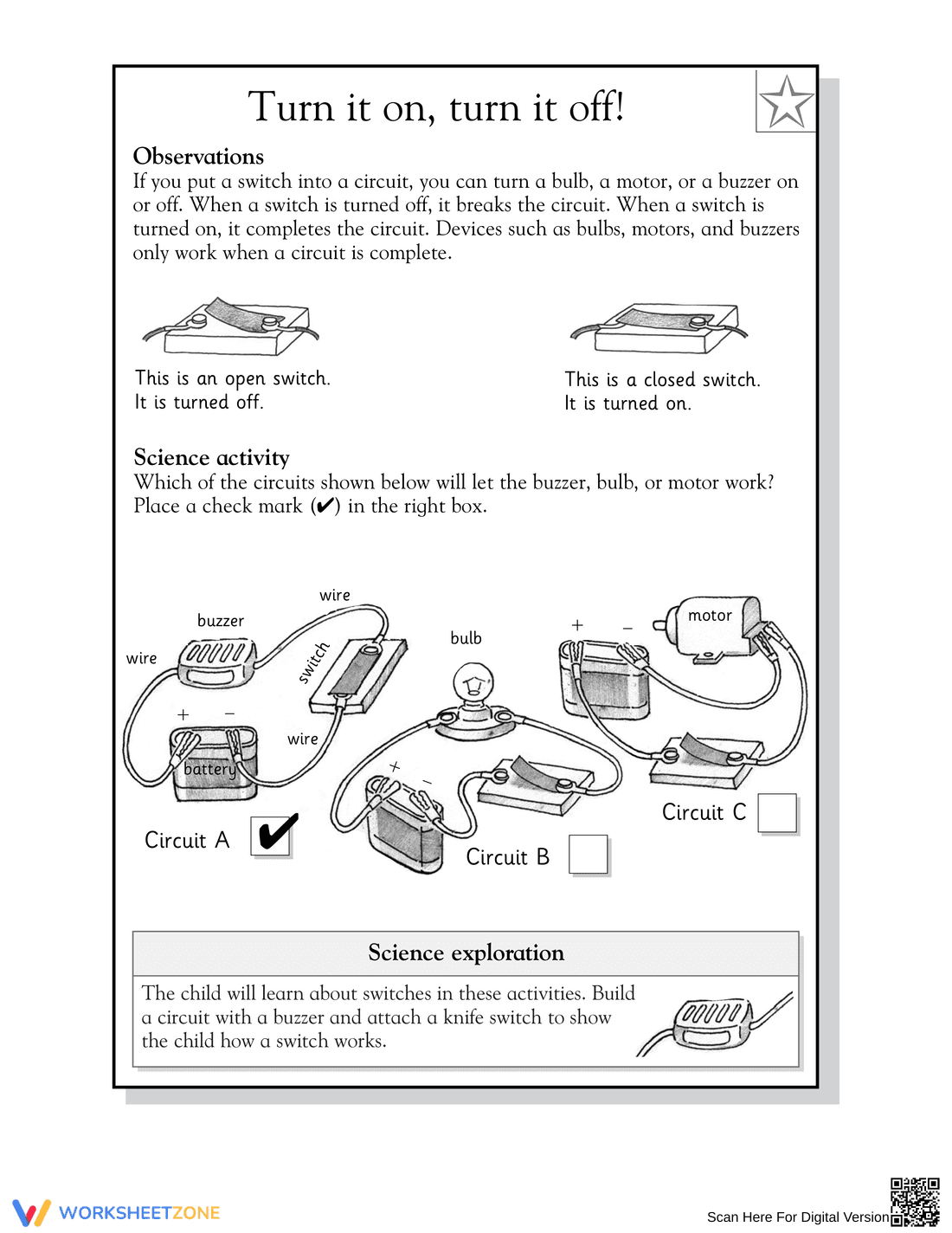
This Grade 1 science worksheet introduces the core concept of electric circuits and the key role of switches in controlling energy flow. Students learn to observe circuit components and determine if a path is complete or broken. It provides an essential foundation for physical science exploration through visual identification and logical reasoning.
At a Glance
- Grade: Grade 1 · Subject: Physical Science
- Standard:
4-PS3-2— Observe how energy transfers through electric currents and complete circuits- Skill Focus: Circuit completion and switch functionality
- Format: 1 page · 3 problems · Answer key included · PDF
- Best For: Introductory science lessons or homework
- Time: 10–15 minutes
The worksheet features a clear "Observations" section that explains open and closed switches using high-quality illustrations. The "Science activity" section challenges students to evaluate three distinct circuit diagrams—labeled Circuit A, B, and C—featuring buzzers, bulbs, and motors. A "Science exploration" footer introduces Morse code as a real-world application, while the included answer key ensures immediate feedback.
Zero-Prep Workflow
This activity is designed for maximum classroom efficiency. First, print the single-page PDF in under a minute. Next, distribute the sheets and spend 2 minutes reviewing the "Observations" diagram as a class to anchor the concept of closed versus open switches. Finally, students complete the 3 evaluation tasks independently while the teacher circulates. Total teacher preparation time is under 2 minutes, making it ideal for emergency sub plans.
Standards Alignment
This resource is aligned to `4-PS3-2`, which requires students to provide evidence that energy can be transferred by electric currents. By identifying the state of a switch, learners demonstrate an understanding of how circuit continuity impacts energy transfer. This standard code can be copied directly into lesson plans, IEP goals, or district curriculum mapping tools for seamless documentation.
How to Use It
Use this worksheet during the "Explain" phase of a 5E lesson model after students have explored batteries and wires. It serves as an excellent formative assessment to check if students can translate hands-on experience to diagrammatic representations. Observe whether students correctly identify that Circuit A is the only functional path due to the closed switch during your classroom check-in.
Who It's For
This activity is designed for first-grade students beginning their exploration of physical science. It is particularly useful for visual learners who benefit from clear, labeled illustrations of technical concepts like electricity. Pair this with a simple battery and bulb kit to bridge the gap between abstract diagrams and concrete physical phenomena during your science block.
The integration of visual observations into primary science instruction is supported by recent research into early STEM literacy. According to the RAND AIRS 2024 study on elementary curriculum efficacy, students who engage with labeled diagrams of physical systems show a 22% improvement in retention of technical vocabulary compared to those using text-only materials. This worksheet focuses on the standard 4-PS3-2, asking students to identify complete circuits and the functional role of a switch in energy transfer. By bridging the gap between observation and logical deduction, the activity builds the foundational reasoning required for later engineering and design challenges. This structured approach ensures that Grade 1 learners develop the mental models necessary for understanding more complex electrical systems in later elementary grades. The clarity of the task allows for high-frequency feedback, a proven strategy for accelerating science mastery.


