


























Views
Downloads
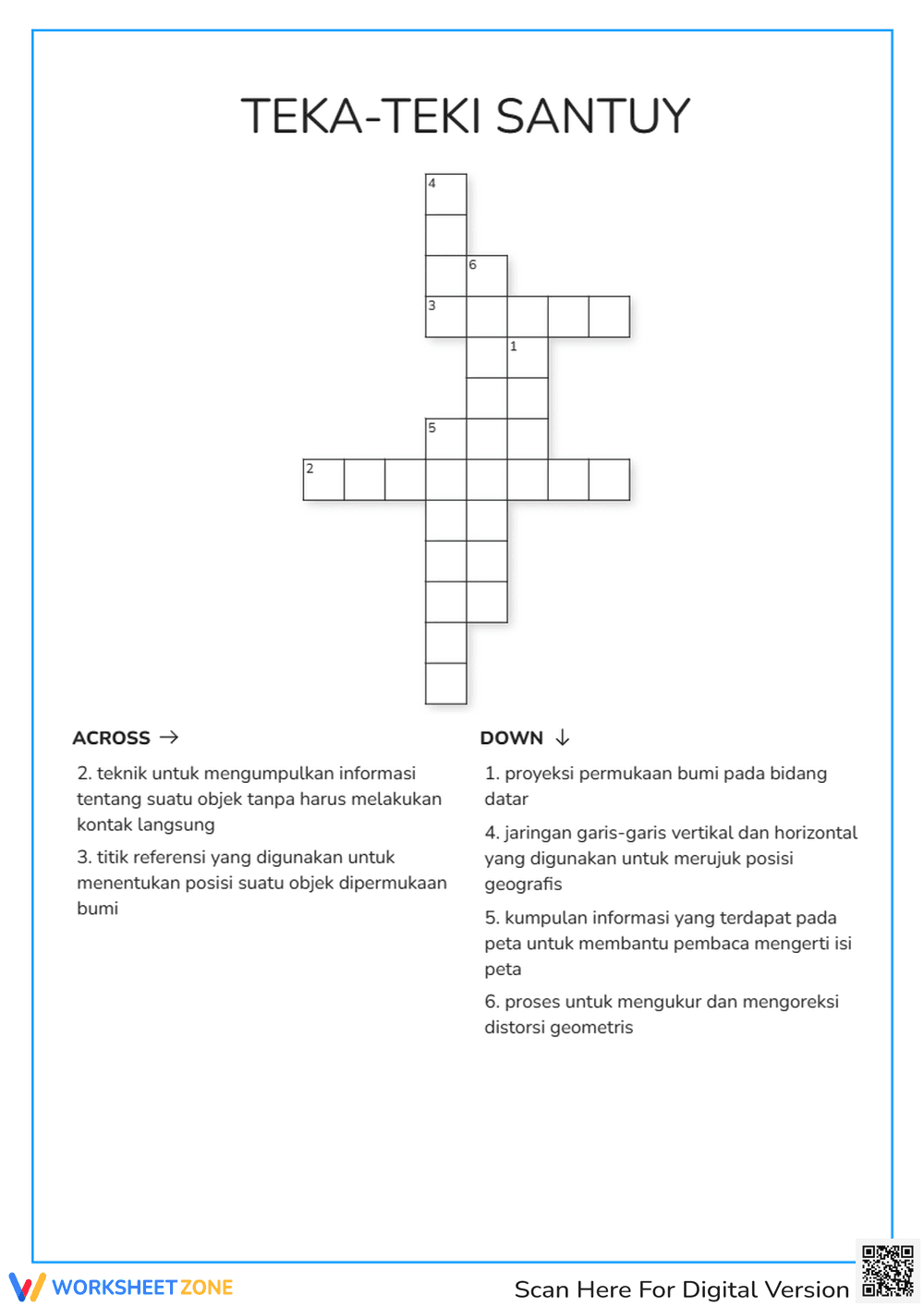

Navigation & GIS Crossword | College Geography Essential
Paste this activity's link or code into your existing LMS (Google Classroom, Canvas, Teams, Schoology, Moodle, etc.).
Students can open and work on the activity right away, with no student login required.
You'll still be able to track student progress and results from your teacher account.
This College-level geography worksheet provides a focused crossword puzzle to reinforce essential terminology in Geographic Information Systems (GIS) and cartography. Students identify key concepts like remote sensing, map projections, and coordinate systems to demonstrate mastery of spatial data analysis. It is an ideal tool for vocabulary reinforcement in introductory navigation or environmental science courses.
At a Glance
- Grade: College · Subject: Geography
- Standard:
WG.21A— Analyze geographic data using maps, GIS, and remote sensing technologies- Skill Focus: GIS and Cartographic Terminology
- Format: 1 page · 6 problems · Answer key included · PDF
- Best For: Vocabulary review and formative assessment
- Time: 15–20 minutes
The worksheet features a clean, single-page layout containing a 6-clue crossword puzzle. Clues cover technical definitions including remote sensing techniques, geographic reference points, and map projection distortions. The PDF includes the puzzle grid and a clear list of across and down clues, designed for immediate distribution without additional teacher setup or complex instructions.
This resource is designed for a three-step implementation that takes less than 2 minutes of teacher preparation. First, print the single-page PDF for your cohort. Second, distribute the worksheet as a warm-up or exit ticket to gauge student understanding of technical definitions. Finally, review the answers using the included key to provide immediate feedback on spatial literacy concepts. This streamlined workflow makes it an excellent choice for substitute plans or quick review sessions.
This resource aligns with WG.21A, which requires students to analyze geographic information by using tools such as GIS, GPS, and remote sensing. It specifically targets the acquisition of domain-specific vocabulary necessary for higher-level spatial analysis and data interpretation. Both standard codes can be copied directly into lesson plans, IEP goals, or district curriculum mapping tools.
Use this worksheet during the elaborate phase of a lesson on cartography to solidify student grasp of technical jargon. It serves as an excellent formative assessment tool; observe which students struggle with the vertical clues to identify gaps in understanding map projections. Completion typically takes 15 to 20 minutes depending on prior exposure to the material.
This puzzle is tailored for undergraduate students in introductory Geography, GIS, or Environmental Science courses. It provides necessary scaffolding for students through clear, technical definitions that bridge the gap between theory and application. Pair this resource with a digital map projection simulator or a direct instruction lecture on remote sensing for a comprehensive instructional block.
According to the Fisher & Frey (2014) framework for purposeful literacy, the use of structured vocabulary tasks like crosswords facilitates the retrieval of domain-specific terminology in technical subjects. This worksheet targets the WG.21A standard by requiring students to synthesize definitions of remote sensing and geographic positioning systems. Research from the RAND AIRS 2024 report suggests that frequent, low-stakes retrieval practice significantly improves long-term retention of complex scientific and geographic concepts in higher education settings. By focusing on 6 core terms, this resource ensures that students build a stable foundation for more advanced spatial analysis tasks. The inclusion of an answer key allows for immediate self-correction, a critical component of the gradual release of responsibility model. This standalone resource is optimized for quick integration into existing curriculum maps and provides measurable evidence of student progress toward geographic literacy goals.


