


























Views
Downloads

Essential Communication Reflection Worksheet | Grades 4-6
Paste this activity's link or code into your existing LMS (Google Classroom, Canvas, Teams, Schoology, Moodle, etc.).
Students can open and work on the activity right away, with no student login required.
You'll still be able to track student progress and results from your teacher account.
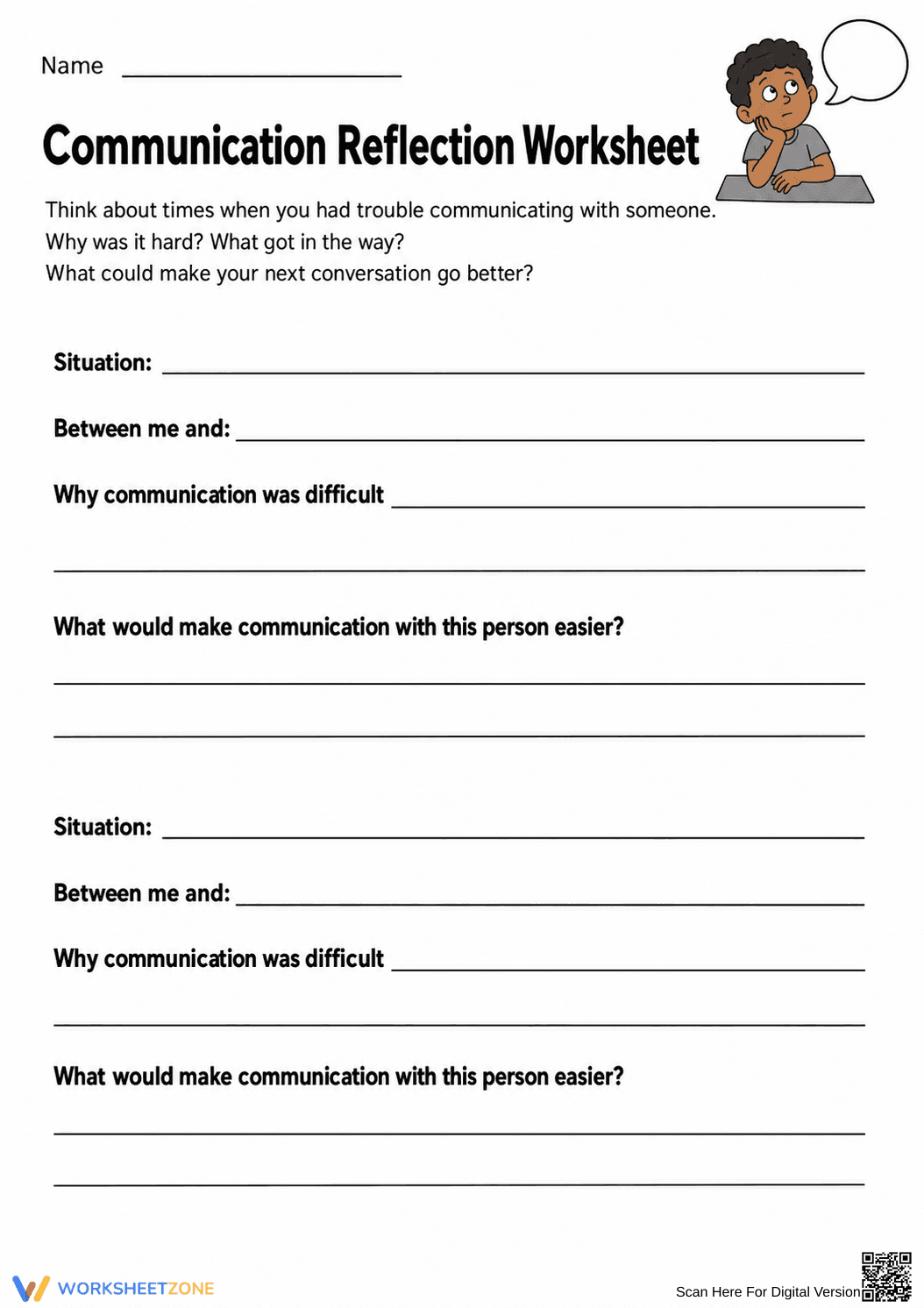
This Communication Reflection Worksheet empowers students to analyze interpersonal friction and develop actionable strategies for better dialogue. By identifying specific barriers in past interactions, learners build the emotional intelligence necessary for effective collaboration. It provides a structured framework for students to process social challenges and improve their verbal and non-verbal exchange skills.
At a Glance
- Grade: 5 · Subject: Social Skills
- Standard:
CCSS.ELA-LITERACY.SL.5.1— Engage effectively in a range of collaborative discussions with diverse partners- Skill Focus: Interpersonal Reflection
- Format: 1 page · 2 scenarios · Open-response · PDF
- Best For: Conflict resolution and social-emotional learning
- Time: 15–20 minutes
Inside this single-page PDF, students find two identical reflection blocks designed to capture real-world social experiences. Each block includes prompts for the specific situation, the individuals involved, the root cause of the communication breakdown, and a forward-looking solution. The clean layout and thoughtful prompts minimize distraction, allowing students to focus entirely on their internal processing and problem-solving.
Zero-Prep Workflow
- Print: Select the single-page PDF and print enough copies for your class in under 30 seconds.
- Distribute: Hand out the sheets at the start of a social-emotional learning block or after a playground conflict.
- Review: Spend 5 minutes facilitating a group share-out of common "communication blockers" identified by the students.
Total teacher preparation time is less than 2 minutes, making this an ideal resource for busy classrooms or unexpected sub plans.
Standards Alignment
This resource aligns with CCSS.ELA-LITERACY.SL.5.1, which requires students to engage effectively in a range of collaborative discussions. By reflecting on why communication was difficult, students meet the standard's demand to build on others' ideas and express their own clearly. This standard code can be copied directly into lesson plans, IEP goals, or district curriculum mapping tools.
How to Use It
Use this worksheet as a formative assessment tool following a group project to gauge how well students are navigating peer dynamics. Alternatively, assign it as a "cool-down" activity after a specific classroom disagreement to help students articulate their feelings before a formal mediation. Observe whether students can identify external factors versus internal factors during their reflection.
Who It's For
This worksheet is designed for upper elementary students in Grades 4 through 6 who are developing more complex social relationships. It is particularly effective for students with IEP goals related to social skills or pragmatic language. Pair this resource with an anchor chart on "Active Listening" or a short video clip demonstrating common communication pitfalls to provide a visual model.
Effective communication is a cornerstone of academic and social success, yet many students lack the metacognitive tools to analyze why interactions fail. According to Fisher & Frey (2014), structured reflection allows students to move from reactive behaviors to intentional communication strategies. This worksheet addresses CCSS.ELA-LITERACY.SL.5.1 by prompting students to identify specific barriers—such as tone, environment, or lack of clarity—that impede collaborative discussion. Research from the RAND AIRS 2024 report suggests that social-emotional learning interventions that utilize written reflection significantly improve a student's ability to resolve conflicts independently. By documenting two distinct scenarios, students practice the transition toward self-regulation. This 1-page PDF provides the necessary scaffolding for Grade 4-6 learners to bridge the gap between recognizing a problem and implementing a functional social solution in real-time classroom environments.


