


























Views
Downloads
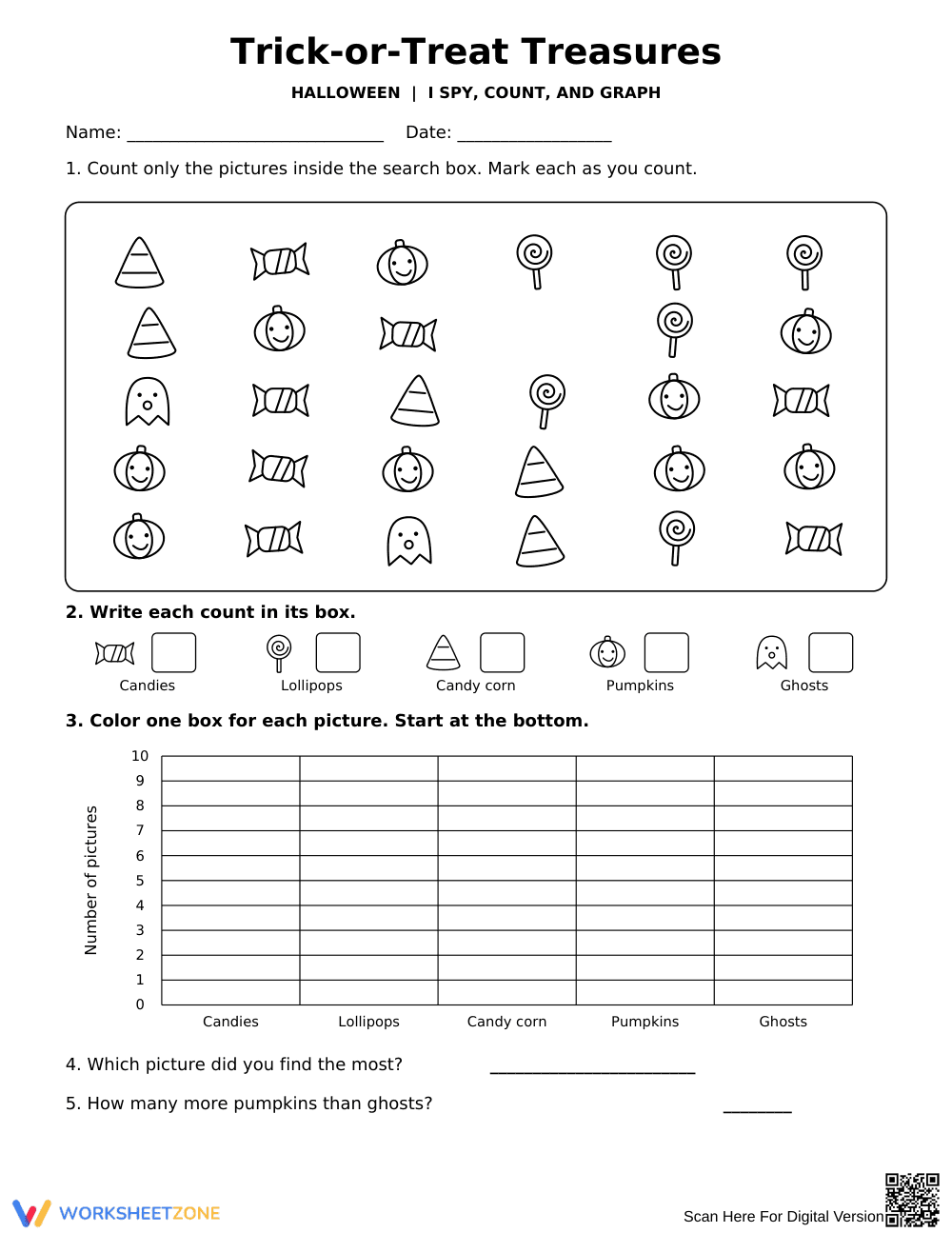

Trick-or-Treat Math: Printable Grade 1 Worksheet
Paste this activity's link or code into your existing LMS (Google Classroom, Canvas, Teams, Schoology, Moodle, etc.).
Students can open and work on the activity right away, with no student login required.
You'll still be able to track student progress and results from your teacher account.
This Grade 1 Halloween-themed math worksheet builds early addition and subtraction skills through 10 engaging word problems set in a trick-or-treat context. Students solve candy-counting scenarios that connect real-world situations to number operations, reinforcing fact fluency and problem-solving strategies within 20.
At a Glance
- Grade: 1 · Subject: Math
- Standard:
CCSS.MATH.CONTENT.1.OA.A.2— Solve word problems that call for adding three whole numbers- Skill Focus: Addition and subtraction word problems within 20
- Format: 2 pages · 10 problems · Answer key included · PDF
- Best For: Seasonal math practice or holiday centers
- Time: 15–25 minutes
The worksheet spans two pages: one student-facing activity page featuring 10 illustrated word problems and one complete answer key page. Each problem presents a short Halloween scenario — counting candy bars, comparing treat totals, or finding how many are left — followed by a writing line and a number sentence frame to guide student responses. No manipulatives or additional materials are required.
- Guided practice (Problems 1–3): Simple one-step addition scenarios with small numbers (sums within 10). Sentence frames are provided to scaffold the equation-writing process.
- Supported practice (Problems 4–7): One-step subtraction and mixed-operation problems within 15. Students write their own number sentences with a partial frame for support.
- Independent practice (Problems 8–10): Multi-step or comparison problems within 20. Students compose the full number sentence and write the answer independently, reflecting the You Do phase of gradual release.
This structure follows a gradual-release model (I Do, We Do, You Do), allowing teachers to use the first cluster for whole-group modeling before releasing students to work through the remaining problems in pairs or independently.
Standards Alignment
Primary standard: CCSS.MATH.CONTENT.1.OA.A.2 — Solve word problems that call for addition of three whole numbers whose sum is less than or equal to 20. Supporting standard CCSS.MATH.CONTENT.1.OA.C.6 applies where students add and subtract within 20 using strategies such as counting on and making ten. Both standard codes can be copied directly into lesson plans, IEP goals, or district curriculum mapping tools.
How to Use It
Use this worksheet after direct instruction on addition and subtraction word problems as a guided or independent practice activity. During small-group work, observe whether students draw pictures or use counting-on strategies before writing the number sentence — this reveals which students need additional concrete support. As a formative check, collect the number sentence lines only; a quick scan of all 10 responses takes under two minutes. Expected completion time is 15–25 minutes for most first graders.
Who It's For
This resource is designed for Grade 1 students building operational fluency with addition and subtraction in context. It works equally well for on-level learners during seasonal math rotations and for Grade 2 students who need a confidence-building review. Pair it with a tens-frame anchor chart or a direct instruction lesson on the Read-Draw-Write strategy to maximize student success.
Aligned to CCSS.MATH.CONTENT.1.OA.A.2, this worksheet targets a foundational first-grade skill: solving addition and subtraction word problems within 20. According to NAEP data, students who regularly practice contextual word problems in early elementary show stronger operational reasoning in later grades. Fisher & Frey (2014) identify structured gradual-release frameworks — modeled here through scaffolded problem sets — as a key driver of student independence in mathematics. The Halloween theme provides a low-stakes, high-engagement context that keeps first graders focused while practicing the same rigorous skill. With 10 problems, a complete answer key, and no required prep materials, this two-page PDF is ready to print and assign immediately for classroom practice, homework, or a seasonal math center.


