


























Views
Downloads
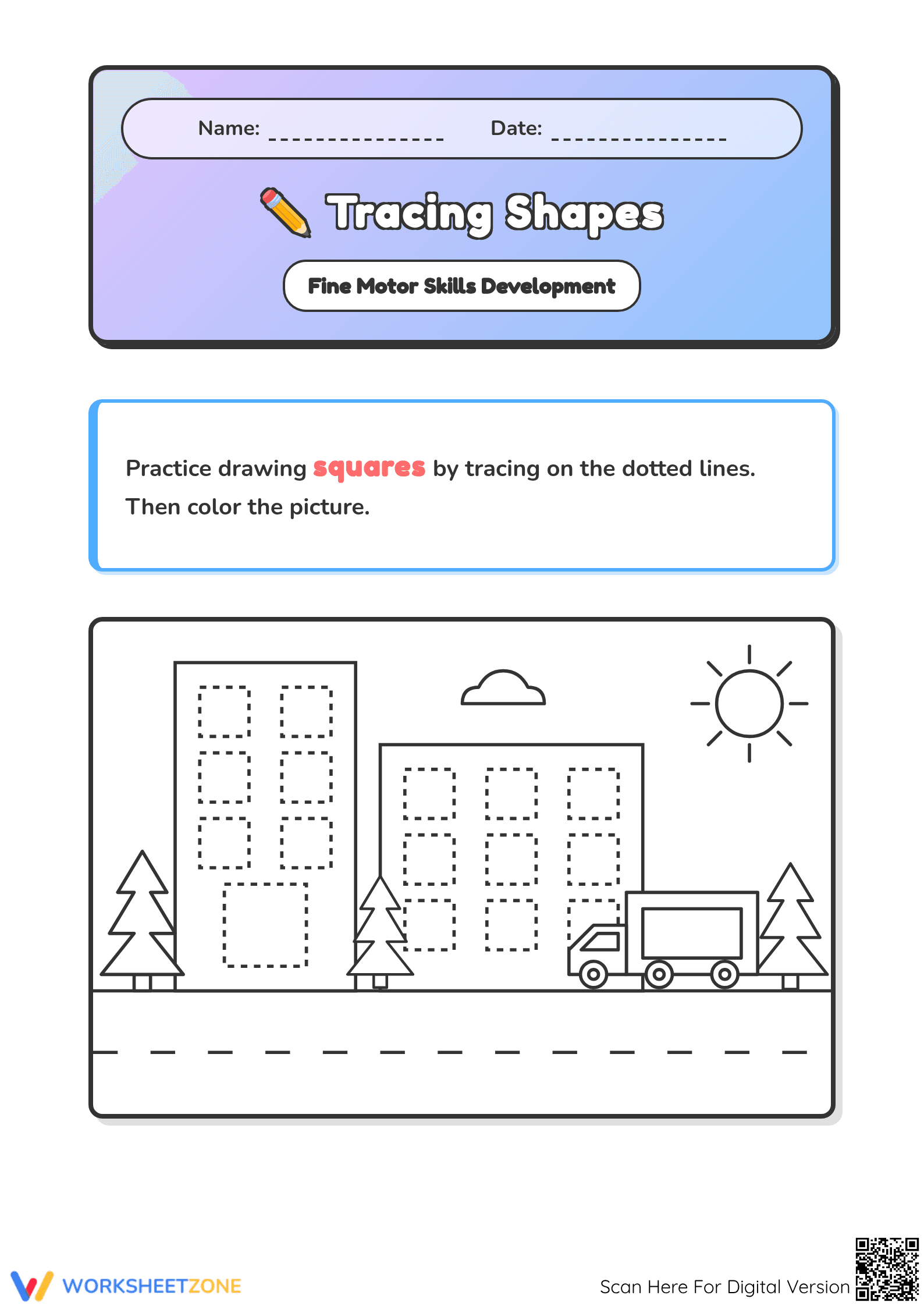


Printable Tracing Squares Worksheet | Preschool Ready
Paste this activity's link or code into your existing LMS (Google Classroom, Canvas, Teams, Schoology, Moodle, etc.).
Students can open and work on the activity right away, with no student login required.
You'll still be able to track student progress and results from your teacher account.
This Preschool tracing squares worksheet helps early learners develop essential fine motor control while reinforcing shape recognition. By guiding students through tracing and drawing activities, this resource builds the hand-eye coordination required for future handwriting success and foundational geometry skills.
At a Glance
- Grade: Preschool · Subject: Early Literacy
- Standard:
CCSS.MATH.CONTENT.K.G.B.5— Draw shapes to model real-world objects- Skill Focus: Tracing squares and fine motor control
- Format: 2 pages · 2 activities · No answer key needed · PDF
- Best For: Morning work or centers
- Time: 10–15 minutes
This two-page printable features two distinct activities designed to engage young learners. The first page presents a fun city scene where students trace the square windows on buildings, providing context for the shape in the real world. The second page transitions to isolated practice, offering three dotted squares to trace and three blank spaces with red starting dots for independent drawing. The black-and-white design also doubles as a coloring page.
- Print (1 minute): Simply download the PDF and print the two pages. No special materials or cutting required.
- Distribute (1 minute): Hand out the worksheets along with pencils, crayons, or markers.
- Review (1 minute): Briefly demonstrate how to start at the top corner and follow the dotted lines before letting students work independently.
This zero-prep resource requires under three minutes of teacher setup, making it an excellent choice for emergency sub plans, morning arrival activities, or quick transitions.
Aligned to CCSS.MATH.CONTENT.K.G.B.5: Model shapes in the world by building shapes from components and drawing shapes. It also supports early writing readiness by developing the pincer grasp and pencil control necessary for letter formation. Both standard codes can be copied directly into lesson plans, IEP goals, or district curriculum mapping tools.
Use this worksheet as a quiet morning work activity as students arrive and settle into the classroom. It also works perfectly as an independent math or literacy center station. While students are working, teachers can use this time for formative assessment by observing pencil grip, stroke directionality, and the ability to stop at corners. Expect most preschool students to complete both pages in 10 to 15 minutes.
This resource is designed for Preschool and Pre-K students building foundational fine motor skills. It is highly beneficial for occupational therapy sessions or students needing extra support with hand-eye coordination. Pair this worksheet with physical manipulatives like building blocks or a read-aloud book about shapes in the city to reinforce the concepts.
Integrating targeted fine motor practice with shape recognition is a critical step in early childhood cognitive and physical development. According to research by Fisher & Frey (2014), structured tracing activities significantly improve the visual-motor integration required for later academic tasks, including reading, writing, and spatial reasoning. When young learners practice controlling a writing instrument along a guided path, they build the essential muscle memory and hand-eye coordination needed for independent production. By aligning directly with CCSS.MATH.CONTENT.K.G.B.5, this worksheet ensures students are purposefully learning to draw shapes to model real-world objects, rather than just practicing random strokes. Early mastery of these foundational skills provides a strong, evidence-based scaffold for future geometric understanding and handwriting fluency, setting the stage for long-term academic confidence and success in both literacy and mathematics.


