


























Views
Downloads



Essential Toy Store Multiplication Worksheet | Grade 3 Math
Paste this activity's link or code into your existing LMS (Google Classroom, Canvas, Teams, Schoology, Moodle, etc.).
Students can open and work on the activity right away, with no student login required.
You'll still be able to track student progress and results from your teacher account.
Master multiplication facts with a fun, real-world shopping simulation. This three-page worksheet helps third graders apply their knowledge of one-digit multiplication to calculate total costs at a toy store. By connecting abstract math to familiar objects like robots and airplanes, students build fluency and confidence in their mathematical reasoning and computational accuracy.
At a Glance
- Grade: 3 · Subject: Math
- Standard:
3.OA.C.7— Fluently multiply within 100 and know all products of two one-digit numbers- Skill Focus: One-Digit Multiplication Facts
- Format: 3 pages · 11 problems · Answer key included · PDF
- Best For: Independent practice and real-world math application
- Time: 20–30 minutes
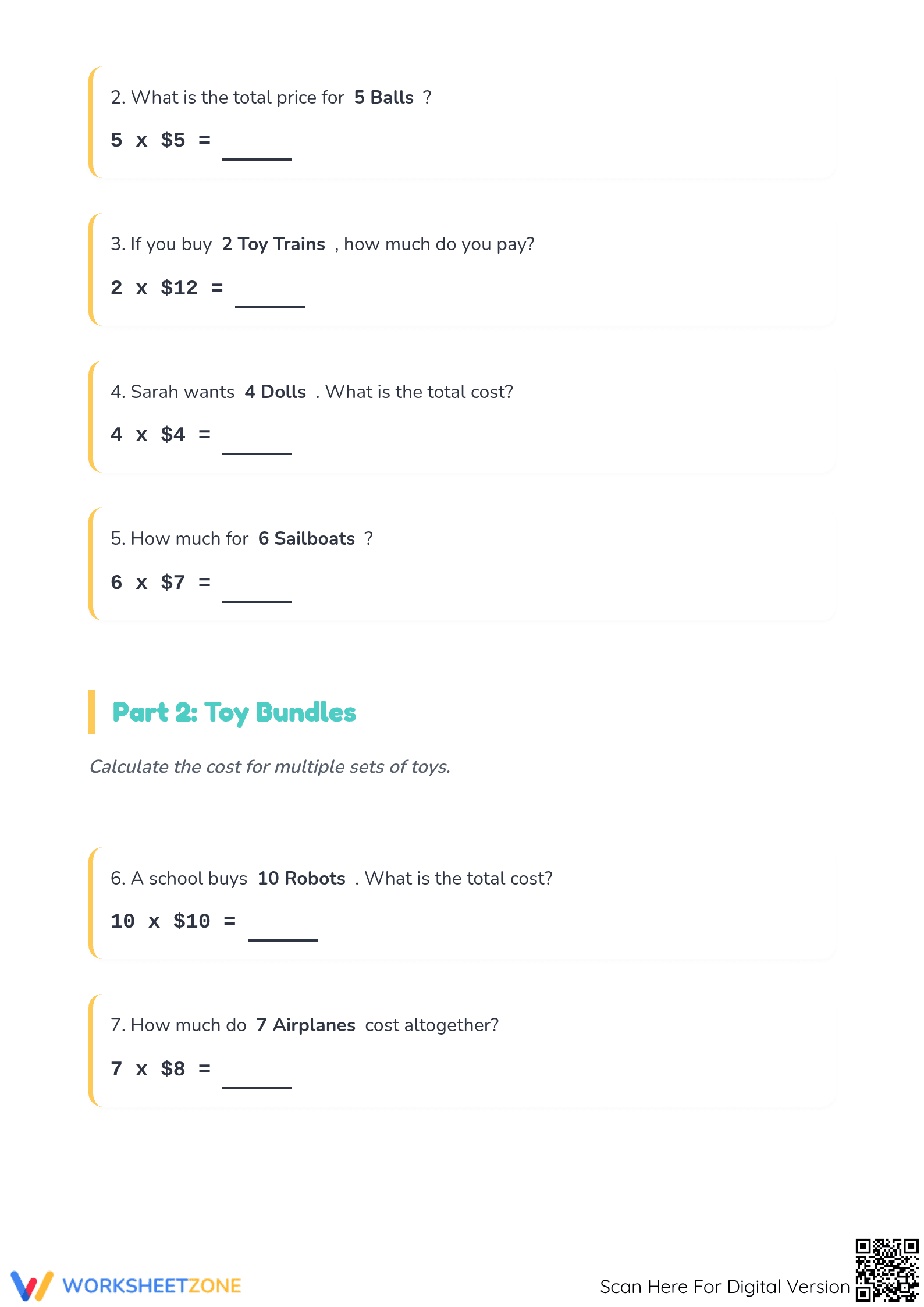
This resource contains three comprehensive pages of math practice. Page one introduces a vibrant price list featuring eight different toys, followed by basic shopping calculations. Page two moves into "Toy Bundles" for set-based multiplication, while page three challenges students with multi-step word problems and a bonus logic puzzle. A complete answer key is provided for immediate feedback.
Skill Progression
- Guided Practice: Students begin by identifying specific toy prices from the provided visual list and solving 5 basic one-to-one multiplication problems.
- Supported Practice: The worksheet transitions to bundle-based problems where students multiply quantities by fixed rates for robots, airplanes, and bears.
- Independent Practice: The final section requires students to solve contextual word problems and a challenge task requiring algebraic thinking.
This structure follows a gradual release model, ensuring students move from simple identification to complex application.
Standards Alignment
This worksheet is fully aligned with standard 3.OA.C.7, focusing on fluency with one-digit multiplication. Students must demonstrate their ability to recall products from memory and apply strategies to determine costs within 100. Both standard codes can be copied directly into lesson plans, IEP goals, or district curriculum mapping tools.
How to Use It
Use this worksheet during the independent practice phase of a multiplication unit to reinforce fact fluency. It is also an excellent tool for a math center rotation where students simulate a store environment. For a quick formative-assessment, observe if students use repeated addition or mental recall to solve the bundle problems. Expected completion time is 25 minutes.
Who It's For
This resource is ideal for Grade 3 students or Grade 4 learners requiring a refresher on multiplication foundations. The shopping theme provides natural engagement for diverse learners, while the word problems offer an entry point for students who excel at applied math. It pairs perfectly with an interactive whiteboard lesson on money or an anchor chart on multiplication strategies.
According to the RAND AIRS 2024 report, contextualizing mathematical problems within real-world scenarios, such as shopping or commerce, significantly improves student engagement and long-term retention of multiplication facts. This worksheet leverages that research by using a toy store theme to ground the abstract skill of multiplying within 100 as outlined in 3.OA.C.7. By requiring students to navigate a price list and solve multi-step problems, the resource moves beyond rote memorization into authentic application. Fisher & Frey (2014) emphasize that gradual release models are most effective when students have concrete anchors for their learning; here, the familiar items of a toy store serve as that anchor. Educators can use these tasks to identify specific gaps in fact fluency or operational understanding. This printable PDF ensures that students meet rigorous standards while maintaining a high level of interest through intentional, thematic design.


