


























Views
Downloads

Printable Times Tables 12s Practice Worksheet | Grade 3
Paste this activity's link or code into your existing LMS (Google Classroom, Canvas, Teams, Schoology, Moodle, etc.).
Students can open and work on the activity right away, with no student login required.
You'll still be able to track student progress and results from your teacher account.
This comprehensive Grade 3 multiplication worksheet helps students master their 12s times tables through a tiered challenge. By progressing from basic recall to advanced mental math, students build the automaticity required for multi-digit multiplication. This printable resource ensures learners develop deep numerical fluency while gaining confidence with traditionally difficult factors.
At a Glance
- Grade: 3 · Subject: Math
- Standard:
CCSS.MATH.CONTENT.3.OA.C.7— Fluently multiply within 100 using strategies such as the relationship between multiplication and division- Skill Focus: Multiplication Fluency (12s Focus)
- Format: 2 pages · 44 problems · Answer key included · PDF
- Best For: Independent practice and timed fluency drills
- Time: 15–20 minutes
What's Inside
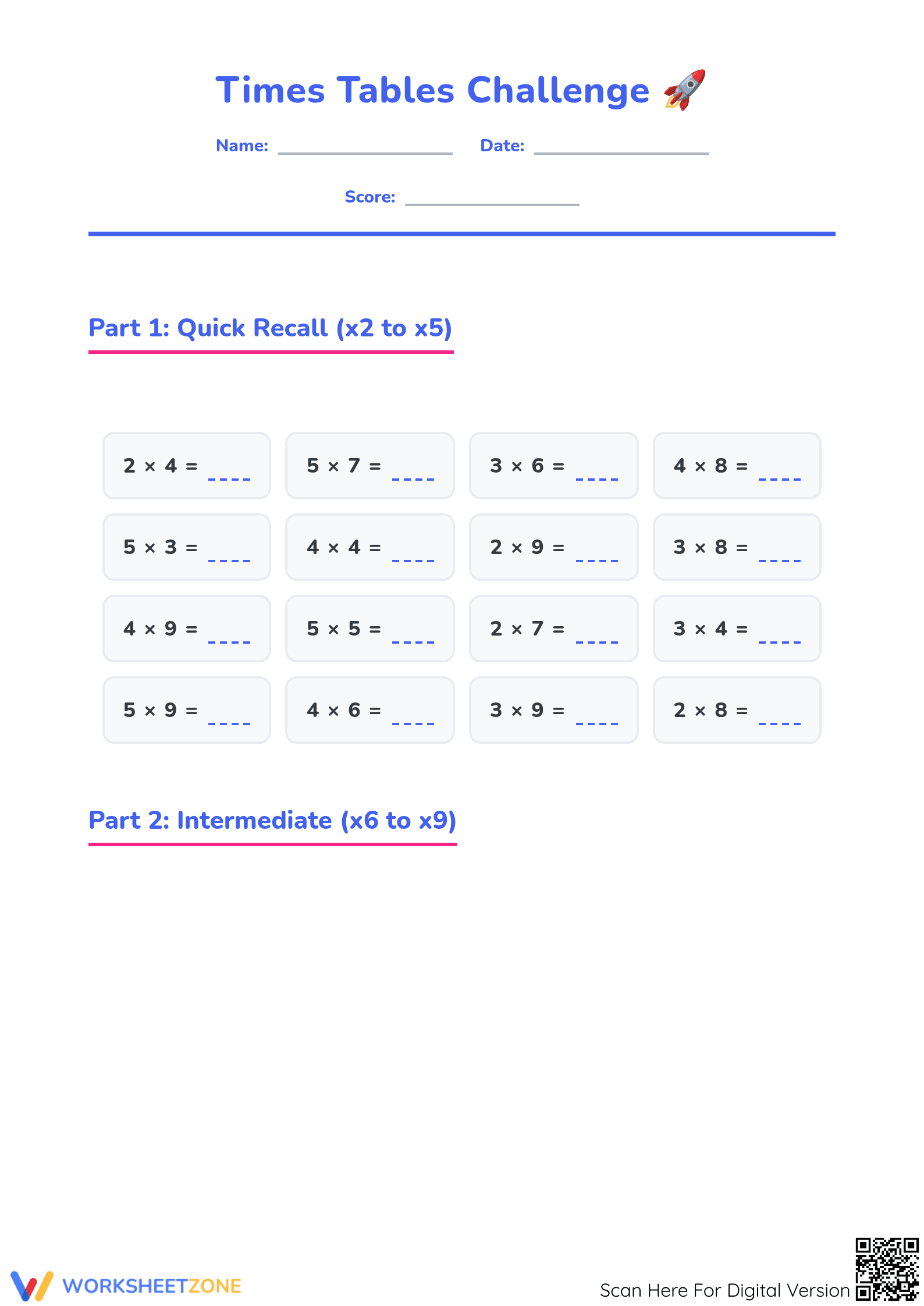
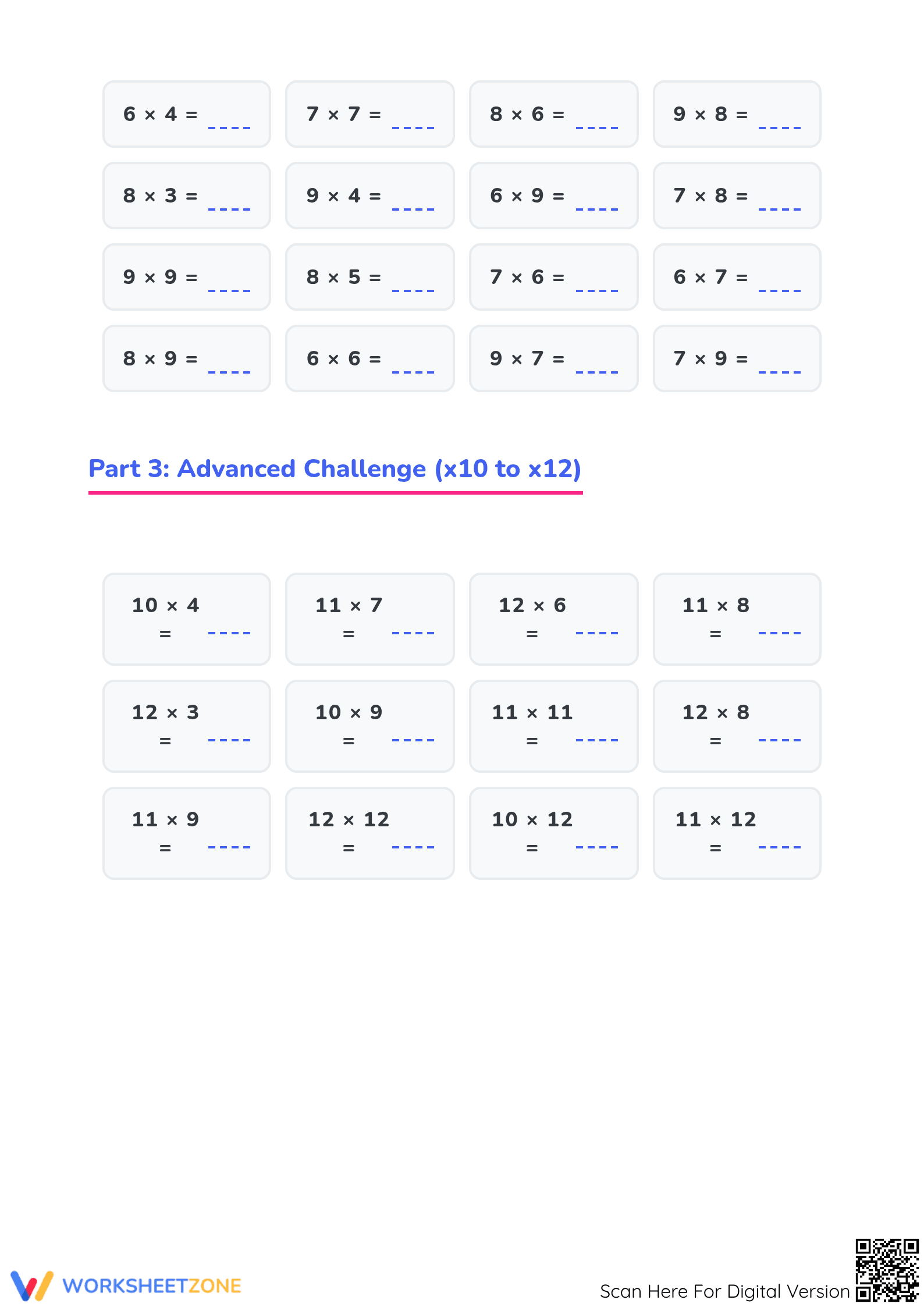
The download features a two-page layout containing 44 distinct multiplication problems. The set is organized into three distinct phases: Quick Recall (x2 to x5), Intermediate (x6 to x9), and the Advanced Challenge (x10 to x12). This structure allows for a warm-up before tackling the core 12s problems. A full answer key is included for rapid grading or self-correction.
Skill Progression
- Guided Recall: 16 introductory problems focus on lower factors, allowing students to establish a rhythm and activate prior knowledge without cognitive overload.
- Intermediate Mastery: 16 mid-tier problems transition the student into more complex products, bridging the gap between basic facts and the target 12s table.
- Advanced Application: 12 high-intensity problems focus specifically on the 10s, 11s, and 12s, requiring higher-order mental processing and precise calculation.
This sequence utilizes a gradual-release model, moving from familiar territory to the "Advanced Challenge" zone.
Standards Alignment
The primary focus is CCSS.MATH.CONTENT.3.OA.C.7, which requires students to multiply and divide fluently within 100. By the end of Grade 3, students are expected to know from memory all products of two one-digit numbers. This standard code can be copied directly into lesson plans, IEP goals, or district curriculum mapping tools.
How to Use It
Use this worksheet as a "mad minute" style timed assessment to measure fact retrieval speed after direct instruction on the 12s. Alternatively, assign it as a morning work activity where students focus on accuracy over speed. Observe if students use skip-counting or the distributive property (e.g., 12x6 as 10x6 + 2x6) to solve the advanced section. Expected completion time ranges from 15 to 20 minutes.
Who It's For
This resource is designed for Grade 3 students but serves as an excellent remedial tool for Grade 4 and 5 learners who haven't yet achieved automaticity. It pairs naturally with 12s multiplication charts or interactive skip-counting songs, providing necessary repetition for students with varying learning needs.
According to the RAND AIRS 2024 report on mathematics instructional materials, consistent, spaced practice of multiplication facts is a critical predictor of success in middle-school algebra. Achieving automaticity in one-digit multiplication, specifically mastering the more difficult 12s times table, reduces cognitive load during complex problem-solving. This worksheet aligns with the "I Do, We Do, You Do" instructional framework by scaffolding the student's entry into the advanced challenge. Research from Fisher & Frey (2014) emphasizes that "purposeful practice" must be targeted and sequential to move information from short-term to long-term memory. By providing 44 structured opportunities to engage with CCSS.MATH.CONTENT.3.OA.C.7, this resource ensures that students are not merely calculating, but are building the mental infrastructure required for mathematical fluency. The tiered approach supports diverse learners by ensuring a high success rate in the initial stages before increasing the rigor.


