


























Views
Downloads

Printable 10s Times Tables Worksheet: Grade 3 Math Fluency
Paste this activity's link or code into your existing LMS (Google Classroom, Canvas, Teams, Schoology, Moodle, etc.).
Students can open and work on the activity right away, with no student login required.
You'll still be able to track student progress and results from your teacher account.
This essential Grade 3 multiplication worksheet provides structured practice for students learning their 10s times tables. By focusing exclusively on multiplying by ten, learners can quickly identify numerical patterns and build the foundational fluency required for multi-digit multiplication. This resource ensures that students move beyond skip-counting by tens to achieve automatic recall of basic math facts.
At a Glance
- Grade: 3 · Subject: Math
- Standard:
CCSS.MATH.CONTENT.3.OA.C.7— Fluently multiply and divide within 100 using various mental calculation strategies- Skill Focus: Multiplying by 10
- Format: 2 pages · 16 problems · Answer key included · PDF
- Best For: Daily math warm-ups or homework
- Time: 10–15 minutes
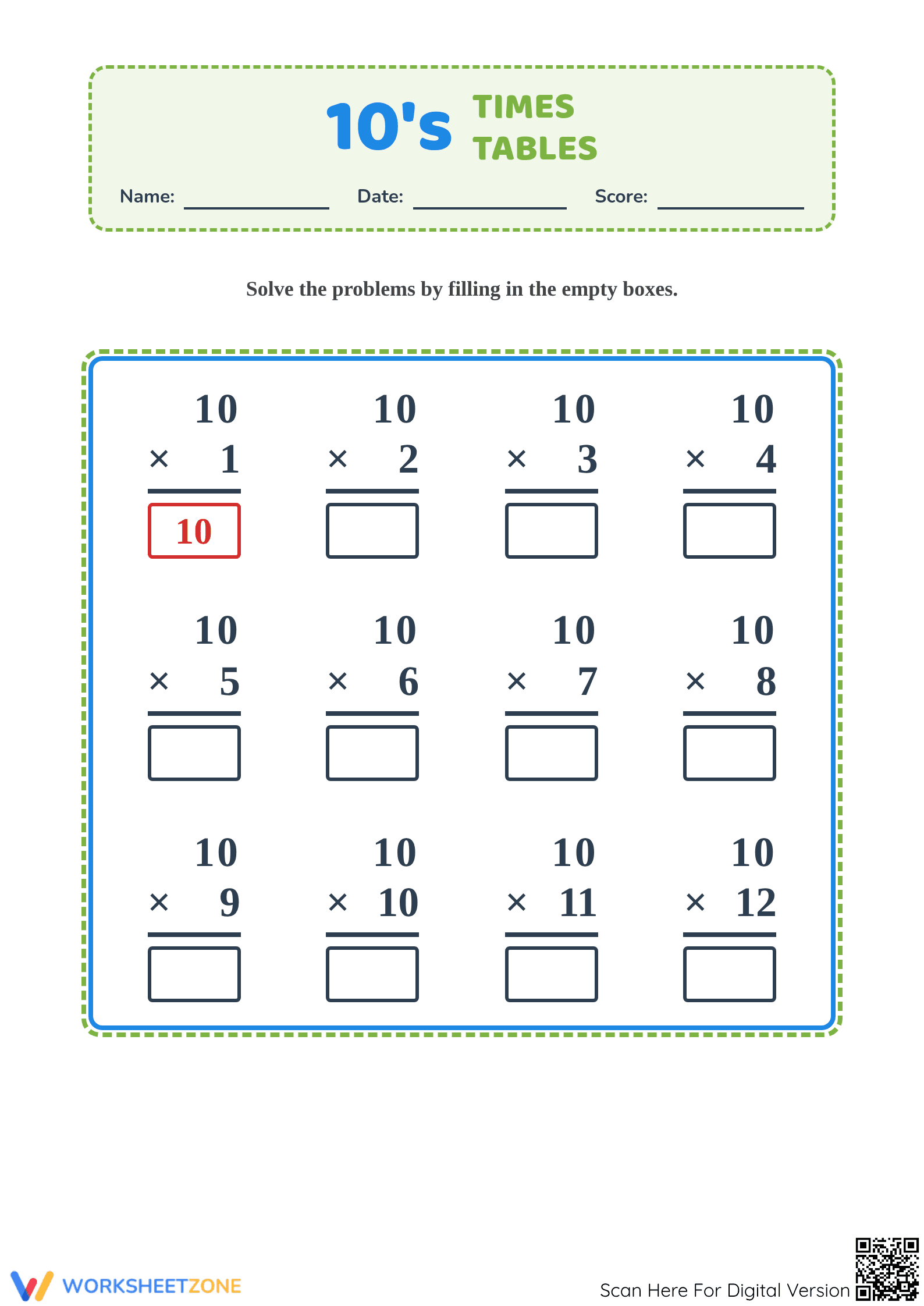
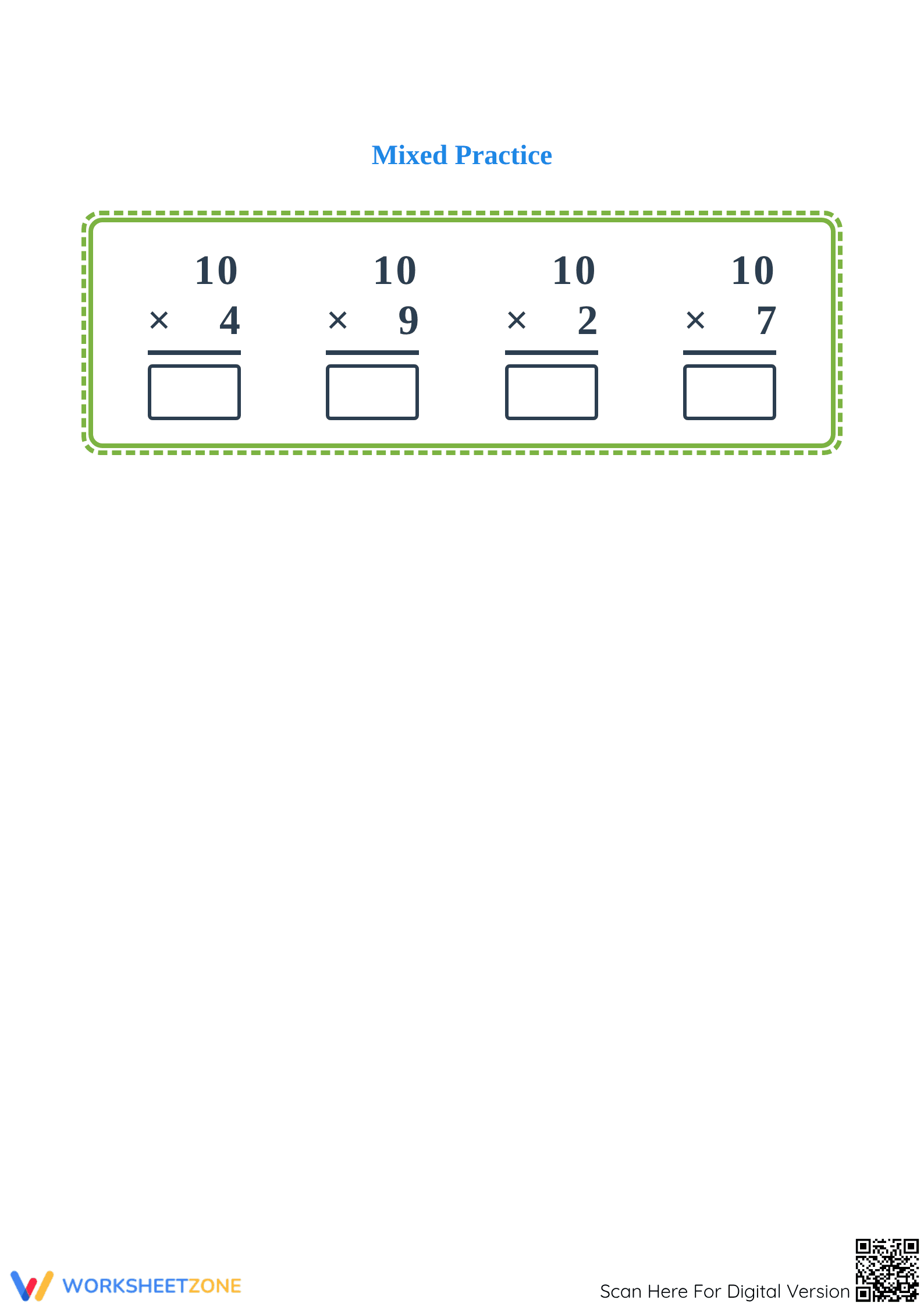
The download includes two comprehensive pages of mathematical practice designed for clarity and focus. The first page features twelve vertically aligned multiplication problems ranging from 10 x 1 to 10 x 12, allowing students to observe the sequential progression of products. The second page provides a mixed practice section with four additional problems to test retention. A full answer key is included for immediate feedback.
Skill Progression
- Guided practice: The first four problems serve as a controlled entry point, where students apply the basic rule of multiplying by ten to single-digit factors.
- Supported practice: The middle section challenges students with double-digit factors up to 12, requiring consistent application of the 10s multiplication rule.
- Independent practice: The mixed practice page removes the sequential order, forcing students to retrieve facts from memory without the help of a predictable list.
This sequence follows a gradual-release model, moving from predictable patterns to randomized application to ensure deep understanding.
Standards Alignment
This resource is directly aligned with CCSS.MATH.CONTENT.3.OA.C.7, which requires students to "fluently multiply and divide within 100, using strategies such as the relationship between multiplication and division or properties of operations." While the primary focus is on multiplication, these facts serve as the essential inverse for future division tasks. This standard code can be copied directly into lesson plans, IEP goals, or district curriculum mapping tools.
How to Use It
Use this worksheet as a timed "Mad Minute" drill during the first five minutes of math class to build computational speed. Alternatively, assign it as a post-instruction exit ticket to check for understanding after a lesson on place value and powers of ten. Teachers should observe if students are still skip-counting or if they have moved to automaticity. Completion usually takes 10 to 15 minutes.
Who It's For
This resource is designed for Grade 3 students but is also suitable for Grade 4 review or RTI Tier 2 interventions for older students struggling with basic fact fluency. It pairs naturally with an anchor chart showing place value shifts or a hundred-chart for visual learners who need to see the "ten more" pattern in action.
According to research by Fisher & Frey (2014) on the gradual release of responsibility, scaffolded practice is vital for developing mathematical automaticity. This worksheet facilitates that transition by moving from sequential 10s facts to a mixed practice format, ensuring that the 10s times tables are not just memorized as a list but understood as a functional operation. The CCSS.MATH.CONTENT.3.OA.C.7 standard emphasizes fluency within 100, and mastering the tens is often the first major milestone for students because of the clear visual pattern in the product. By providing sixteen targeted tasks, this resource allows for enough repetition to move the information from short-term to long-term memory.


