


























Views
Downloads
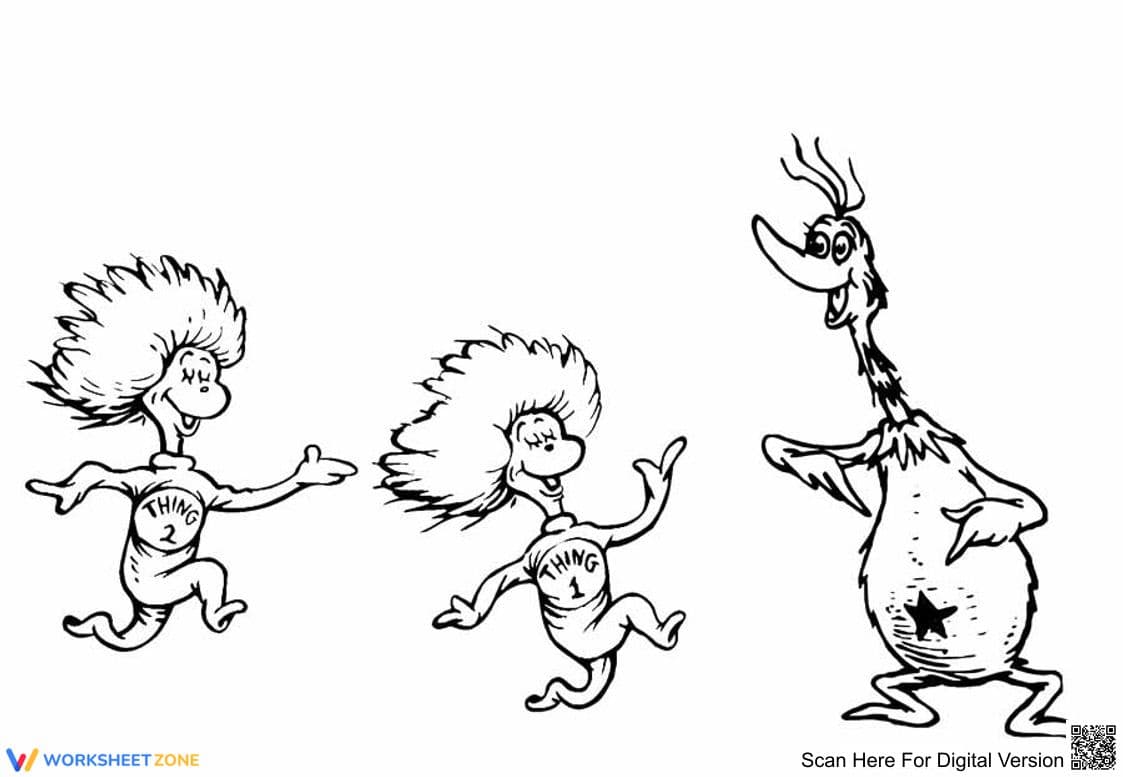

Thing 1 and Thing 2 Coloring Page | Essential Dr. Seuss
Paste this activity's link or code into your existing LMS (Google Classroom, Canvas, Teams, Schoology, Moodle, etc.).
Students can open and work on the activity right away, with no student login required.
You'll still be able to track student progress and results from your teacher account.
This printable Dr. Seuss coloring page features Thing 1, Thing 2, and a Star-Bellied Sneetch to help young learners engage with classic literary characters. By focusing on character recognition and fine motor control, students develop the foundational skills necessary for reading comprehension and artistic expression. It provides a creative outlet during literacy blocks or Read Across America week.
At a Glance
- Grade: Kindergarten · Subject: Arts & English
- Standard:
CCSS.ELA-LITERACY.RL.K.3— Identify characters, settings, and major events in a story- Skill Focus: Fine Motor & Character Recognition
- Format: 1 page · 1 task · No answer key · PDF
- Best For: Early finishers and literacy centers
- Time: 15–20 minutes
Inside this resource, you will find a high-quality, single-page PDF illustration. The line art is crisp and clear, featuring three iconic figures from the world of Dr. Seuss. There are no complex instructions, making it accessible for the youngest learners to begin working immediately without teacher intervention. The layout is optimized for standard letter-sized paper to ensure easy printing.
The zero-prep workflow for this worksheet is designed for maximum efficiency. First, print the single-page PDF (30 seconds). Second, distribute the sheets along with crayons or colored pencils to your students (1 minute). Third, as students color, circulate to ask identifying questions about the characters to check for comprehension (ongoing). Total teacher preparation time is under 2 minutes, making it an ideal choice for emergency sub plans or transition periods.
This activity aligns with `CCSS.ELA-LITERACY.RL.K.3`, which requires students to identify characters in a story. By visualizing Thing 1 and Thing 2, students bridge the gap between text and imagery. This visual representation helps solidify the concept of character traits and physical descriptions. Both standard codes can be copied directly into lesson plans, IEP goals, or district curriculum mapping tools.
Use this worksheet during a "Read Across America" celebration or after reading "The Cat in the Hat." It serves as an excellent formative assessment tool; observe if students can distinguish between the numbered characters or describe the Sneetch. Expected completion time is 15 to 20 minutes depending on the detail level and student age. It works well as a quiet-time activity following high-energy direct instruction.
This resource is designed for Kindergarten and Grade 1 students, particularly those developing pincer grasp and color boundaries. It is also suitable for English Language Learners who are building basic vocabulary related to characters and numbers. It pairs naturally with a read-aloud session of Dr. Seuss classics or a classroom anchor chart detailing character traits and story elements.
Research from Fisher & Frey (2014) emphasizes the importance of visual scaffolds in early literacy development. This worksheet, aligned to CCSS.ELA-LITERACY.RL.K.3, utilizes character recognition to reinforce story elements. By engaging with the distinct visual identities of Thing 1 and Thing 2, students build the mental models required for later narrative recall. Fine motor activities, such as coloring within defined boundaries, are not merely artistic; they are foundational precursors to handwriting and letter formation. According to the NAEP, early exposure to literary themes through multi-sensory engagement—combining listening, viewing, and creating—significantly improves long-term engagement with text. This 1-page printable provides a low-stakes environment for students to demonstrate their understanding of character identity while practicing the physical control necessary for academic success. It is a practical, evidence-based tool for any early childhood classroom focusing on the intersection of art and literacy.


